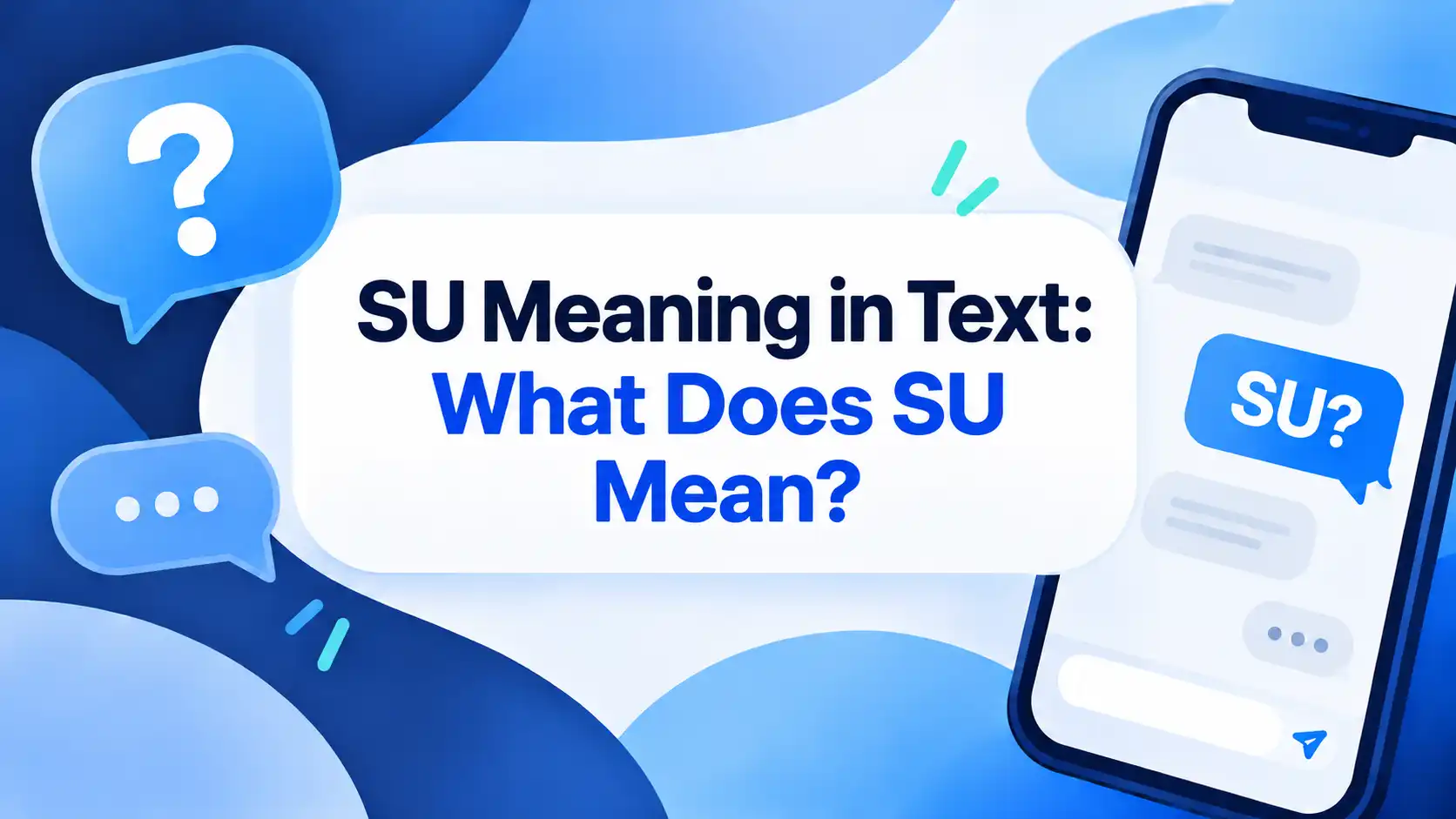
If you have received a message containing SU, this guide will help you understand what the sender probably means. SU Meaning in Text changes with the conversation, platform, punctuation, and tone.
The most common uses include “shut up,” “what’s up,” and “swipe up.” You’ll also learn about less common meanings, see real conversation examples, and discover how to choose the right interpretation before replying.
Quick Answer
SU in text most commonly means “shut up,” especially in casual chats. Depending on context, it can also mean “what’s up?” or “swipe up.” Less common uses include “see you” and “sign up.”
TL;DR
- SU often means “shut up” in casual texts.
- SU? can sometimes mean “what’s up?”
- S/U may mean “swipe up” in social-media contexts.
- Tone can make “shut up” playful or rude.
- SU is informal and context-dependent.
- Read the surrounding message before choosing a meaning.
What Does SU Mean in Text?
SU is a short form whose meaning changes according to context. In everyday texting, the strongest interpretations are usually “shut up,” “what’s up,” and, in certain social-media contexts, “swipe up.”
There is no universal rule that assigns one meaning to every SU message. Current slang references also list less common interpretations such as “see you” and other context-specific expansions, so the surrounding words are essential.
| SU meaning | Typical context | Example |
|---|---|---|
| Shut up | Texts, DMs, group chats | “SU! No way!” |
| What’s up? / Sup? | Casual greetings | “Hey, SU?” |
| Swipe up | Social-media instructions | “SU for the link” |
| See you | Less common casual shorthand | “Okay, SU tomorrow” |
| Sign up | Forms, websites, events | “Tap here to SU” |
The first three are the most useful meanings for someone trying to understand a casual message. Less common meanings should only be chosen when the conversation clearly supports them.
SU Meaning: “Shut Up”
In ordinary texting, SU can mean “shut up.” It can be a literal command, but friends also use it as an emotional reaction to surprising, funny, or unbelievable information.
That difference is important. “SU 😂” may mean something like “No way!” while “SU.” during an argument can sound dismissive or hostile. The same letters can therefore communicate very different feelings.
Examples:
- “SU! You actually got the tickets?” → surprised disbelief
- “SU 😂 That is hilarious.” → playful reaction
- “SU, seriously?” → surprise or annoyance
- “SU. I’m trying to talk.” → direct and potentially rude
When someone uses SU after surprising news, don’t automatically assume they are telling you to be silent.
SU Meaning: “What’s Up?”
SU can sometimes work like “sup,” a shortened form of “what’s up?” This use is mainly informal and appears as a casual conversation opener.
For example, someone might send “SU?” when they want to know what you are doing or how things are going. This meaning is more likely when SU appears by itself at the beginning of a conversation.
Examples:
- “Hey, SU?” → “Hey, what’s up?”
- “SU bro?” → casual greeting
- “SU tonight?” → may ask what is happening tonight, depending on context
- “Not much. You?” → natural reply
There is an important distinction between SU and SUP. SUP is much more directly recognizable as a form of “what’s up?” Therefore, a bare SU can be more ambiguous.
SU Meaning: “Swipe Up”
In social-media contexts, SU can mean “swipe up.” It functions as an instruction telling viewers to interact with linked content.
This meaning became associated with Stories and other social-media content where an upward gesture opened a link. However, platform interfaces have changed, so “swipe up” may now describe older social-media language rather than a literal current interface action. Current competitors specifically note the shift from older swipe-up interactions toward newer link controls.
Examples:
- “SU for the full video.” → swipe up
- “SU for details.” → swipe up
- “S/U for the link.” → swipe up
- “SU 👆” → likely a social-media action
The words around SU provide the strongest clue. If you see link, Story, details, video, or 👆, “swipe up” becomes much more likely.
Other Meanings of SU
Not every SU message refers to ordinary texting slang. Depending on the setting, SU can represent other phrases, including “see you” or “sign up.” These meanings are less likely in a normal conversation unless the surrounding words support them.
For example, “SU tomorrow” might be intended as “see you tomorrow,” although that use is less common than simply writing “see you.”
Similarly, a website or event instruction could use SU as shorthand for “sign up.” That is different from conversational slang because the surrounding topic provides a functional clue.
Use these clues:
- Goodbye or plans → “see you” may fit.
- Registration or membership → “sign up” may fit.
- A surprising message → “shut up” may fit.
- A casual opener → “what’s up?” may fit.
- A social-media link instruction → “swipe up” may fit.
Do not treat every possible expansion as equally common. Frequency and context matter.
How to Tell Which SU Meaning Someone Intended
The easiest way to interpret SU is to use a few clues instead of guessing from the letters alone.
Start with the message immediately before SU. Then check punctuation, emojis, platform, and nearby words. This approach is more reliable than assuming that SU always has one definition.
Use This Quick Check
- Look at the previous message.
If someone shared shocking news, “shut up” may be a playful reaction. - Look for action words.
“Link,” “Story,” “details,” or “video” can point toward “swipe up.” - Check whether SU starts the conversation.
A standalone “SU?” may be a casual greeting. - Notice punctuation.
“SU!” can feel like an emotional reaction, while “SU.” can sound colder. - Check emojis.
😂 or 😭 can support playful disbelief, although emojis do not have fixed meanings. - Consider the platform.
A Story instruction differs from a private text. - Consider your relationship.
Friends may use “shut up” playfully in ways strangers would not. - Ask if the meaning remains unclear.
“What do you mean by SU?” is better than guessing.
Is SU Rude or Friendly?
SU is not automatically rude. When it means “shut up,” the tone depends heavily on the relationship and situation.
Among close friends, it can express excitement or disbelief. During an argument, however, the same phrase can sound like a direct command to stop speaking.
Compare these examples:
- “SU 😂 No way!” → likely playful
- “SU!!! You actually won?” → excited disbelief
- “SU. I’m done.” → potentially hostile
- “Please stop.” → clearer and more direct
- “No way!” → safer alternative for surprise
If you don’t know the person well, avoid assuming that a blunt “SU” is friendly.
SU Meaning on Snapchat
On Snapchat, SU can have more than one meaning. In ordinary chats, it may refer to “shut up” or “what’s up?” In Story-related content, “swipe up” can be a possible interpretation.
Some current references describe swipe up as a major Snapchat interpretation, while other current pages emphasize greeting or conversational meanings. That difference itself shows why the location of the abbreviation matters.
Check these clues:
- SU 😂 in a chat → likely “shut up”
- SU? at the start of a chat → possibly “what’s up?”
- SU for the link → likely “swipe up”
- S/U 👆 beside content → likely an action instruction
Don’t assume Snapchat gives SU one permanent definition.
SU Meaning on Instagram, TikTok, and WhatsApp
The platform can help narrow down the meaning, but it should not decide the meaning by itself. The message still matters most.
On Instagram and TikTok, SU can appear in comments, captions, DMs, or social-media instructions. On WhatsApp, a normal chat is more likely to use SU as conversational slang than as a platform-navigation instruction.
Examples:
- Instagram DM: “SU 😂” → likely playful “shut up”
- WhatsApp: “su?” → possibly “what’s up?”
- Story instruction: “SU for details” → “swipe up”
- TikTok comment: “SU no way 😭” → likely surprise
Platform features can change, so older phrases may remain in online language even after the original interface changes.
SU Meaning in DMs and Group Chats
In DMs and group chats, SU is usually interpreted from the conversation around it. Short messages can be especially difficult because text does not carry facial expressions or voice tone automatically.
A friend might write “SU 😂” after hearing an unbelievable story. Another person might write “SU.” during a disagreement. The letters are identical, but the conversational meaning is not.
Watch for these clues:
- A surprising statement before SU → likely playful reaction
- A disagreement before SU → potentially rude command
- A question mark after SU → possibly “what’s up?”
- A link-related instruction → possibly “swipe up”
- A laughing emoji → often supports playful intent
- A cold period → can make the message feel more abrupt
SU Meaning in Dating Conversations
SU does not have a special romantic meaning simply because someone sends it while dating. The same abbreviation can be a greeting, playful reaction, or instruction in a dating conversation.
Avoid reading romantic intent into two letters. Look at the complete message and the conversation that surrounds it.
For example:
- “SU?” → probably a casual opener
- “SU 😂 You’re impossible.” → possibly playful teasing
- “SU for the photo.” → potentially an action instruction
- “SU, seriously?” → surprise or disbelief
The safest approach is to interpret the actual conversation, not the sender’s gender or dating status.
What Does SU Mean From a Guy or Girl?
The sender’s gender does not determine the meaning of SU. A guy and a girl can use the same abbreviation in the same way.
Some online explanations separate “SU from a guy” and “SU from a girl,” but that can encourage unnecessary assumptions. Current usage examples show that the same basic interpretations apply regardless of who sends the message.
Instead, focus on:
- What was said before SU
- Whether SU has punctuation
- Whether an emoji appears
- Whether the conversation is casual or serious
- Whether a link or Story is involved
- How that person normally texts
If those clues still don’t answer the question, simply ask.
How to Reply When Someone Says SU
Your reply should match the likely meaning. If you aren’t sure, clarification is usually better than an awkward guess.
If SU means “what’s up?”
“Not much! What about you?”
If SU means playful “shut up”
“I know 😂 I couldn’t believe it either.”
If SU expresses disbelief
“Seriously! I couldn’t believe it.”
If SU means “swipe up”
Follow the instruction if you want to view the linked content.
If the meaning is unclear
“Wait, what do you mean by SU?”
If the message feels rude
“Everything okay?”
The best response is not always the cleverest one. Clarity beats guessing.
Common Mistakes When Reading SU
The biggest mistake is assuming that SU always means “shut up.” That interpretation is common, but social-media and greeting contexts can point elsewhere.
Another mistake is treating every possible expansion as equally likely. A technically possible abbreviation is not automatically the intended meaning.
Avoid these mistakes:
- Assuming SU always means “shut up.”
- Assuming every social-media SU means “swipe up.”
- Treating “shut up” as automatically hostile.
- Assuming SU has a hidden romantic meaning.
- Using the sender’s gender as your main clue.
- Ignoring punctuation and emojis.
- Ignoring the message immediately before SU.
- Forgetting that platform features can change.
- Treating rare meanings as common slang.
- Guessing when a quick clarification would solve the problem.
Is SU Formal or Informal English?
SU is informal digital language. It belongs mainly in casual texts, DMs, group chats, comments, and conversations between people who understand the shorthand.
Avoid it in professional emails, formal school assignments, business documents, or other situations where clarity matters.
Use clearer alternatives when needed:
- Instead of “SU?” → “What’s up?”
- Instead of “SU!” → “No way!”
- Instead of “SU” as an instruction → “Open the link above.”
- Instead of an unexplained abbreviation → write the complete phrase
Texting slang can be useful, but standard English is usually better when the audience or purpose is formal.
SU vs. SUP, S/U, and Similar Abbreviations
These forms look similar, but they can perform different jobs.
| Term | Likely meaning | Typical use |
|---|---|---|
| SU | Shut up | Reaction or command |
| SU? | What’s up? | Casual greeting |
| SUP | What’s up? | Casual greeting |
| S/U | Swipe up | Social-media instruction |
| See you | Goodbye | Casual conversation |
| Sign up | Register | Websites, events, forms |
The punctuation and surrounding words often provide more information than capitalization alone.
For example, “SUP?” is much easier to read as “what’s up?” than an isolated “SU?”. Meanwhile, “S/U for details” clearly provides an action-related clue.
SU Examples in Real Conversations
Seeing SU in complete conversations makes the differences easier to understand.
Example: Playful Surprise
Alex: “I accidentally emailed the meme to my boss.”
Jordan: “SU 😂”
Meaning: “Shut up!” as playful disbelief.
Example: Casual Greeting
Alex: “Hey, SU?”
Jordan: “Not much. You?”
Meaning: “What’s up?”
Example: Social-Media Instruction
Alex: “The full video is in my Story.”
Jordan: “SU for the link.”
Meaning: “Swipe up.”
Example: Serious Tone
Alex: “I need to finish explaining.”
Jordan: “SU.”
Meaning: A blunt command to stop talking.
Example: Possible “See You”
Alex: “I have to go now.”
Jordan: “Okay, SU tomorrow.”
Meaning: Possibly “see you tomorrow,” although this use is less common.
Example: Unclear Message
Alex: “SU”
Jordan: “What do you mean by SU?”
Meaning: The context is insufficient, so clarification is the best response.
FAQs
What does SU mean in a text message?
SU most commonly means “shut up” in casual texting, especially when someone reacts to surprising or funny information. It can also mean “what’s up?” or “swipe up,” depending on context.
The surrounding message is the best clue. Look at punctuation, emojis, platform, and the words before or after SU.
What does SU mean on Snapchat?
On Snapchat, SU can mean “shut up,” “what’s up,” or “swipe up.” A Story or link-related instruction makes “swipe up” more likely.
A direct chat may use SU differently. Always read the complete message before deciding.
Can SU mean “see you”?
Yes, SU can sometimes be used for “see you,” but this is less common than the major texting meanings.
If SU appears before a future meeting or goodbye, “see you” may fit. Otherwise, another interpretation may be more natural.
What does S/U mean?
S/U commonly means “swipe up” in social-media contexts. The slash can help distinguish this action-related abbreviation from conversational uses of SU.
However, abbreviations vary between communities, so the surrounding message remains important.
Is SU rude in text?
It can be rude when “shut up” is intended as a literal command. Friends may also use it playfully to express surprise or disbelief.
If you don’t know the sender well, don’t assume the playful interpretation. Tone and relationship can change the meaning significantly.
What does SU mean in a group chat?
In a group chat, SU can mean “shut up,” “what’s up,” or another context-specific phrase. A reaction to surprising news often points toward “shut up,” while a conversation opener may suggest “what’s up?”
Read the messages immediately before SU. Group-chat context often provides enough information to identify the intended meaning.
What does SU mean from a guy or girl?
SU has the same basic meanings regardless of the sender’s gender. The message, relationship, tone, and platform provide better clues than whether the sender is a guy or girl.
If you are unsure, asking what they mean is more reliable than guessing about romantic intent.
Conclusion
SU Meaning in Text depends on context, not just the two letters. In casual conversations, it commonly means “shut up,” while “what’s up?” and “swipe up” can fit specific situations.
Before replying, check the surrounding message, tone, punctuation, emojis, and platform. If the meaning still isn’t clear, ask for clarification instead of guessing.