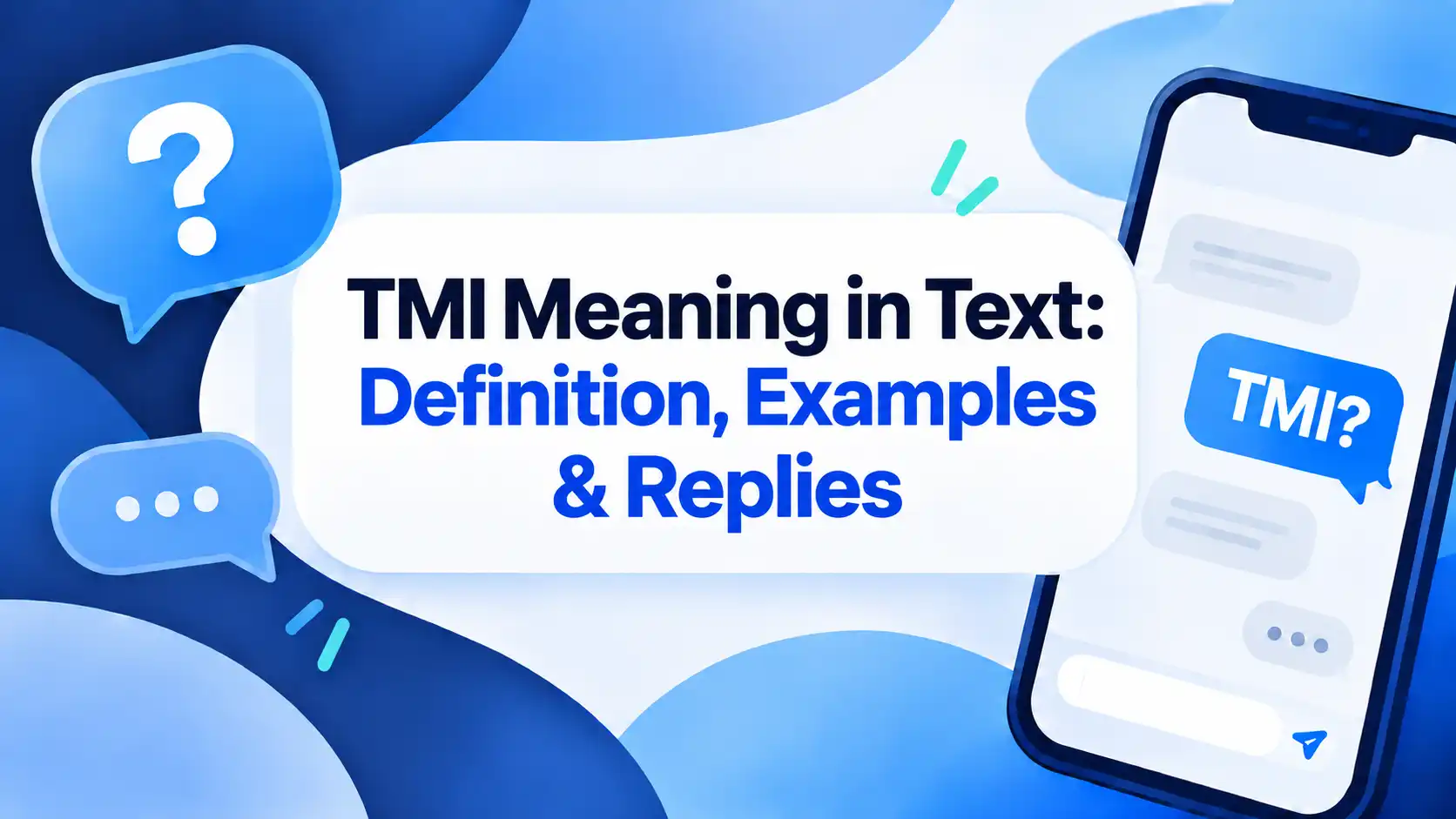
TMI is a common abbreviation in texting, chats, comments, and casual American English. It usually means “Too Much Information” and tells someone that they have shared more detail than expected.
You may see TMI after a personal story, awkward confession, embarrassing detail, or overly detailed explanation. The expression can be funny between friends, but it can also signal genuine discomfort. Learning the difference helps you understand the message instead of guessing what the sender means.
What Does TMI Mean in Text?
TMI means “Too Much Information.” In text messages, it usually reacts to information that feels too personal, unnecessary, embarrassing, or detailed for the conversation.
Cambridge Dictionary classifies TMI as an informal abbreviation and defines it as a response to excessive details, especially private or embarrassing ones. The standard pronunciation is “tee-em-eye.”
For example:
Alex: “I told my new coworker my entire dating history.”
Sam: “TMI 😂”
Here, Sam probably isn’t angry. The reply jokingly says that Alex shared more personal information than necessary.
TMI can mean:
• That was more information than I needed.
• You shared too many personal details.
• I probably didn’t need to know that.
• That’s a little awkward or uncomfortable.
• You’re oversharing.
The exact tone depends on the conversation, the relationship, punctuation, and emojis.
What Does TMI Stand For?
TMI stands for “Too Much Information.” It is an initialism, meaning people normally pronounce the individual letters rather than the full phrase.
You may see it written in several ways:
• TMI
• tmi
• That’s TMI.
• Sorry, TMI.
• TMI but…
• Not to be TMI, but…
The capitalization usually makes no difference in casual texting.
A particularly useful form is “TMI but…” or “Sorry, TMI.” These phrases can warn the reader that a personal detail is coming or acknowledge that the speaker has already overshared.
Example:
“Sorry, TMI, but I haven’t slept properly all week.”
In this sentence, the writer knows the information is somewhat personal and uses TMI as a self-aware warning.
TMI Meaning in Slang and Casual English
In slang, TMI is a quick way to react to oversharing. It is especially common in informal conversations between friends, family members, dating partners, and online communities.
The expression doesn’t necessarily mean that the information is bad. Something can be completely harmless and still feel like TMI because it is too detailed for the situation.
For example:
“I haven’t washed my gym shoes in three months.”
A friend might respond:
“Bro, TMI.”
The friend may be joking rather than seriously criticizing the person.
TMI can also describe information that crosses a stronger privacy boundary:
“She posted private details about her breakup for everyone to see.”
A response such as “That’s TMI” would sound more serious in this situation.
TMI Can Be a Reaction or a Warning
These two uses are easy to confuse.
As a reaction:
“You told everyone what happened at the doctor’s office?”
“TMI!”
As a warning:
“TMI, but I had the most embarrassing moment today.”
The first reacts to information already shared. The second warns that personal information is about to follow.
Is TMI Rude?
TMI is not automatically rude. Its tone depends heavily on the situation.
Among close friends, “TMI 😂” can be playful. Between people who don’t know each other well, “TMI.” may sound blunt or dismissive.
Compare these messages:
| Message | Likely tone |
|---|---|
| TMI 😂 | Playful or teasing |
| TMI 😭 | Humorous shock |
| Okay, TMI | Mild discomfort |
| That’s TMI | Direct reaction |
| TMI. | Short and potentially blunt |
| TMI. Please stop. | Clear boundary |
| Sorry, TMI | Self-aware apology |
These are not fixed rules. Emojis and punctuation can influence tone, but the surrounding conversation matters more.
When TMI May Be a Poor Choice
Avoid using TMI as a joke when someone is sharing serious personal information.
For example, someone discussing grief, abuse, illness, or another difficult experience may need support rather than a joke about oversharing.
Instead of:
“TMI.”
You could say:
“I’m sorry you’re dealing with that. You don’t have to share more than you’re comfortable sharing.”
That response respects the person’s situation without shutting them down.
TMI Examples in Text Messages
The easiest way to understand TMI meaning in text is to see how the expression works in different situations.
Funny Examples
“I ate pizza for breakfast, lunch, and dinner.”
“TMI, but honestly, impressive.”
“I just tripped over my own backpack.”
“TMI 😂”
“I’ve been wearing the same hoodie for three days.”
“Okay, TMI.”
These examples are usually playful because the information is embarrassing or unnecessary rather than deeply sensitive.
Awkward Examples
“I told someone I just met about my entire family argument.”
“That might have been TMI.”
“My first date spent an hour describing every past relationship.”
“That’s a lot of TMI for a first date.”
Here, TMI points to too much personal information too soon.
Self-Aware Examples
“TMI, but I cried during that commercial.”
“Sorry, TMI. I really needed to vent.”
“Not to be TMI, but I haven’t slept well lately.”
The speaker recognizes that the information may be more personal than usual.
Social Media Examples
Comment: “TMI 😂”
Caption: “TMI but I checked my ex’s profile again.”
DM: “Okay, that was definitely TMI.”
On Instagram, Snapchat, TikTok, or other platforms, the basic meaning remains “Too Much Information.” The platform usually changes the setting, not the definition.
What Does “TMI 😂” Mean?
“TMI 😂” usually means “That was too much information, but I’m laughing.”
The laughing emoji often softens the reaction. It can show that the sender finds the situation funny rather than seriously offensive.
For example:
Friend: “I accidentally sent my boss a message meant for my sister.”
You: “TMI 😂”
The message can mean:
“Wow, that’s a lot, but this is funny.”
Compare it with:
“TMI.”
Without an emoji or softening phrase, the same abbreviation can feel more direct.
This is why texting tone cannot always be understood from the abbreviation alone.
What Does TMI Mean From a Girl or Guy?
If a girl or guy says “TMI,” the basic meaning does not change. It still normally means “Too Much Information.”
There is no standard hidden romantic meaning built into the abbreviation.
For example:
“TMI 😂”
could be playful whether the sender is a woman or a man.
The important clues are:
• What was said immediately before TMI
• Whether the person used an emoji
• Whether the conversation was serious or playful
• How well the two people know each other
• Whether the person continued chatting afterward
• Whether the message included a clear boundary
So, if someone searches for “TMI meaning from a girl” or “TMI meaning from a guy,” the safest starting point is the same: Too Much Information.
Don’t assign a romantic meaning to TMI without additional context.
TMI Meaning in Dating and Relationships
In dating and relationships, TMI often relates to personal boundaries.
Someone might use it when a conversation becomes too detailed, especially when discussing an ex, private experiences, family problems, or intimate subjects.
For example:
“We’ve been talking for ten minutes, and he already told me every detail about his last breakup.”
A friend might reply:
“That sounds like TMI for a first date.”
TMI does not mean that honesty is bad. The issue is usually the amount, timing, or audience of the information.
A person can be open and still choose not to share every detail.
TMI in a Relationship Can Be Playful
Couples who know each other well may use TMI as friendly teasing.
“I just sent you a photo of my terrible haircut.”
“TMI 😂”
The phrase may have little emotional weight in that setting.
TMI Can Also Signal a Boundary
“I don’t need all the details. TMI.”
This version is more direct. The speaker may be asking the other person to stop or change the subject.
How to Reply When Someone Says TMI
Your response should match the tone.
If they are clearly joking, a playful answer can keep the conversation relaxed.
Casual Replies
• “Haha, my bad!”
• “Okay, I’ll stop there.”
• “Fair enough.”
• “Oops, I overshared.”
• “You’re right. That was a lot.”
Funny Replies
• “You asked! 😂”
• “Too late. You already know.”
• “My oversharing era continues.”
• “Okay, I’ll spare you the rest.”
Respectful Replies
• “Sorry, I didn’t mean to make you uncomfortable.”
• “You’re right. I probably shared too much.”
• “Thanks for telling me. I’ll change the subject.”
• “No problem. I’ll keep the details private.”
If someone sounds genuinely uncomfortable, don’t argue about whether your story was technically TMI. A short acknowledgment usually works better.
When Should You Use TMI?
TMI works best in informal communication. It is natural with close friends and casual online conversations.
The expression is less suitable when you need a professional or carefully worded response.
Good Situations for TMI
• Casual text messages
• Friendly group chats
• Conversations with close friends
• Informal social-media comments
• Playful conversations
• Lighthearted reactions to oversharing
Situations Requiring More Care
• Workplace conversations
• Professional emails
• Serious emotional disclosures
• Conversations involving someone else’s private information
• Public posts about sensitive subjects
Instead of “TMI” at work, you might say:
“That may be more personal detail than we need here.”
That communicates the same basic concern in a more professional way.
TMI vs. Oversharing
TMI and oversharing are related, but they are not the same thing.
Oversharing is the act of giving more personal information than the situation calls for. TMI is usually the reaction to that information.
Think of it this way:
Person A: shares too many personal details.
Person B: “TMI!”
The first person is oversharing. The second person is using TMI as a reaction.
Quick Comparison
| Term | Meaning | Example |
|---|---|---|
| TMI | A reaction to excessive information | “TMI 😂” |
| Oversharing | Giving excessive personal information | “He was oversharing.” |
| Too much information | The full phrase behind TMI | “That was too much information.” |
Something can also be TMI without being offensive. A long story about an embarrassing moment might simply contain more detail than the listener wanted.
Is TMI Appropriate at Work?
TMI is generally too casual for formal workplace writing. You may see it in a friendly team chat, but professional communication usually benefits from clearer wording.
For example, instead of writing:
“TMI, but I can’t come in because of my stomach.”
A professional message could say:
“I’m not feeling well and won’t be able to come in today.”
The second version communicates the necessary information without unnecessary personal details.
In a casual workplace group chat, coworkers may use TMI jokingly. Still, remember that professional relationships have different privacy and communication expectations.
Does TMI Have Other Meanings?
In everyday texting, TMI almost always means “Too Much Information.”
However, abbreviations can have different meanings in other contexts. For example, Three Mile Island is another established American use of the letters TMI.
The surrounding subject usually makes the intended meaning clear.
If someone writes:
“That story was TMI.”
they almost certainly mean “Too Much Information.”
If a historical or news discussion mentions TMI, the meaning may be different.
When an abbreviation has multiple meanings, context is the deciding factor.
TMI Grammar and Sentence Usage
Although TMI is slang, it can work in several positions within an informal sentence.
As a Standalone Reaction
“TMI!”
This is the shortest and most direct use.
After a Description
“That was definitely TMI.”
Here, TMI functions as a noun-like expression describing the information.
Before Sharing a Detail
“TMI, but I barely slept last night.”
This acts as a warning that the following information may be personal.
With “Sorry”
“Sorry, TMI.”
This shows that the speaker realizes they may have shared too much.
With “That’s”
“That’s TMI for a first date.”
This connects the expression to a particular situation.
These forms are informal English, so they are most natural in speech, texting, and casual digital communication.
Common Mistakes With TMI
Understanding the definition is only part of using the expression naturally.
Mistake: Assuming TMI Is Always Rude
Better: Look at the tone and relationship.
“TMI 😂” may be friendly teasing, while “TMI. Stop.” is much more serious.
Mistake: Assuming TMI Means Rejection
Better: Treat TMI as a reaction to the information, not proof of someone’s feelings toward you.
A person can say TMI and continue the conversation normally.
Mistake: Looking for a Gender-Specific Definition
Better: The abbreviation means the same thing regardless of whether a girl or guy uses it.
Mistake: Using TMI in Formal Writing
Better: Spell out your concern in professional settings.
Mistake: Mocking Sensitive Information
Better: If someone is discussing a serious problem, respond with empathy rather than teasing.
Mistake: Ignoring the Conversation Before TMI
Better: Read the previous message before interpreting the abbreviation.
The surrounding context often tells you whether the sender is joking or setting a boundary.
FAQs About TMI
What does TMI mean in text?
TMI means “Too Much Information.” It is usually used when someone shares more personal, awkward, or unnecessary detail than expected.
The tone can be playful or serious depending on the conversation.
Is TMI a bad word?
No. TMI is not a swear word. It is an informal abbreviation used to react to excessive or overly personal information.
However, using it at the wrong moment can sound dismissive.
What does “TMI 😂” mean?
“TMI 😂” usually means the information was too much, but the sender is reacting humorously.
The laughing emoji often makes the message softer and more playful.
What does “Sorry, TMI” mean?
“Sorry, TMI” means the speaker realizes they may have shared too much information.
It is often a quick way to acknowledge oversharing and move on.
Does TMI mean someone is flirting?
Not by itself. TMI simply means “Too Much Information,” and the abbreviation does not establish romantic interest.
Look at the broader conversation before interpreting someone’s intentions.
Can TMI be used at work?
It can appear in a casual workplace chat, but it is usually too informal for professional communication.
In formal situations, explain the concern directly and avoid unnecessary personal details.
Is TMI the same as oversharing?
No. Oversharing is the behavior, while TMI is usually the reaction.
Someone overshares information, and another person may respond, “TMI!”
Conclusion
TMI meaning in text is usually “Too Much Information.” It is an informal expression used when someone shares details that feel too personal, unnecessary, awkward, or excessive.
The most useful clue is context. “TMI 😂” may be friendly teasing, while “TMI. Please stop.” communicates a clear boundary. When you’re unsure, consider the conversation, tone, and relationship before interpreting the message.
Next time you see TMI in a text, read the message around it before assuming what the sender means.