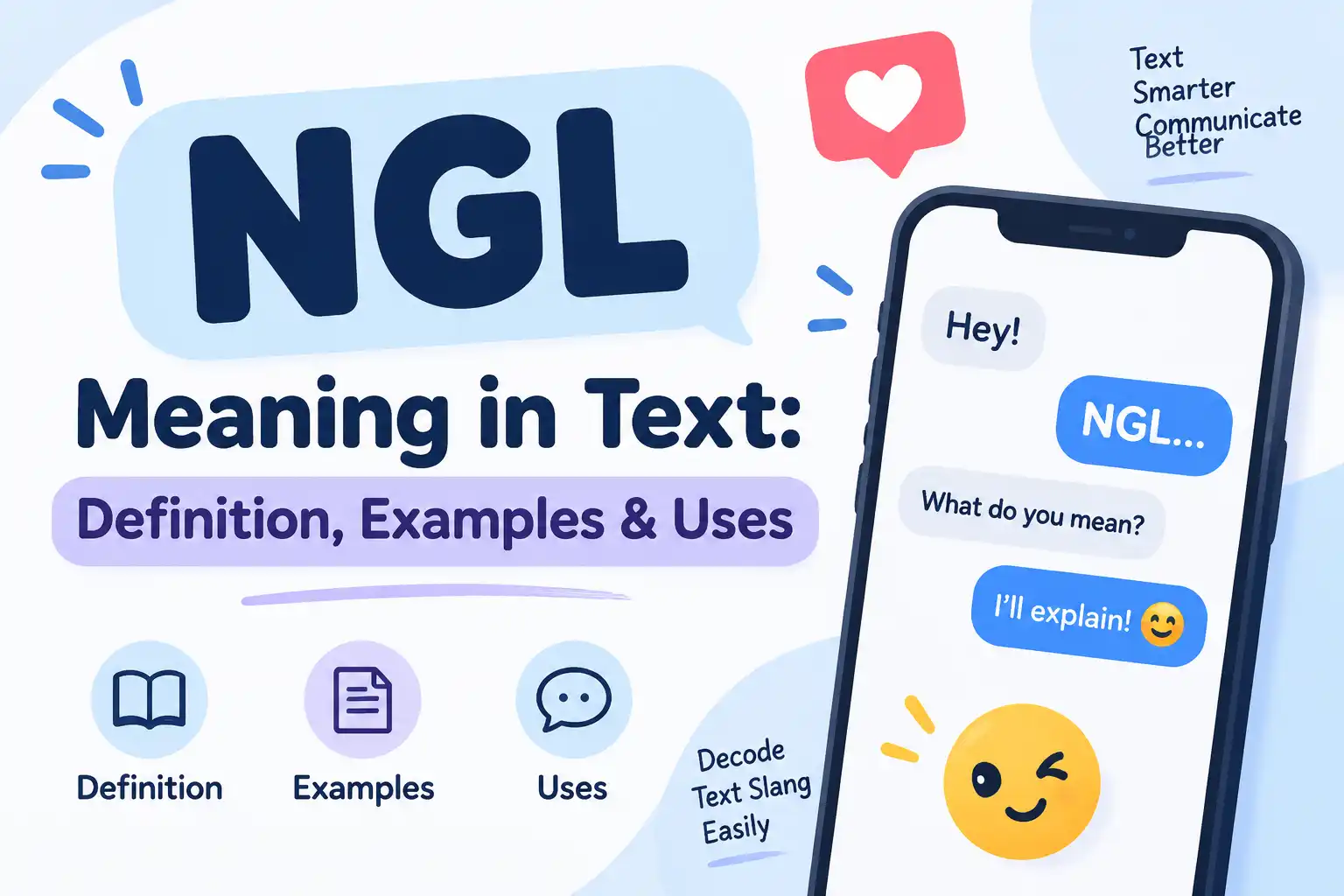
English learners, students, and everyday texters can use this guide to understand NGL Meaning in Text and use the abbreviation naturally. In most casual messages, NGL means “not gonna lie.”
It often introduces an honest opinion, admission, reaction, or observation. Below, you’ll see real-style examples, sentence patterns, tone differences, formal alternatives, and the other meaning of NGL.
Quick Answer
NGL usually means “not gonna lie” in texting. People use it before an honest opinion, reaction, or admission.
TL;DR
- NGL usually means “not gonna lie.”
- It is common in casual texting and social media.
- It can introduce praise, criticism, surprise, or an admission.
- NGL is informal and suits relaxed communication.
- TBH has a similar meaning but a slightly different feel.
- Formal writing usually needs “honestly” or direct wording.
What Does NGL Mean in Text?
NGL means “not gonna lie” in most texting and social-media conversations. It tells the reader that the next thought is meant to sound candid.
For example, “NGL, I loved that movie” introduces a personal opinion. The writer is not making a formal claim about the movie. They are sharing how they genuinely felt.
What Does NGL Stand For?
NGL stands for “not gonna lie.” The phrase uses “gonna,” a casual spoken form of “going to.”
That makes NGL strongly associated with informal English. You are more likely to see it in texts, comments, DMs, and casual chats than in school papers or business documents.
How Is NGL Used in Texting?
NGL commonly appears before a statement that the writer wants to present as candid. It can introduce either a positive or negative opinion.
It does not automatically mean the statement is harsh. The words after NGL usually determine whether the message sounds warm, critical, surprised, or neutral.
- NGL, your idea is really good. — praise
- NGL, I was nervous. — admission
- NGL, that ending surprised me. — reaction
- NGL, I expected more. — criticism
- NGL, I agree with you. — agreement
- NGL, I wasn’t expecting that. — surprise
- NGL, this might be my favorite song. — personal opinion
- NGL, I almost canceled the trip. — personal admission
NGL Meaning in Social Media
On social media, NGL can appear in comments, captions, replies, and private messages. Its basic slang meaning usually remains the same.
The difference comes from context. A friendly comment such as “NGL, this picture is amazing” sounds very different from a critical comment that follows NGL.
NGL Sentence Examples
Here are natural examples showing different uses:
- NGL, I really enjoyed the concert.
- NGL, that test was harder than I expected.
- I love this place, NGL.
- NGL, your explanation helped me understand it.
- NGL, I didn’t like the ending.
- That was a close game, NGL.
- NGL, I thought you were joking.
- NGL, I’m glad we changed the plan.
- NGL, this is better than I expected.
- I was worried at first, NGL.
The key idea is context. NGL does not tell you whether the following opinion is positive or negative.
NGL at the Beginning of a Sentence
Putting NGL at the beginning is probably the easiest pattern for learners to recognize.
A comma commonly follows it when NGL introduces the sentence:
NGL, I really liked the book.
Here, NGL signals that the writer is about to give a personal opinion.
NGL at the End of a Sentence
NGL can also appear at the end of a casual sentence.
For example:
That restaurant was expensive, NGL.
This placement gives the sentence a conversational ending. It can feel similar to adding “honestly” or “to be honest” after the main thought.
Is NGL Formal or Informal?
NGL is informal slang. It works naturally in relaxed communication with friends, family, classmates, and online communities.
It is usually better to avoid NGL in formal essays, professional reports, official documents, and important workplace emails.
For example:
- Casual: NGL, I really liked the presentation.
- Neutral: Honestly, I really liked the presentation.
- Formal: I found the presentation particularly effective.
The best choice depends on the audience and purpose.
Is NGL Rude?
NGL is not inherently rude. Its tone comes mainly from the statement that follows it.
Compare these examples:
- NGL, you did an amazing job. — positive
- NGL, I think your idea could work. — neutral
- NGL, I don’t understand your point. — direct
- NGL, that was a terrible decision. — strongly critical
The abbreviation can make a message feel more candid, but it does not automatically make the message polite or impolite.
NGL vs TBH
NGL and TBH are closely related texting expressions.
NGL means “not gonna lie,” while TBH means “to be honest.” Both can introduce a personal opinion or candid statement.
There is plenty of overlap:
NGL, this is my favorite.
TBH, this is my favorite.
Both sound natural in casual messages. NGL can feel especially conversational, while TBH can work naturally when someone directly frames an opinion as honest.
NGL vs Honestly
“Honestly” is more flexible than NGL because it can work in casual and neutral English.
Compare:
NGL, I didn’t expect that.
Honestly, I didn’t expect that.
The first sounds strongly conversational. The second can fit a wider range of situations.
For formal writing, “honestly” may still be unnecessary. Often, the clearest choice is simply to state the point directly.
How to Pronounce NGL
When people pronounce NGL, they may say the individual letters “N-G-L.”
However, people also commonly say the full expression “not gonna lie” in spoken conversation. If you’re learning English, knowing both forms can help you understand texts and speech.
Common Mistakes With NGL
- Using NGL in a formal academic essay.
- Assuming NGL always introduces criticism.
- Thinking NGL proves that a statement is objectively true.
- Using NGL repeatedly in every message.
- Forgetting the casual tone of “gonna.”
- Treating NGL as a universal replacement for “honestly.”
- Confusing slang NGL with its technical meanings.
- Using NGL when a direct statement would be clearer.
- Assuming everyone knows internet abbreviations.
- Ignoring the relationship between the people communicating.
Better Alternatives to NGL
The best alternative depends on the tone you need.
- not gonna lie — casual and direct
- honestly — casual to neutral
- to be honest — conversational and flexible
- frankly — more direct and formal
- in my opinion — clearly marks a personal view
- I think — simple and neutral
- I found — useful for measured personal observations
- I believe — suitable for some formal contexts
For example, change “NGL, I liked the presentation” to “I thought the presentation was effective” when a more professional tone is needed.
NGL in Real Conversations
NGL often works best when you imagine an actual conversation rather than a dictionary definition.
Friend A: “Did you like the new restaurant?”
Friend B: “NGL, I loved the food.”
Here, NGL introduces a positive reaction.
Another example:
Friend A: “Was the exam difficult?”
Friend B: “NGL, the last section was tough.”
The abbreviation signals a candid response without changing the basic meaning of the sentence.
Does NGL Have Other Meanings?
Yes. Context matters because NGL can refer to different things outside internet slang.
In the energy industry, NGL can mean “natural gas liquids.” This meaning has nothing to do with “not gonna lie.”
For example, a casual text saying “NGL, I’m tired” almost certainly uses the slang meaning. A technical energy report discussing petroleum production may use NGL for natural gas liquids.
FAQs
What does NGL mean in texting?
NGL usually means “not gonna lie.” It introduces a candid opinion, reaction, or personal admission.
What does NGL stand for?
NGL stands for “not gonna lie.” It is a common abbreviation in informal digital communication.
Is NGL slang?
Yes. NGL is informal internet slang commonly found in texts, comments, social media, and casual conversations.
Is NGL rude?
Not by itself. The tone depends on the words that follow NGL and the relationship between the people communicating.
Can I use NGL in a formal email?
Usually, no. In professional writing, “honestly,” “to be honest,” or direct wording is generally more appropriate.
Is NGL the same as TBH?
They are similar but not exactly identical. NGL means “not gonna lie,” while TBH means “to be honest.”
What else can NGL mean?
In casual texting, NGL usually means “not gonna lie.” In energy-related writing, NGL can mean “natural gas liquids.”
Conclusion
NGL Meaning in Text is usually “not gonna lie,” an informal phrase used to introduce an honest thought, reaction, admission, or opinion. Its tone depends on the words and situation around it.
Use NGL freely in appropriate casual conversations, but choose more neutral wording for formal writing. Next, compare it with other texting abbreviations so you can recognize informal English more confidently.