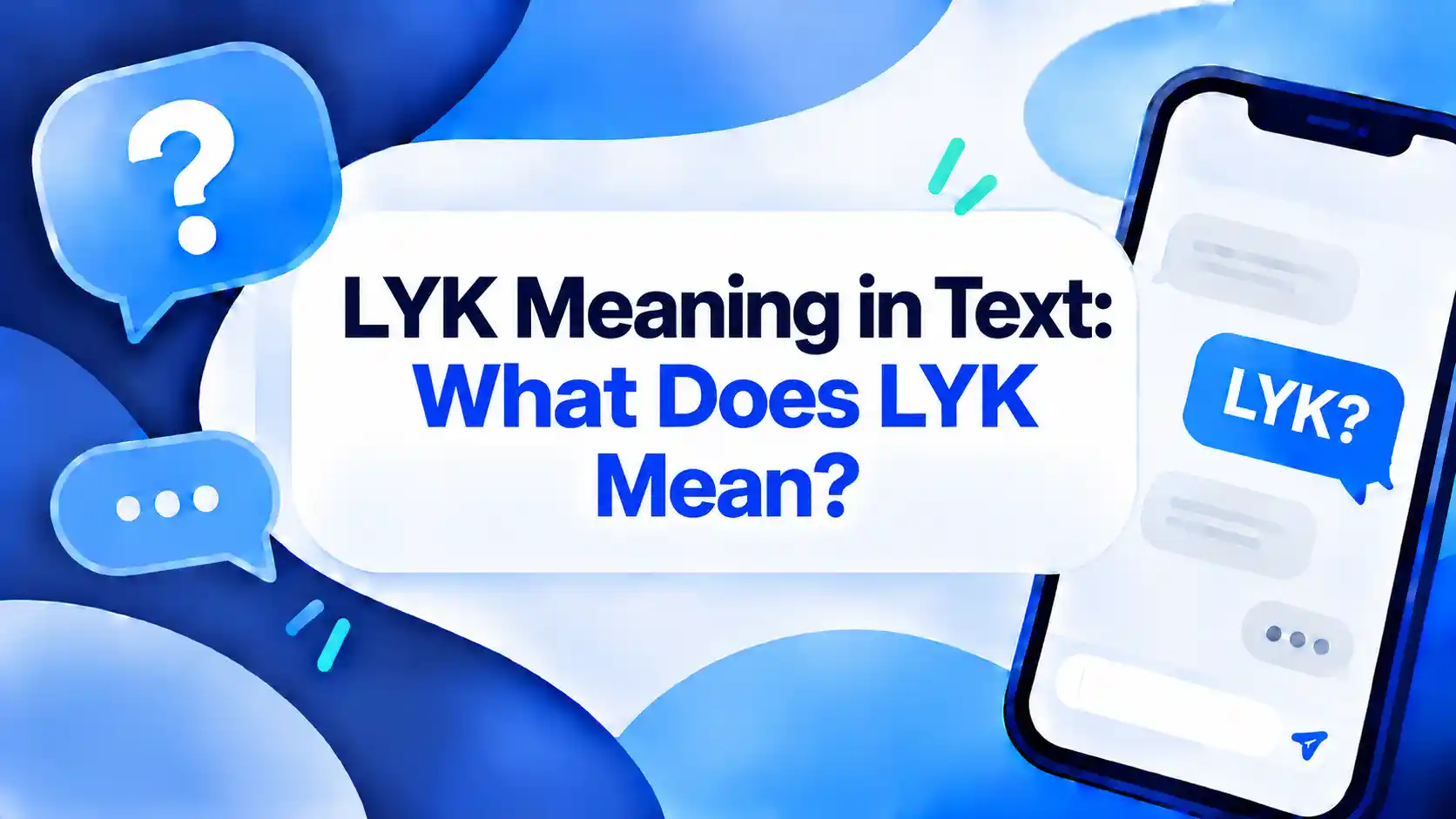
For English learners and everyday texters, LYK meaning in text is usually simple: “let you know.” It often appears when someone plans to give an answer or update later.
This guide shows how LYK works in real messages and how to interpret it from context. You’ll also learn the difference between LYK and LMK and when spelling out the phrase is better.
Quick Answer
LYK commonly means “let you know.” For example, “I’ll LYK tonight” means “I’ll let you know tonight.”
TL;DR
• LYK commonly means “let you know.”
• It is mainly informal texting shorthand.
• “I’ll LYK” means “I’ll let you know.”
• LMK means “let me know.”
• Formal writing usually uses the full phrase.
LYK Meaning in Text
LYK commonly represents the phrase “let you know.” It is a shortened form used in casual digital communication.
The sender usually uses it when they expect to provide information later. In most ordinary messages, the surrounding sentence makes this meaning clear.
• “I’ll LYK tonight.”
• “I’ll LYK after work.”
• “I’ll LYK when I know.”
• “I’ll LYK if plans change.”
What Does LYK Stand For?
LYK stands for “let you know” in its common texting use. The phrase normally appears as part of a larger sentence.
The abbreviation is especially easy to recognize when it follows “I’ll.” In that pattern, the sender is promising to give the other person an update.
• LYK = let you know
• I’ll LYK = I’ll let you know
• I’ll LYK later = I’ll let you know later
• I’ll LYK tomorrow = I’ll let you know tomorrow
What Does LYK Mean in Texting?
In texting, LYK provides a short way to say that information will follow later. It can refer to plans, decisions, schedules, or other updates.
For example, someone may need to check their calendar before answering. Saying “I’ll LYK” means the answer is not ready yet.
• “Can you come Friday?” — “I’ll LYK.”
• “Do you know the price?” — “I’ll LYK after I check.”
• “Are we still meeting?” — “I’ll LYK tonight.”
How Is LYK Used in a Sentence?
LYK is usually part of an informal sentence rather than a standalone expression. Its position depends on the wording around it.
The most common patterns involve a future update. These examples show how the abbreviation can fit naturally into conversation.
• “I’ll LYK after lunch.”
• “I’ll LYK when I arrive.”
• “I’ll LYK once I check.”
• “I’ll LYK before Friday.”
• “I’ll LYK if anything changes.”
• “She said she would LYK tomorrow.”
• “We’ll LYK when we decide.”
• “I’ll LYK as soon as I know.”
What Does “I’ll LYK” Mean?
“I’ll LYK” means “I’ll let you know.” It usually communicates that the speaker will give an answer later.
Consider this short exchange:
Alex: Are you free Saturday?
Sam: I need to check. I’ll LYK tonight.
Here, Sam has not made a decision yet. The abbreviation tells Alex that an update will come later.
LYK vs LMK: What’s the Difference?
LYK and LMK are easy to confuse because their letters look similar. Their meanings are different because the pronouns change.
LYK usually means “let you know.” LMK means “let me know.” One describes the speaker giving information, while the other asks the listener to provide information.
• “I’ll LYK tomorrow.” = I’ll let you know tomorrow.
• “LMK tomorrow.” = Let me know tomorrow.
• LYK usually signals an update from the speaker.
• LMK usually requests an update from the other person.
Is LYK Formal or Informal?
LYK should generally be treated as informal texting shorthand. It can be understood easily in casual messages, but it is not the best choice for polished formal writing.
For professional emails, school assignments, applications, and official communication, write “let you know” instead.
• Casual: “I’ll LYK later.”
• Professional: “I’ll let you know later.”
• Formal: “I’ll let you know once I have the information.”
Examples of LYK in Text Messages
The easiest way to understand LYK is to see how it works in different situations. Most examples involve plans, decisions, or information that is still pending.
• “I’ll LYK when I get home.”
• “I’m checking my schedule. I’ll LYK.”
• “I’ll LYK after I talk to her.”
• “Not sure yet. I’ll LYK tonight.”
• “I’ll LYK about the tickets.”
• “I’ll LYK if anything changes.”
• “I’ll LYK once I get the details.”
• “I’ll LYK tomorrow morning.”
How to Reply When Someone Says LYK
A person who says LYK is usually promising an update. You can respond briefly because they have already indicated that more information will come later.
The right reply depends on how casual the conversation is.
• “Sounds good.”
• “Okay, thanks.”
• “Sure, let me know.”
• “No problem.”
• “Got it.”
• “Thanks, I’ll wait.”
• “Okay, keep me posted.”
• “All right, talk later.”
Common Mistakes With LYK
The biggest mistake is confusing LYK with LMK. Their similar appearance can change the meaning of the entire sentence.
Another mistake is assuming that every reader knows the same texting shorthand. When the audience is unfamiliar, spelling out the phrase is clearer.
• Do not automatically treat LYK as LMK.
• Do not use LYK in formal writing without a reason.
• Do not assume every audience knows the abbreviation.
• Read the full sentence before interpreting it.
• Check whether the speaker promises an update.
• Use “let you know” when clarity matters.
• Ask for clarification when the message remains unclear.
• Remember that texting shorthand is informal.
Can LYK Mean Something Else?
The common interpretation of LYK is “let you know,” but short forms can be affected by context. A typo or personal shorthand may sometimes produce another interpretation.
Do not force the usual meaning if it makes the sentence sound unnatural. Look at the surrounding words and the conversation before deciding.
• Check the complete message.
• Look for clues around LYK.
• Consider whether a typing mistake is possible.
• Consider the conversation topic.
• Ask the sender when the meaning is uncertain.
LYK in American English Texting
In American English texting, LYK can fit casual conversations where short forms are expected. It is most natural when the people communicating already use informal digital language.
Understanding LYK does not mean you need to use it yourself. The best wording depends on your audience, purpose, and relationship with the reader.
LYK in Social Media and Chat
LYK can appear in casual direct messages, group chats, and other informal digital conversations. The same basic “let you know” interpretation usually applies when the sentence supports it.
A mixed audience may not recognize every abbreviation. When clarity matters, writing the complete phrase is a safer choice.
• Personal chats can use familiar shorthand.
• Group chats may include different language habits.
• Public posts often benefit from clearer wording.
• Professional social messages should favor straightforward language.
LYK vs Similar Text Abbreviations
Learning a few related abbreviations can make texting language easier to understand. Focus on what each abbreviation represents rather than only its letters.
• LYK = let you know
• LMK = let me know
• IDK = I don’t know
• IK = I know
• BTW = by the way
• FYI = for your information
• TBH = to be honest
• WYD = what are you doing
When Should You Avoid LYK?
Avoid LYK when the reader may not know texting shorthand. This matters especially in professional, academic, or official communication.
Using the complete phrase can make your message clearer without adding much length.
• Job applications
• School assignments
• Formal emails
• Business documents
• Official notices
• Important instructions
• Messages to unfamiliar readers
• Situations requiring maximum clarity
Quick Tips for Understanding LYK
A simple substitution test can help. Replace LYK with “let you know” and read the whole message again.
If the sentence makes sense, the common meaning probably fits. If it does not, check the context instead of guessing.
• Replace LYK with “let you know.”
• Read the complete sentence.
• Check who is giving the information.
• Look for a future update.
• Compare LYK with LMK.
• Consider the tone of the conversation.
• Check for possible typing errors.
• Ask when the intended meaning remains unclear.
FAQs
What does LYK mean in text?
LYK commonly means “let you know.” It is informal shorthand used in casual digital communication.
What does “I’ll LYK” mean?
“I’ll LYK” means “I’ll let you know.” The speaker usually plans to provide an answer or update later.
Is LYK the same as LMK?
No. LYK means “let you know,” while LMK means “let me know.” The direction of the information is different.
Is LYK appropriate for formal writing?
Usually, spelling out “let you know” is better for formal writing. It is clearer for professional and academic readers.
How do you reply to LYK?
You can say “Sounds good,” “Okay, thanks,” or “Sure, let me know.” Your response should match the tone of the conversation.
Can LYK have another meaning?
The common texting interpretation is “let you know,” but context can affect short abbreviations. If the phrase does not fit, ask the sender for clarification.
Is LYK rude?
LYK is not inherently rude. The tone depends on the complete message and the relationship between the people communicating.
Conclusion
LYK meaning in text is commonly “let you know.” It is informal shorthand often used when someone plans to provide information or an update later.
Remember that LYK and LMK have different meanings, and formal situations usually call for the full phrase. Next time you see LYK, replace it with “let you know” and read the entire sentence for context.