Have you received a message containing IDK and wondered what it means? This popular abbreviation is widely used in text messages, social media comments, and everyday online conversations.
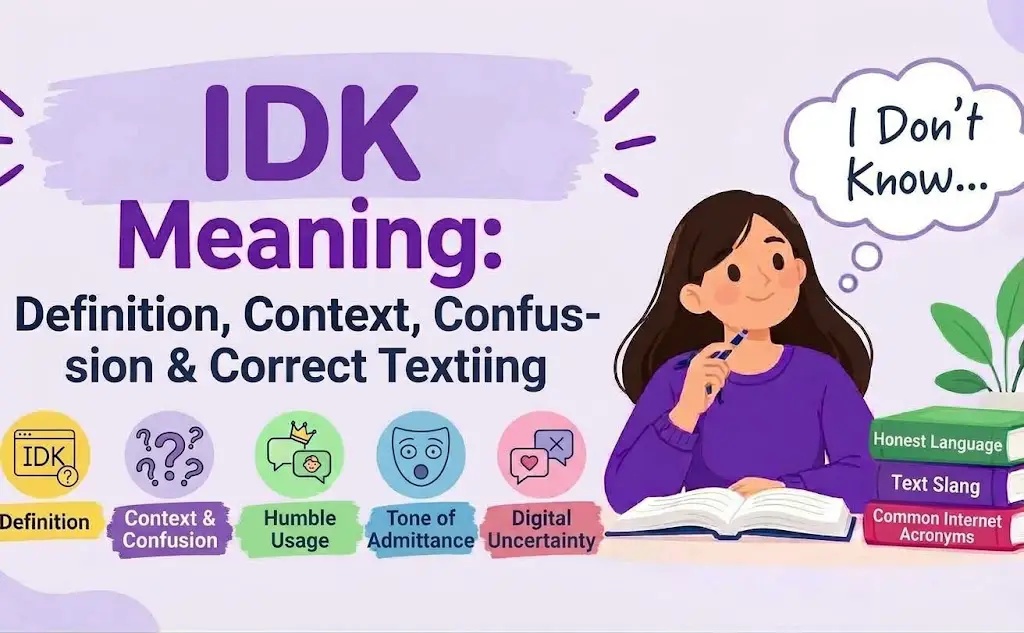
IDK stands for “I Don’t Know.” People use it when they are unsure about something, do not have an answer, or simply want to respond quickly. Understanding IDK can help you follow digital conversations and communicate naturally with friends and family.
What Does IDK Mean in Text?
In texting, IDK means “I Don’t Know.” It is a casual abbreviation used to express uncertainty, a lack of information, or confusion about a question or situation.
For example:
- “IDK what time the movie starts.”
- “IDK where I left my keys.”
- “IDK if I’ll be able to come.”
In each example, IDK communicates that the sender does not know the answer or is uncertain about something.
What Does IDK Stand For?
IDK stands for I Don’t Know. It is one of the most common abbreviations in informal digital communication because it saves time and makes messages shorter.
People commonly use IDK when they:
- Do not know the answer to a question.
- Are unsure about a plan or decision.
- Need more information.
- Feel confused about something.
- Want to give a quick, casual response.
Although IDK is widely understood online, writing the complete phrase is usually better in formal or professional communication.
How to Use IDK in a Sentence
You can use IDK at the beginning or within a sentence. It is especially common in conversations with friends, family members, and people you know well.
Examples:
- “IDK what to wear tonight.”
- “IDK if the store is still open.”
- “IDK how to solve this problem.”
- “IDK why she hasn’t replied.”
- “IDK, maybe we should ask someone else.”
IDK can stand alone as a short answer or form part of a longer message.
IDK Meaning on Social Media
On platforms such as Instagram, TikTok, Snapchat, Facebook, and X, IDK is often used in comments, captions, direct messages, and replies.
Examples:
- “IDK why this video is so funny.”
- “IDK who needs to hear this, but you’re doing great.”
- “IDK what this trend is about.”
- “IDK, this outfit looks better in black.”
- “IDK how people wake up that early.”
On social media, IDK can express genuine uncertainty, playful confusion, or a casual reaction. The surrounding message usually makes the intended meaning clear.
IDK Meaning in Chat With Friends
When friends use IDK, they are usually saying they do not know something or have not made a decision yet.
Example conversation:
Alex: “What time should we meet?”
Sam: “IDK, maybe around 6?”
Another example:
Friend: “What do you want to eat?”
You: “IDK. Anything is fine with me.”
In these examples, IDK keeps the conversation short and informal.
What Does IDK Mean From a Girl or a Guy?
IDK has the same basic meaning regardless of who sends it: “I Don’t Know.” It does not automatically indicate flirting, disinterest, anger, or any particular emotion.
For example:
- “IDK what to wear.” — The sender is unsure about a choice.
- “IDK, maybe later.” — The sender may be uncertain about a plan.
- “IDK why you think that.” — The sender may be confused or questioning something.
To understand the sender’s intention, consider the full conversation and their usual communication style. A short reply alone is not enough to determine someone’s feelings.
IDK vs. IDC: What’s the Difference?
IDK and IDC look similar, but their meanings are different.
| Abbreviation | Full Form | Meaning |
|---|---|---|
| IDK | I Don’t Know | Expresses uncertainty or lack of knowledge |
| IDC | I Don’t Care | Expresses a lack of concern or interest |
IDK example: “IDK which movie we should watch.”
IDC example: “IDC which movie we watch.”
The first person does not know which movie to choose. The second person is saying the choice does not matter to them. Depending on the context, IDC can sound dismissive or rude.
IDK vs. IMO: What’s the Difference?
IDK and IMO serve different purposes in online conversations.
- IDK means “I Don’t Know” and expresses uncertainty.
- IMO means “In My Opinion” and introduces a personal viewpoint.
Examples:
- “IDK if this restaurant is good.”
- “IMO, this restaurant is excellent.”
The first sentence shows a lack of information, while the second expresses a personal opinion.
Is IDK Rude or Disrespectful?
IDK is not inherently rude. It is a common, neutral abbreviation that can be perfectly appropriate in casual conversations. However, the tone may depend on how it is used.
Neutral example: “IDK what time the event starts.”
Potentially dismissive example: “IDK. Figure it out yourself.”
In the second example, the additional wording makes the response sound unfriendly. If you want to be polite, you can provide more context or use a complete sentence, such as “I’m not sure, but I can check.”
Is IDK Formal or Informal?
IDK is mainly an informal abbreviation. It is suitable for text messages, casual chats, and social media conversations.
In professional emails, academic assignments, and formal documents, write “I don’t know” in full or use a more appropriate expression.
Informal: “IDK when the report will be ready.”
More professional: “I’m not certain when the report will be ready, but I’ll confirm the timeline.”
Choosing the right form depends on your audience and the situation.
Common Examples of IDK in Text Messages
Here are more examples showing how people use IDK in everyday conversations:
- “IDK what happened yesterday.”
- “IDK if I can make it tonight.”
- “IDK where everyone went.”
- “IDK which option is better.”
- “IDK why my phone isn’t working.”
- “IDK, let’s decide tomorrow.”
- “IDK what to say to him.”
- “IDK how she finished so quickly.”
- “IDK whether I should buy it.”
- “IDK, but I’ll find out.”
These examples show how IDK can be used for questions about plans, decisions, people, and everyday situations.
Other Text Abbreviations Similar to IDK
If you want to understand more common texting slang, these abbreviations are also useful:
- IDC: I Don’t Care
- IMO: In My Opinion
- TBH: To Be Honest
- NGL: Not Gonna Lie
- IKR: I Know, Right?
- BTW: By the Way
- FYI: For Your Information
- BRB: Be Right Back
- WYD: What You Doing?
Each abbreviation has a different meaning, so choose the one that best matches what you want to communicate.
FAQs About IDK Meaning in Text
1. What does IDK mean in texting?
IDK means “I Don’t Know.” It is commonly used in text messages and online chats to express uncertainty or indicate that someone does not have an answer.
2. What does IDK mean on Instagram?
On Instagram, IDK usually means “I Don’t Know.” People use it in comments, captions, and direct messages to respond quickly or express uncertainty about a topic.
3. What does IDK mean from a girl?
When a girl uses IDK, it generally means “I Don’t Know.” It does not automatically mean she is upset, uninterested, or flirting. The surrounding conversation helps clarify her intention.
4. What does IDK mean from a guy?
When a guy sends IDK, he is usually expressing uncertainty or saying he does not know the answer. The abbreviation alone does not reveal his feelings or intentions.
5. Is IDK rude in a text?
No, IDK is not inherently rude. However, a very short response may sometimes seem dismissive, depending on the situation. Adding context can make the message sound friendlier.
6. What is the difference between IDK and IDC?
IDK means “I Don’t Know,” while IDC means “I Don’t Care.” IDK expresses uncertainty; IDC expresses a lack of concern or interest.
7. Should I use IDK in professional emails?
It is better to avoid IDK in formal emails. Use “I don’t know,” “I’m not sure,” or “I’ll check and get back to you” for a more professional tone.
Conclusion
IDK means “I Don’t Know” in text messages, social media posts, and online conversations. It is a quick, convenient way to express uncertainty, answer a question, or explain that you do not have enough information.
Although IDK is widely accepted in casual communication, writing the complete phrase is more suitable for formal situations. By understanding the context around the abbreviation, you can interpret messages more accurately and respond appropriately.