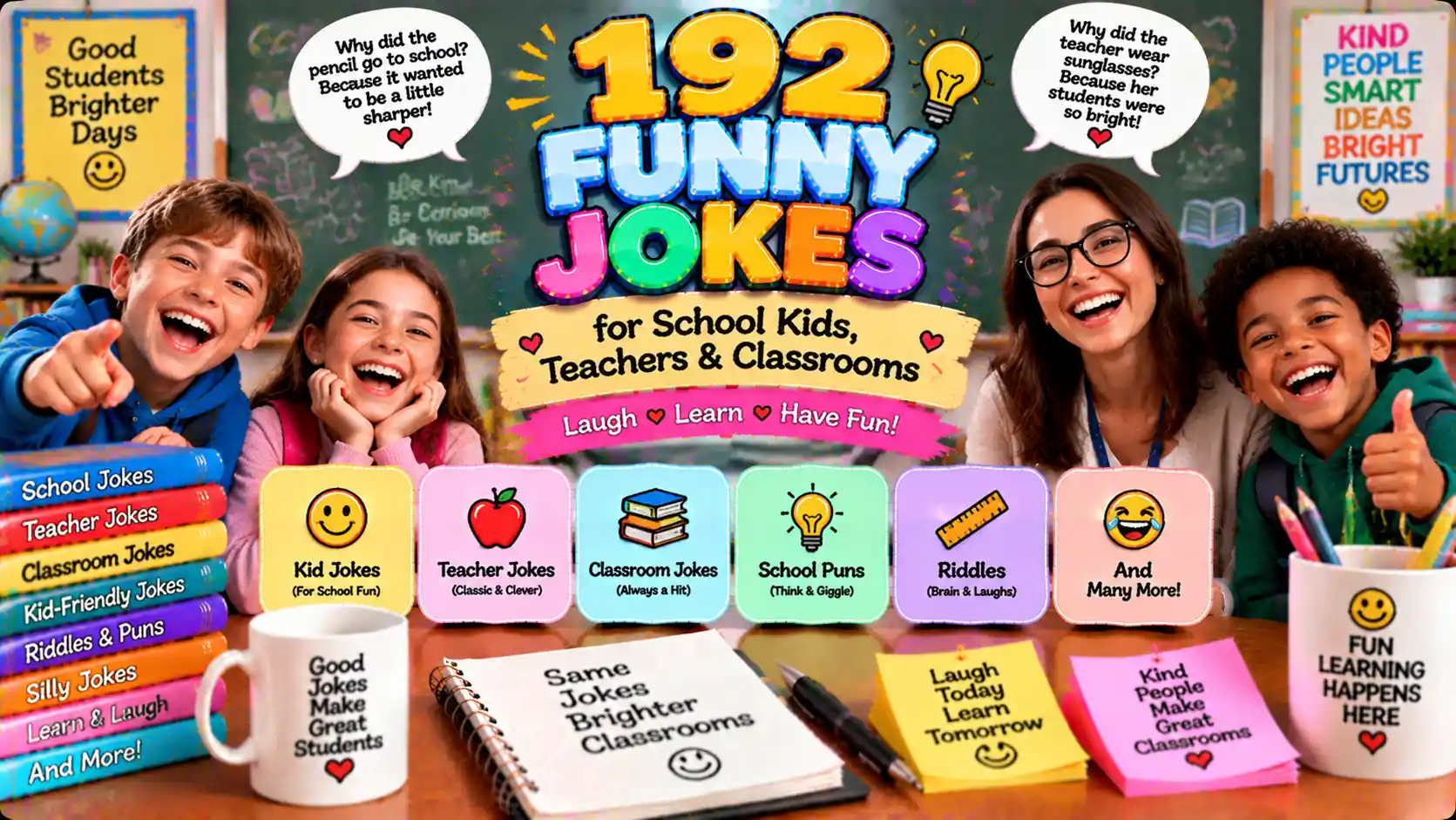
Clean, clever, and classroom-friendly jokes about homework, teachers, tests, school supplies, lunch, subjects, and student life.
Students, teachers, and parents can use these jokes for school when they need a quick, clean laugh that fits the setting. The collection is built around familiar moments such as homework, lockers, lunch, tests, pencils, schedules, and school buses.
You’ll find short jokes, clever puns, teacher humor, student jokes, riddles, knock-knocks, captions, and lunchbox notes. The humor stays friendly by focusing on school situations rather than embarrassing or insulting real people.
Quick Answer
Jokes for school are short, clean jokes about classrooms, teachers, homework, subjects, school supplies, lunch, tests, and student life. The best ones are easy to remember, simple to tell, and appropriate for the people hearing them.
TL;DR
- Choose short jokes for classrooms and quick breaks.
- Use subject jokes for math, science, English, or reading.
- Pick gentle teacher jokes instead of personal teasing.
- Try lunchbox jokes for a small surprise at lunchtime.
- Use captions for first-day and school-photo posts.
- Keep classroom humor kind, clean, and easy to understand.
Funny School Jokes
School provides endless material because everyone recognizes the setting. A missing pencil, strange schedule, noisy hallway, or mysterious backpack can become a punchline without making anyone the target.
These jokes are good for classroom warm-ups, family conversations, bus rides, and quick brain breaks. They are deliberately short enough to retell without memorizing a long story.
- Why did the school hallway get a map? It kept losing its direction.
- My backpack has one amazing talent: finding every heavy book at once.
- The school bell has perfect timing, especially when nobody wants class to end.
- Why did the notebook look confident? It had everything written down.
- My pencil isn’t indecisive. It just likes to draw its own conclusions.
- Why did the classroom clock become popular? Everyone wanted to know its time.
- School supplies have a secret talent: disappearing exactly when you need them.
- Why did the desk stay calm? It knew how to support the whole class.
- My school schedule has more surprises than a mystery novel.
- Why did the classroom door smile? It was always opening new opportunities.
- I asked my backpack what it learned today. It said, “A lot about carrying responsibility.”
- The school bus has the best route in town because it always knows where class is.
Short School Jokes
Sometimes the best joke is the one you can tell before the teacher finishes taking attendance. Short jokes also fit lunch notes, texts, captions, and school announcements.
Keep these handy when you need something quick, clean, and easy to repeat. Most can be remembered after hearing them once.
- My pencil has a sharp personality.
- Homework and I are working through some things.
- My backpack is basically a portable locker.
- Recess is my favorite subject, and I’m an expert.
- My notebook always has a page to spare.
- School supplies disappear faster than free time.
- My ruler measures everything except my patience.
- I came prepared. My homework didn’t.
- The bell is my favorite school announcement.
- My locker has one password: good luck.
- My calculator and I have a number of things in common.
- I study hard, especially the clock.
Teacher And Student Jokes
The best teacher-student jokes are playful rather than disrespectful. A clever misunderstanding, literal answer, or classroom situation can create the laugh without putting a real person on the spot.
These are suitable for students, teachers, appreciation cards, classroom boards, and family sharing. The punchline should make the student sound clever, not rude.
- Teacher: “Name two pronouns.” Student: “Who, me?”
- Teacher: “Why is your homework blank?” Student: “I wanted to leave room for creativity.”
- Teacher: “Did you finish the assignment?” Student: “I finished looking at it.”
- Teacher: “Why are you carrying two pencils?” Student: “One is for backup thinking.”
- Teacher: “What comes after Friday?” Student: “The weekend, thankfully.”
- Student: “Can I be excused for something I didn’t do?” Teacher: “What?” Student: “My homework.”
- Teacher: “Why are you smiling during the test?” Student: “I remembered something from yesterday.”
- Teacher: “Where is your textbook?” Student: “It’s taking a personal day.”
- Student: “I know the answer!” Teacher: “What’s the question?” Student: “I’m still working on that.”
- Teacher: “Please write a sentence with the word ‘future.’” Student: “The future is tomorrow.”
- Student: “Do we have homework tonight?” Teacher: “Yes.” Student: “Then tonight has officially been canceled.”
- Teacher: “Why did you bring an umbrella?” Student: “The forecast said there might be a pop quiz.”
Homework Jokes
Homework humor works because the assignment itself can be the comic character. That keeps the joke relatable without blaming a teacher, parent, or student.
Use these at the kitchen table, in lunchboxes, on worksheets, or during a study break. A quick joke can lighten the mood without becoming an excuse to skip the work.
- My homework and I agreed to take things one page at a time.
- Why did the worksheet bring a suitcase? It had a lot of baggage.
- My homework asked for a break, so I gave it a bookmark.
- The assignment said, “Show your work.” I showed it my desk.
- Why did the pencil stay late? It had unfinished business.
- My homework doesn’t scare me. It just has excellent timing.
- Why did the worksheet look tired? It had been through several drafts.
- I finished one page of homework and celebrated like it was graduation.
- My assignment and my snack have something in common: both disappear eventually.
- Why did the notebook stay open? It was committed to the assignment.
- Homework is great at hide-and-seek because I keep finding it everywhere.
- My pencil told my homework, “Let’s work this out together.”
Test And Exam Jokes
Tests create plenty of harmless comedy, especially when the joke focuses on pencils, questions, studying, or the clock. Avoid humor that makes fun of students for struggling.
These work well for test-day warm-ups, study groups, classroom boards, and nervous students who need a small mood reset.
- Why did the test bring a pencil? It expected some sharp answers.
- My study guide and I have become very close. We have covered a lot together.
- Why did the exam look tired? It had too many questions to answer.
- I studied the clock during the test. It was the only thing moving quickly.
- Why did the answer sheet feel confident? It had plenty of options.
- My pencil said, “Stay calm.” Then it broke during question three.
- Why did the student bring a ruler to the exam? To measure success.
- The test asked for my best answer. I asked if my second-best would do.
- Why did the calculator stay calm? It knew the numbers would work out.
- My test strategy is simple: read, think, erase, repeat.
- Why did the question bring a jacket? It expected a few cold answers.
- The hardest part of a test is deciding which answer looks least suspicious.
Math Jokes
Math gives school humor plenty of possibilities, from fractions and geometry to calculators and equations. The strongest jokes use a familiar math idea with a simple twist.
These are useful for math-class warm-ups, bulletin boards, study groups, and math-club humor.
- Why did the equation stay calm? It knew how to balance things.
- Why did the calculator get promoted? Everyone could count on it.
- The fraction wanted a vacation, but it couldn’t find the right portion.
- Why did the angle stay quiet? It didn’t want to make a scene.
- The decimal had a great point to make.
- Why did the triangle get invited to every party? It had three good angles.
- My ruler doesn’t brag. It just measures up.
- Why did the circle avoid arguments? It didn’t want to go around in circles.
- The multiplication sign loves teamwork because it brings things together.
- Why was the geometry notebook popular? It had great connections.
- The calculator joined the debate club because it had plenty of functions.
- Why did the number bring a ladder? It wanted to reach a higher value.
Science Jokes
Science humor is most useful when the wordplay stays understandable. These jokes cover biology, chemistry, physics, space, laboratories, and everyday science terms.
They’re a good fit for science classrooms, lab days, study groups, and students who enjoy jokes with a little extra thought behind them.
- Why did the atom bring a friend? It didn’t want to split up.
- Why did the magnet get invited everywhere? It was attractive.
- Why did the scientist bring a pencil? There were plenty of points to record.
- Why did the microscope feel useful? It helped everyone see things differently.
- Why did the planet study hard? It wanted to improve its orbit.
- Why did the beaker stay calm? It could handle the pressure.
- Why did the cell bring lunch? It needed energy for the day.
- Why did the telescope love school? It always looked ahead.
- Why did the lab notebook stay organized? It had a good system.
- Why did the rocket finish its homework early? It wanted to launch into the weekend.
- Why did the biology student bring a ruler? To measure the growth.
- Why did the science teacher smile after the experiment? The reaction was positive.
English And Grammar Jokes
Language class turns ordinary words into comedy material. Punctuation, spelling, vocabulary, and grammar all have built-in opportunities for wordplay.
These jokes are useful for English classes, writing warm-ups, spelling activities, and school newsletters.
- Why did the comma take a break? It needed a pause.
- The period had one job: knowing when to stop.
- Why did the dictionary feel important? It had the words everyone needed.
- Why was the verb always busy? It was constantly doing something.
- The adjective was confident because it knew how to describe itself.
- Why did the spelling bee love school? It was always buzzing about words.
- Why did the thesaurus make friends easily? It had plenty of alternatives.
- Why did the paragraph stay together? Its ideas were connected.
- The apostrophe looked small, but it knew how to show possession.
- Why did the quotation mark join the conversation? It had something to say.
- Why did the sentence bring a pencil? It wanted to make a good point.
- The dictionary never gets lost because it always knows where the words are.
Book And Library Jokes
Books make excellent joke material because stories, chapters, characters, shelves, and bookmarks already have playful meanings. These jokes work especially well in reading corners and libraries.
They also suit book clubs, reading challenges, librarian boards, and students who would rather discuss a novel than a worksheet.
- Why did the book bring a jacket? It wanted a good cover.
- Why did the bookmark feel important? It always knew where the story stood.
- Why did the novel take a break? It needed time between chapters.
- Why did the library card feel powerful? It opened a world of possibilities.
- Why did the mystery book look nervous? Someone was getting close to the answer.
- Why did the bookshelf stay organized? It liked keeping things in their places.
- Why did the reader carry a pencil? The story had some noteworthy moments.
- Why did the librarian love maps? They always helped people find their way.
- Why did the chapter feel proud? It was part of a bigger story.
- Why did the dictionary visit the library? It wanted to meet more words.
- Why did the book sit by the window? It wanted a fresh chapter.
- Why did the novel go to school? It wanted to develop its character.
School Supply Jokes
School supplies are safe joke targets because everyone recognizes them. Pencils, erasers, glue, rulers, paper, and backpacks can carry the humor without making fun of people.
These are especially good for elementary classrooms, lunchboxes, supply-label notes, and younger students.
- The pencil joined the debate team because it always had a point.
- Why did the eraser become a counselor? It helped people move past mistakes.
- Why did the glue win an award? It held everything together.
- Why did the ruler become a leader? It knew how to measure up.
- Why did the notebook apply for a job? It had excellent references.
- Why did the backpack need a vacation? It was carrying too much.
- Why did the scissors become a storyteller? They knew how to cut to the point.
- Why did the stapler stay calm? It knew how to keep things together.
- Why did the marker join art class? It wanted to make an impression.
- Why did the crayon stay cheerful? It saw the colorful side of things.
- Why did the paper feel confident? It was ready for a fresh start.
- Why did the pencil case look organized? It had all its points covered.
Cafeteria And Lunchbox Jokes
Lunch is one of the easiest school moments to make funny because everyone understands the excitement of opening a lunchbox. Food jokes also work well without targeting anyone.
These lines are ideal for lunchbox notes, cafeteria conversations, family texts, and school photo captions.
- Why did the sandwich study hard? It wanted to make the honor roll.
- Why did the apple enjoy school? It liked being the core of the class.
- Why did the lunchbox feel prepared? It had everything packed.
- Why did the banana arrive early? It didn’t want to split the schedule.
- Why did the cookie bring a notebook? It wanted to take sweet notes.
- Why did the carrot like math? It enjoyed getting to the root of things.
- Why did the sandwich join the debate team? It had strong fillings.
- Why did the orange enjoy class? It had a positive outlook.
- Why did the lunch tray stay calm? It had everything under control.
- Why did the snack get invited to the party? It had great appeal.
- Why did the spoon like lunchtime? It always enjoyed a good scoop.
- Why did the lunchbox avoid gossip? It had enough to chew on already.
Recess And Sports Jokes
Recess humor should make the activity funny rather than making a student’s athletic ability the joke. Balls, whistles, playground equipment, and games give you plenty of safer targets.
These work well for gym class, recess, playground conversations, and elementary-school joke boards.
- Why did the soccer ball go to school? It wanted to improve its kick.
- Why did the basketball like math? It enjoyed bouncing ideas around.
- Why did the swing love recess? It was always moving up.
- Why did the whistle become popular? It knew how to get everyone’s attention.
- Why did the jump rope make friends? It knew how to keep things moving.
- Why did the gym floor feel important? Everyone depended on its support.
- Why did the baseball bring homework? It wanted to study its pitches.
- Why did the tennis ball stay positive? It always bounced back.
- Why did the playground clock feel important? It counted down to recess.
- Why did the coach bring a pencil? Every game needs a few good points.
- Why did the traffic cone enjoy gym class? It liked marking the spot.
- Why did the relay baton love school? It enjoyed passing things along.
First Day And Back-To-School Jokes
The first day can bring excitement and nerves at the same time. A quick joke can make a new classroom, new schedule, or early morning feel less serious.
Use these for back-to-school photos, breakfast notes, bus-stop laughs, classroom boards, and family messages.
- Why did the backpack wake up early? It was ready for a fresh start.
- Why did the pencil arrive first? It wanted to make a good impression.
- Why did the school bus smile? It was ready for another great route.
- Why did the notebook feel excited? It was starting a new chapter.
- Why did the alarm clock dislike the first day? Summer had spoiled it.
- Why did the schedule bring a pencil? It wanted to write down every surprise.
- Why did the lunchbox feel confident? It had everything packed.
- Why did the locker practice before school? It wanted to master the combination.
- Why did the student pack extra pencils? First days are unpredictable.
- Why did the classroom door look excited? It was meeting everyone.
- Why did the calendar stretch? It had a long school year ahead.
- Why did the new notebook smile? It had a whole year of stories waiting.
Middle School And High School Jokes
Older students usually respond better to jokes about schedules, lockers, group projects, essays, tests, and the strange rhythm of a packed school day.
The humor can be a little more clever while remaining clean, respectful, and easy to share with classmates.
- Why did the locker become a detective? It was always cracking combinations.
- Why did the schedule need a break? It had too many periods.
- Why did the group project bring a calendar? Somebody had to handle the deadlines.
- Why did the hallway need traffic lights? Everyone kept changing directions.
- Why did the calculator take advanced classes? It wanted more functions.
- Why did the study guide feel confident? It knew the key points.
- Why did the school ID look serious? It had an official face.
- Why did the backpack become a planner? It was carrying everyone’s deadlines.
- Why did the essay wear layers? It had several levels of meaning.
- Why did the lab partner bring snacks? Every experiment needs support.
- Why did the hallway clock feel powerful? It controlled the schedule.
- Why did the senior’s notebook look proud? It had years of experience.
End-Of-School-Year Jokes
The final weeks of school have their own rhythm: finished assignments, field trips, yearbooks, celebrations, and a countdown to summer.
These jokes are useful for end-of-year cards, classroom boards, student celebrations, teacher gifts, and school photos.
- Why did the calendar celebrate? It finally reached the last page.
- Why did the backpack look relaxed? Its workload was shrinking.
- Why did the pencil feel proud? It had made it through the whole year.
- Why did the notebook close early? It had nothing left to prove.
- Why did the school bus feel nostalgic? It had collected a year of stories.
- Why did the classroom clock smile? Summer was getting closer.
- Why did the yearbook bring a pen? It had plenty of signatures to collect.
- Why did the locker clean itself? It wanted to leave a good impression.
- Why did the report card bring sunglasses? Summer was on the horizon.
- Why did the desk feel emotional? It was saying goodbye to another school year.
- Why did the final bell sound proud? It had reached the grand finale.
- Why did the backpack book a vacation? It was finally ready to unpack.
School Riddles And Brain Teasers
Riddles are useful when you want students to think before they laugh. They can work as morning warm-ups, classroom transitions, family games, or quick challenges.
Give younger students a few seconds to solve each one. The answer should feel satisfying rather than impossible.
- What has pages, a cover, and still gets opened every morning? A school book.
- What school item can make a point without speaking? A pencil.
- What has a face and hands but never does homework? A classroom clock.
- What can travel from home to school without taking a single step? A backpack.
- What gets shorter every time you use it but helps you write? A pencil.
- What can hold hundreds of words but never says one aloud? A notebook.
- What has four legs in a classroom but never goes anywhere? A desk.
- What gets erased but still helps you learn? A mistake.
- What rings at school but never answers the phone? The school bell.
- What can have a combination but isn’t a math problem? A locker.
- What carries books but never reads them? A backpack.
- What gets checked before class but never takes a test? The schedule.
School Captions And Lunchbox Notes
School humor is also useful when you need something short enough for a photo or sweet enough for a lunchbox. The best caption usually matches the moment instead of trying too hard to be a joke.
For lunchbox notes, combine humor with encouragement. A child should finish reading the note feeling supported, not embarrassed.
- New year, fresh pages, same great attitude.
- Backpack packed. Confidence loading.
- First day, fresh start.
- Today is looking like an A+ kind of day.
- Class is in session; personality included.
- Making memories between the bells.
- School supplies: packed. Snack: essential.
- New schedule, new stories.
- Keep your head up and your pencil sharp.
- You can do hard things—and still have time for lunch.
- Your only assignment today is to give it your best.
- You’ve got this. Now go make your own good story.
How To Choose The Right School Joke
The best joke depends on who will hear it and where it will be used. A joke that works at home may not work in a classroom, and a joke for a first-grader may feel too simple for a high-school student.
A useful rule is to make the situation, object, or wordplay the target. Avoid jokes about a student’s appearance, intelligence, family, identity, disability, or personal struggles.
Quick Guide
| Situation | Best Choice |
|---|---|
| Classroom warm-up | Short one-liner |
| Elementary students | Simple object pun |
| Middle school | Clever school-life joke |
| High school | Schedule, test, or group-project humor |
| Lunchbox | Warm one-liner |
| First day | Back-to-school joke |
| Teacher appreciation | Respectful teacher joke |
| Math class | Number or geometry pun |
| Science class | Subject-based wordplay |
| School photo | Short caption |
| End-of-year card | Warm joke or message |
| Brain break | Knock-knock or riddle |
FAQs
What makes a joke appropriate for school?
A school-appropriate joke uses clean language and avoids personal attacks, adult themes, slurs, stereotypes, or humiliating situations. The safest jokes focus on shared experiences such as homework, pencils, subjects, lunch, schedules, and school routines.
What are good jokes for kids to tell at school?
Short jokes with familiar setups are usually easiest for children to remember. Pencil jokes, classroom one-liners, riddles, knock-knocks, and simple subject puns are good starting points.
Can teachers use jokes in the classroom?
Yes. A short joke can work as a morning warm-up, transition, brain break, or discussion starter. Keep it brief and avoid humor that singles out a student or turns classroom behavior into public embarrassment.
What are good jokes for the first day of school?
Choose jokes about new notebooks, backpacks, school buses, schedules, pencils, or returning after summer. These subjects are familiar to nearly every student and don’t require anyone to be the target of the joke.
What jokes work well in lunchboxes?
The best lunchbox jokes are short enough to read quickly and friendly enough to brighten the day. Pair a simple pun with encouragement, such as a reminder that the child is doing a great job.
What are good school jokes for middle school students?
Middle schoolers often enjoy humor about lockers, schedules, group projects, tests, homework, school technology, and changing classes. Slightly more clever wordplay usually works better than very simple preschool-style jokes.
How can I write my own school joke?
Start with something familiar, such as a pencil, test, locker, cafeteria, or school bus. Give that object an unexpected role, then build a short punchline around a second meaning or surprising connection.
Conclusion
The best jokes for school don’t need complicated setups or risky punchlines. A simple observation about homework, lunch, lockers, pencils, tests, or the school day can create a laugh that everyone can share.
Choose the joke that fits the moment, keep the humor kind, and save your strongest lines for when people actually need a smile. For a classroom, lunchbox, first-day photo, or school celebration, the right short joke can go a long way.