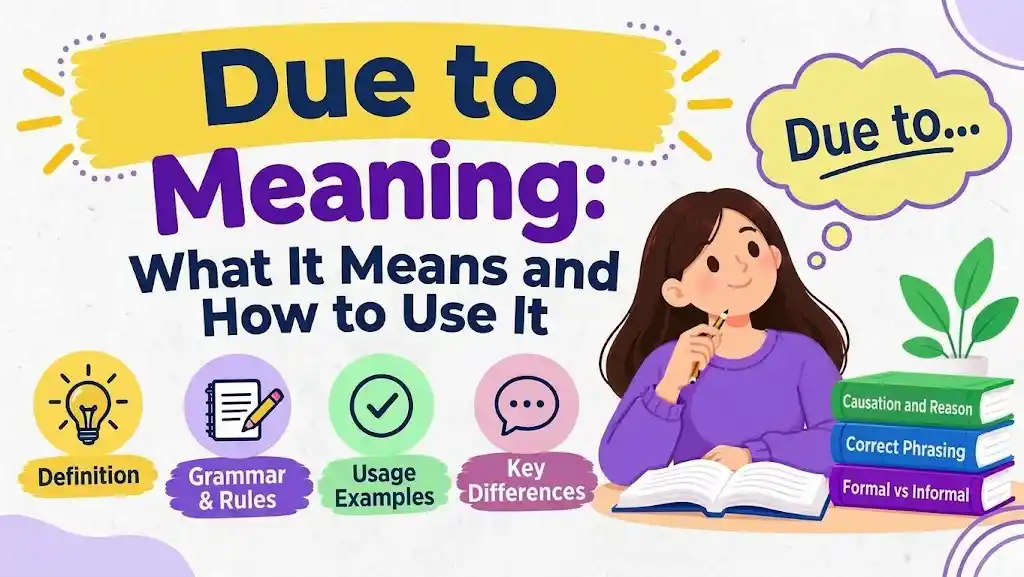
Learn the meaning of due to, how it works in English sentences, and when to use it naturally.
This guide explains due to vs because of, due to vs because, due to vs owing to, and due to vs do to.
You’ll also learn common mistakes, formal usage, and the different meaning of due to arrive.
This guide helps English learners, students, and writers understand due to meaning and use the phrase correctly. In most sentences, due to means because of or caused by.
The phrase can also appear in a different structure, such as due to arrive, where it means something is expected or scheduled. Understanding the words around due to will help you choose the right expression.
Quick Answer
Due to usually means because of, caused by, or resulting from. For example, “The flight was delayed due to fog” means fog caused the delay.
TL;DR
- Due to usually expresses a cause or reason.
- It commonly comes before a noun phrase.
- Because normally comes before a complete clause.
- Because of also introduces a cause.
- Do to is different from due to.
- Due to arrive means expected or scheduled to arrive.
What Does “Due To” Mean?
The main due to meaning is because of or as a result of. It connects a situation or result with the reason behind it.
For example, “The picnic was canceled due to rain” means the rain caused the cancellation. Likewise, “The delay was due to traffic” identifies traffic as the reason for the delay.
The phrase often appears in American English, everyday conversation, workplace writing, news reports, and formal documents.
How “Due To” Shows Cause or Reason
Use due to when you want to identify the cause of something. The cause may be an event, condition, problem, decision, or circumstance.
Consider these examples:
• The flight was delayed due to bad weather.
• The road was closed due to flooding.
• The project failed due to poor planning.
• The meeting changed due to a scheduling conflict.
• Her progress was due to regular practice.
• The computer stopped working due to a damaged cable.
• The school closed early due to extreme heat.
• The delivery arrived late due to heavy traffic.
In each sentence, due to identifies something responsible for the result.
How to Use “Due To” in a Sentence
A common structure is subject + be + due to + noun phrase. For example, “The cancellation was due to severe weather.”
You can also place the causal phrase at the beginning: “Due to severe weather, the cancellation was announced early.” This sentence structure is widely used in modern English, although some formal style guides may prefer because of in certain contexts.
“Due To” + Noun Phrase
A noun phrase is a noun together with words that describe or determine it. After due to, you might see phrases such as heavy rain, a technical problem, or the lack of staff.
Examples:
• The delay was due to heavy rain.
• The mistake was due to a typing error.
• The closure was due to a power outage.
• The change was due to the new schedule.
• The problem was due to a lack of communication.
• The cancellation was due to unexpected circumstances.
• The improvement was due to better training.
• The damage was due to strong winds.
A useful pattern to remember is:
due to + noun or noun phrase
Can You Start a Sentence With “Due To”?
Yes. Starting a sentence with due to is common in modern English.
For example:
Due to heavy snow, the school closed early.
However, traditional grammar instruction sometimes recommends using due to mainly after a form of be and choosing because of when explaining why an action occurred.
That older distinction still appears in some editing and style guidance. Modern dictionaries and usage references recognize broader use, so the choice can depend on the publication’s style and the sentence’s clarity.
“Due To” After a Form of “Be”
The traditional pattern is:
subject + be + due to + cause
Examples:
• The delay was due to traffic.
• The cancellation was due to bad weather.
• The error was due to a software problem.
• The change was due to new regulations.
A useful traditional test is to replace due to with attributable to.
The delay was due to traffic.
→ The delay was attributable to traffic.
If attributable to fits naturally, the relationship is clearly describing the cause of the noun.
“Due To” vs “Because Of”
Due to and because of can both express a cause. In modern English, their meanings often overlap.
The traditional distinction says due to should describe a noun, while because of should explain the reason for an action.
Compare:
• The cancellation was due to rain.
• The event was canceled because of rain.
Both clearly connect rain with the cancellation.
For straightforward writing, because of is often a useful choice when the phrase directly explains why someone did something or why an event happened.
“Due To” vs “Because”
The most useful difference is the structure that follows each expression.
Because normally introduces a clause, which contains a subject and a verb.
Due to normally introduces a noun phrase.
Compare:
• We stayed home because it was raining.
• We stayed home because of the rain.
• Our decision to stay home was due to the rain.
Notice the difference:
because + subject + verb
because of + noun phrase
due to + noun phrase
This simple pattern prevents many common grammar mistakes.
“Due To” vs “Owing To”
Owing to is another expression meaning because of or as a result of. It can often replace due to without changing the basic meaning.
Compare:
• The match was postponed due to rain.
• The match was postponed owing to rain.
Both sentences identify rain as the cause.
Owing to can sound slightly more formal or traditional, while due to is very common in modern American English.
“Due To the Fact That” vs “Because”
Due to the fact that can introduce a complete clause, but it is often unnecessarily long.
Compare:
We left early due to the fact that it was getting dark.
with:
We left early because it was getting dark.
The second sentence is shorter and more direct.
In most everyday, academic, and professional writing, because is the better choice when you need to introduce a complete reason.
“Due To” vs “Do To”
The correct causal expression is due to, not do to.
For example:
The delay was due to traffic. ✓
The delay was do to traffic. ✗
However, do and to can appear next to each other when they have separate grammatical roles.
For example:
What did you do to my computer?
Here, do is a verb and to introduces the object affected by the action. Therefore, do to is not always an error. It simply does not mean because of.
“Due To Arrive” Has a Different Meaning
The phrase due to does not always express cause.
In:
The train is due to arrive at 8:30.
due to arrive means expected or scheduled to arrive.
Compare that with:
The train was delayed due to snow.
Here, due to snow gives the reason for the delay.
So remember:
due to + noun phrase → often expresses a cause
due to + verb in a structure like due to arrive → often expresses an expected or scheduled event
Other Meanings of “Due”
The word due has several meanings, so it should not always be treated as part of the causal phrase due to.
For example:
• The rent is due Friday. — Payment is required by Friday.
• The train is due at noon. — The train is expected at noon.
• The package is due tomorrow. — The package is expected tomorrow.
• She received the respect due to her position. — She received the respect appropriate to her position.
• Our thanks are due to the volunteers. — The volunteers deserve our thanks.
Context tells you which meaning of due is intended.
“Due To” in Formal American English
Due to is common in both everyday and formal American English. However, formal writing has traditionally treated its grammatical role more narrowly.
Modern dictionaries recognize broader uses, while some style guides continue to recommend the traditional distinction. This means you may encounter different advice from reputable sources.
When writing for school, work, or publication, follow the relevant style guide if one is provided. Otherwise, choose the expression that makes the sentence clear, natural, and precise.
Common Mistakes With “Due To”
Most mistakes happen when writers confuse due to, because, because of, and do to.
• Incorrect: Due to it was raining, we stayed home.
Better: Because it was raining, we stayed home.
• Incorrect: The delay was do to traffic.
Better: The delay was due to traffic.
• Wordy: We left early due to the fact that it was dark.
Better: We left early because it was dark.
• Clear: The cancellation was due to bad weather.
Clear alternative: The event was canceled because of bad weather.
• Different meaning: The train is due to arrive at noon.
Here, due to arrive means expected to arrive.
The key is to check both meaning and sentence structure.
Practice: Choose the Best Expression
Choose due to, because of, or because for each sentence.
• The flight was delayed ___ heavy snow.
• We stayed home ___ the roads were dangerous.
• The cancellation was ___ a mechanical problem.
• The meeting ended early ___ everyone had another appointment.
• The road was closed ___ flooding.
• She missed the bus ___ she left home late.
• The change was ___ a new company policy.
• The event was postponed ___ severe weather.
Answers
• due to
• because
• due to
• because
• because of
• because
• due to
• because of
The main pattern is simple: use because before a full clause and due to or because of before a noun phrase when expressing a cause.
Quick Rules to Remember
Use these rules as a fast reference when writing:
• Due to usually means because of or caused by.
• Use because + clause: “because the store was closed.”
• Use because of + noun phrase: “because of the closure.”
• Due to + noun phrase commonly expresses a cause.
• Due to arrive means expected or scheduled to arrive.
• Write due to, not do to, when expressing a cause.
• Owing to can often replace due to.
• In formal writing, follow your required style guide when its rules differ.
• Prefer clear wording over unnecessarily complicated phrasing.
• Use the attributable to test when checking the traditional construction.
FAQs
What does “due to” mean in simple English?
Due to usually means because of or caused by. It explains the reason something happened or existed.
For example, “The flight was delayed due to fog” means fog caused the delay.
Is “due to” grammatically correct?
Yes. Due to is an established English expression and is widely used to express cause.
Some style guides maintain the traditional noun-modifier distinction, while modern English recognizes broader usage. Follow a required house or academic style when applicable.
Can “due to” start a sentence?
Yes. Due to can begin a sentence when it introduces a cause.
For example, “Due to heavy rain, the game was canceled.” Some conservative editors may prefer because of heavy rain in certain contexts.
Is “due to” the same as “because of”?
They often have the same basic meaning. Both can introduce a cause, although traditional grammar distinguishes their functions.
For everyday clarity, because of is often a straightforward way to explain why an action occurred.
Can “due to” be followed by a complete clause?
A causal due to normally introduces a noun phrase rather than a complete clause.
Write “due to the rain”, not “due to it was raining.” For the full clause, use “because it was raining.”
Is “due to the fact that” correct?
It can be grammatically possible, but it is often wordy. Because usually gives the same meaning more directly.
For example, “We left because it was late” is clearer than “We left due to the fact that it was late.”
What does “due to arrive” mean?
Due to arrive means expected or scheduled to arrive. It describes an expected event rather than a cause.
For example, “The bus is due to arrive at 7:00” gives its expected arrival time.
Conclusion
The main due to meaning is because of, caused by, or resulting from. It commonly introduces a cause, while structures such as due to arrive express an expected or scheduled event.
When choosing between similar expressions, check what follows the phrase. Use because with a full clause, and choose due to or because of when a noun phrase clearly expresses the cause.