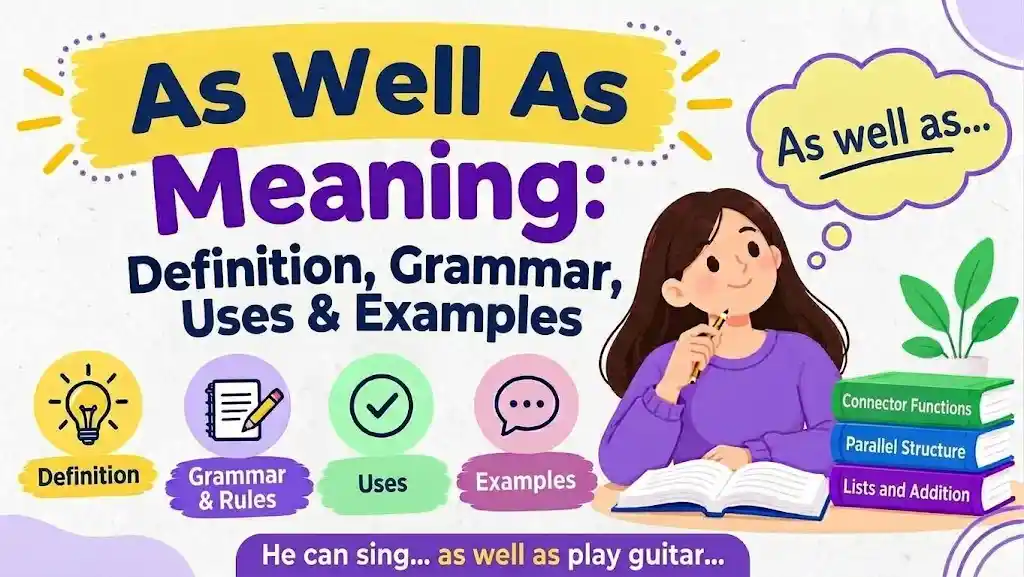
As well as meaning is a common English expression that usually means “in addition to” or “also.” It adds another person, thing, action, or quality to a sentence.
Understanding as well as helps you write clearer English and avoid common grammar mistakes. This guide explains its meaning, sentence patterns, verb agreement, comparisons, and everyday uses.
Quick Answer
As well as usually means “in addition to” or “also.” It adds extra information without always treating that information exactly like a second main subject.
Example:
Maria speaks Spanish as well as English.
Here, as well as English adds another language Maria speaks.
TL;DR
• As well as usually means in addition to.
• It can connect nouns, phrases, and actions.
• The main subject usually controls the verb.
• It differs from and in sentence structure.
• Matching forms make sentences clearer.
• Avoid unnecessary combinations like as well as also.
What Does “As Well As” Mean?
As well as adds one piece of information to another. In many sentences, it has a meaning close to “in addition to.”
For example, “She studies biology as well as chemistry” tells us that she studies both subjects, while presenting chemistry as added information.
Common examples include:
• He speaks English as well as Spanish.
• We need time as well as money.
• She is smart as well as hardworking.
• The store sells books as well as magazines.
• I enjoy reading as well as writing.
• The course covers grammar as well as vocabulary.
How to Use “As Well As” in a Sentence
Use as well as when you want to add related information to a sentence. It can connect nouns, adjectives, activities, skills, places, and other grammatical elements.
The connected elements should fit naturally together. When actions are connected, keeping their grammatical forms similar usually makes the sentence easier to read.
• Nouns: We bought apples as well as oranges.
• Adjectives: The room is bright as well as comfortable.
• Activities: She enjoys swimming as well as hiking.
• Skills: The job requires writing as well as editing.
• Subjects: He studies history as well as science.
• Places: We visited Boston as well as Chicago.
• Qualities: The plan is practical as well as affordable.
• People: Alex, as well as Jordan, attended the event.
As Well As vs And
As well as and and can both connect information, but they can create different grammatical structures.
With and, two subjects are commonly presented as a coordinated pair. With as well as, the first subject remains the main subject, while the second is added information.
• Sarah and Mark are coming.
Both Sarah and Mark form the subject.
• Sarah, as well as Mark, is coming.
Sarah is the main subject.
• I bought bread and milk.
Both items are presented together.
• I bought bread as well as milk.
Milk is presented as additional information.
This distinction becomes especially important when choosing the verb.
As Well As vs Also
Also adds information, but it usually does not connect two elements in exactly the same way as as well as.
For example, also can appear before a main verb, while as well as commonly connects one element with another.
• She also speaks French.
• She speaks French as well as Spanish.
• He also enjoys cooking.
• He enjoys cooking as well as gardening.
Both expressions communicate addition, but their sentence structures differ.
As Well As vs Too
Too often appears near the end of a sentence and can mean “also.” It does not normally work as a direct replacement for every use of as well as.
Compare these sentences:
• She speaks Spanish too.
• She speaks Spanish as well as French.
The first sentence adds Spanish to information already understood. The second connects Spanish and French directly.
Use the expression that fits the structure you want.
As Well As and Subject-Verb Agreement
One of the most common mistakes involves subject-verb agreement. When an as well as phrase adds information to a subject, the main subject usually controls the verb.
Consider:
The teacher, as well as the students, is ready.
The main subject is teacher, which is singular. Therefore, is is appropriate.
Compare it with:
The teacher and the students are ready.
Here, teacher and students form a plural subject, so are is used.
More examples:
• My brother, as well as my parents, enjoys gardening.
• The manager, as well as her assistants, has arrived.
• The dog, as well as the cats, needs attention.
• The dogs, as well as the cat, need attention.
The best habit is to identify the main subject before choosing the verb.
As Well As With -Ing Forms
When as well as connects actions, an -ing form often creates a natural structure.
Matching forms are especially helpful when both actions depend on the same verb.
• She enjoys reading as well as writing.
• He likes cooking as well as baking.
• They practice speaking as well as listening.
• I enjoy walking as well as cycling.
Avoid mismatched structures when a parallel form is expected:
Less natural:
She enjoys reading as well as to write.
Better:
She enjoys reading as well as writing.
The matching -ing forms make the relationship between the two activities clear.
Commas With As Well As
Comma use depends on how as well as functions in the sentence. You should not automatically place a comma before every occurrence.
When the phrase is parenthetical or adds extra information about the main subject, commas can help separate it.
The manager, as well as her assistant, attended the meeting.
But a comma is usually unnecessary when as well as simply connects items:
The store sells clothing as well as shoes.
Compare:
• My sister, as well as my brother, lives nearby.
• She enjoys hiking as well as fishing.
• The report discusses costs as well as benefits.
• The director, as well as several employees, attended.
Look at the sentence structure rather than applying a one-size-fits-all comma rule.
Is As Well As Formal or Informal?
As well as is standard English and works in both everyday and formal writing.
In professional writing, it can be useful when you want to add related information without repeatedly using and.
Examples include:
• The report examines costs as well as potential benefits.
• The position requires writing skills as well as editing experience.
• The policy affects employees as well as managers.
• The course develops reading skills as well as writing skills.
Still, and may be clearer when two elements are equally important. Good formal writing focuses on clarity rather than choosing longer expressions.
As Well As in Everyday English
You will often hear as well as in conversations about activities, preferences, skills, and possessions.
It works naturally when someone wants to add another detail.
• I like coffee as well as tea.
• She plays tennis as well as soccer.
• We need chairs as well as tables.
• He watches movies as well as TV shows.
• I brought snacks as well as drinks.
• She speaks English as well as Spanish.
These examples show how the expression can connect ordinary nouns and activities.
Common Mistakes With As Well As
The most common mistakes involve treating as well as exactly like and. This can lead to incorrect verb agreement or awkward sentence structure.
Another frequent problem is repeating the same idea with unnecessary words.
• Incorrect: The teacher, as well as the students, are ready.
Correct: The teacher, as well as the students, is ready.
• Incorrect: She enjoys reading as well as to write.
Correct: She enjoys reading as well as writing.
• Awkward: He speaks English as well as also Spanish.
Better: He speaks English as well as Spanish.
• Awkward: I like both coffee as well as tea.
Better: I like both coffee and tea.
• Incorrect: The manager, as well as her assistants, have arrived.
Correct: The manager, as well as her assistants, has arrived.
Check the main subject, the grammatical forms, and any unnecessary repeated words.
As Well As Synonyms and Alternatives
Several expressions can communicate a similar idea, but they are not interchangeable in every sentence.
And is often the most direct choice when two elements are being coordinated. Also and too add information but have different sentence positions.
In addition to is useful when you want to clearly introduce something extra. Along with and together with can emphasize association or accompaniment.
Examples:
• She studies English and Spanish.
• She also studies Spanish.
• She studies Spanish too.
• She studies Spanish as well as English.
• She studies Spanish in addition to English.
• She studies Spanish along with English.
Choose the expression that best matches your intended structure.
Can As Well As Start a Sentence?
Yes, as well as can begin a sentence when the construction is clear.
It commonly introduces an additional action or circumstance:
As well as studying grammar, she practices speaking.
Here, the opening phrase gives extra information about what she does.
More examples include:
• As well as learning vocabulary, students practice pronunciation.
• As well as working full time, he takes evening classes.
• As well as teaching English, she writes textbooks.
• As well as improving writing, the course develops reading skills.
If the sentence becomes difficult to follow, rewrite it using in addition to or another clearer structure.
As Well As in Different Contexts
The central meaning stays connected to addition, but the expression can connect many types of information.
Understanding what it connects makes the grammar easier to recognize.
• People: Alex, as well as Jordan, attended.
• Things: We bought bread as well as fruit.
• Actions: She reads as well as writes.
• Qualities: The plan is practical as well as affordable.
• Skills: The job requires writing as well as editing.
• Subjects: He studies history as well as science.
• Places: They visited Dallas as well as Austin.
• Activities: We enjoy hiking as well as camping.
As Well As in American English
As well as is a standard expression in American English. It does not require a special regional grammar rule.
American writers and speakers can use it in casual, professional, educational, and formal contexts.
For American English learners, the main points to remember are:
• It commonly means in addition to.
• It can connect related words or phrases.
• The main subject normally controls the verb.
• Matching grammatical forms improve clarity.
• And, also, and too are related but structurally different.
• Context determines the clearest choice.
As Well As Practice
Try these examples without looking at the answers first.
Choose the Correct Form
Sarah, as well as her friends, ___ coming.
• is
• are
Answer: is
The main subject is Sarah, so the singular verb is is used.
Correct the Sentence
She enjoys reading as well as to write.
Correct:
She enjoys reading as well as writing.
The two activities use matching -ing forms.
Compare the Meaning
Tom and Lisa are attending.
Tom, as well as Lisa, is attending.
Both sentences mention Tom and Lisa, but their grammatical structures differ.
Remove Unnecessary Repetition
She speaks French as well as also Spanish.
Better:
She speaks French as well as Spanish.
The word also is unnecessary because as well as already expresses addition.
As Well As: Quick Reference
Meaning: usually in addition to or also
Basic pattern:
A + as well as + B
Example:
She studies grammar as well as vocabulary.
With activities:
She enjoys reading as well as writing.
With a main subject:
The teacher, as well as the students, is ready.
With equal coordination:
The teacher and the students are ready.
Common mistake:
as well as also
Better:
as well as
When choosing between as well as, and, also, and too, focus on the sentence structure and the meaning you want to emphasize.
FAQs
What Does “As Well As” Mean?
As well as usually means “in addition to” or “also.” It adds another person, thing, action, or quality.
For example, “She speaks Spanish as well as English” means she speaks both languages.
Is “As Well As” the Same as “And”?
Not always. And commonly presents two coordinated elements, while as well as often presents the second element as additional information.
This difference can affect subject-verb agreement.
Does “As Well As” Take a Singular or Plural Verb?
When as well as adds information to a subject, the main subject normally determines the verb.
For example, “The teacher, as well as the students, is ready” uses is because teacher is the main subject.
Is “As Well As” Followed by an -Ing Form?
It can be. When two activities are connected, matching -ing forms often create a clear and natural structure.
For example, “She enjoys reading as well as writing.”
Is “As Well As” Formal or Informal?
As well as is used in both formal and informal English. It is appropriate in everyday conversation, professional writing, and educational writing.
The best choice depends on sentence structure and clarity.
Can “As Well As” Start a Sentence?
Yes. It can introduce an additional action or circumstance.
For example, “As well as studying grammar, she practices speaking.”
Conclusion
As well as usually means “in addition to” or “also.” It is useful for adding information, but its grammar differs from simple coordination with and.
Remember the main rules: identify the main subject, use matching grammatical forms, avoid unnecessary repetition, and choose the clearest expression for your sentence. Try writing five original examples to practice the pattern.