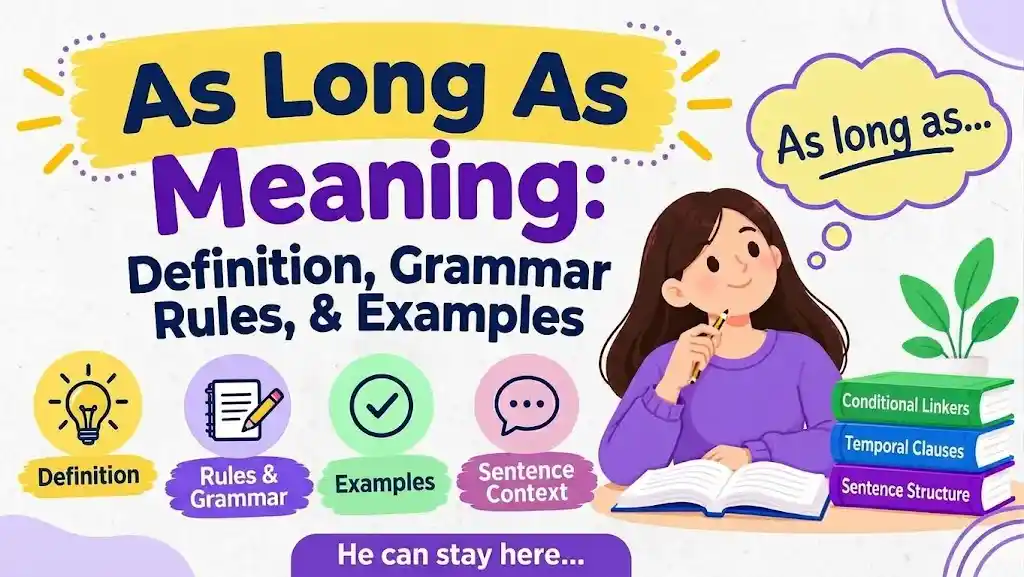
“As long as Meaning” is a common English phrase with two main uses. It can introduce a condition, similar to “if” or “provided that,” or describe how long something continues.
For example, “You can borrow my car as long as you drive carefully” gives a condition. But “You can stay as long as you want” describes duration. Understanding that difference makes this phrase much easier to use correctly.
This guide explains the meaning of “as long as,” its grammar, sentence patterns, tense rules, common mistakes, and differences from similar expressions. You’ll also learn a quick way to identify which meaning applies in any sentence.
Quick Answer
“As long as” usually means “if/provided that” or “for the entire time that.” The context determines whether it expresses a condition or duration.
TL;DR
- As long as can introduce a condition.
- It can also describe duration.
- It often means if in conditional sentences.
- It can mean for the time that in time-related sentences.
- Future conditions usually use the present tense after it.
- So long as can have the same conditional meaning.
What Does “As Long As” Mean?
“As long as” has more than one meaning in English. Its most common uses involve a condition or a period of time.
When it introduces a condition, it means something like “if” or “provided that.” When it describes time, it means “for the entire period that” something happens.
Condition meaning
You can use my computer as long as you are careful.
This means:
You can use my computer if you are careful.
Duration meaning
Stay here as long as you need.
This means:
Stay here for as much time as you need.
A useful question can help:
- Does the phrase set a condition? → Think if.
- Does it describe a period of time? → Think for as long as or during the time that.
How “As Long As” Works in a Sentence
“As long as” commonly introduces a dependent clause. That clause gives information about a condition, duration, or related circumstance.
The phrase can appear at the beginning or middle of a sentence. When the dependent clause comes first, a comma normally follows it.
Common sentence patterns
- As long as + subject + verb, main clause
- Main clause + as long as + subject + verb
Examples
- As long as you study, you can improve.
- You can improve as long as you study.
- As long as the weather stays clear, we’ll go hiking.
- We’ll go hiking as long as the weather stays clear.
- As long as you need help, I’ll stay.
- I’ll stay as long as you need help.
The placement changes the rhythm, but it does not normally change the basic relationship between the clauses.
“As Long As” Meaning “If”
One of the most common uses of “as long as” is to state a condition. In this use, something can happen only when the condition is satisfied.
This meaning is close to “if,” “provided that,” or “on the condition that.”
Examples of the conditional meaning
- You can borrow the book as long as you return it tomorrow.
- We can start as long as everyone is ready.
- You can stay here as long as you follow the rules.
- I’ll help you as long as you are honest with me.
- She can join us as long as she finishes her work.
- We’ll go outside as long as the weather remains safe.
Compare:
You can come as long as you call first.
This is very close to:
You can come if you call first.
The phrase “as long as” can make the condition feel like a requirement or boundary.
“As Long As” for Duration
“As long as” can also describe the length of time something continues. Here, there is no special requirement being imposed.
Consider:
Stay as long as you like.
The speaker is talking about duration. The meaning is roughly “stay for whatever amount of time you like.”
More duration examples
- I’ll wait as long as necessary.
- Stay as long as you want.
- She worked there as long as she could.
- He stayed awake as long as possible.
- I’ll remember this moment as long as I live.
- You can keep the book as long as you need it.
- We talked as long as we had time.
- They stayed at the beach as long as the weather allowed.
A useful question
Ask:
“How long?”
If the sentence answers that question, “as long as” probably has a duration meaning.
“As Long As” in Future Sentences
A common grammar mistake involves using “will” immediately after “as long as” when the phrase introduces a normal future condition.
In standard English, future conditions usually use the present tense after “as long as.” The main clause can then express the future result.
Correct examples
- As long as it rains, we’ll stay home.
- As long as you finish your work, you can leave.
- We’ll continue as long as everyone agrees.
- I’ll help as long as I have enough time.
Common mistake
❌ As long as it will rain, we’ll stay home.
Better:
✅ As long as it rains, we’ll stay home.
The same pattern appears with other expressions that introduce future conditions.
Remember the pattern
As long as + present tense → future result
As long as you study, you’ll improve.
The verb “study” is present tense, even though the sentence refers to a future situation.
“As Long As” vs. “If”
“As long as” and “if” can express very similar conditions, but they do not always carry exactly the same emphasis.
If simply introduces a condition. As long as can emphasize that the condition is a requirement or limit.
| Expression | Example | Main idea |
|---|---|---|
| If | If you finish, you can leave. | Condition |
| As long as | As long as you finish, you can leave. | Condition or requirement |
| Provided that | Provided that you finish, you can leave. | Formal condition |
For everyday English, both “if” and “as long as” can sound natural.
You can use my phone if you are careful.
You can use my phone as long as you are careful.
The second sentence puts slightly more attention on the requirement.
“As Long As” vs. “Until”
These expressions can both relate to time, but they focus on different ideas.
“Until” normally identifies an endpoint. “As long as” can emphasize duration or establish a condition.
Compare:
Wait until 6 p.m.
The endpoint is 6 p.m.
Wait as long as necessary.
The length of the wait depends on what is necessary.
More examples
- I’ll stay until you return. → Your return is the endpoint.
- I’ll stay as long as you need me. → Your need determines the duration.
- We worked until midnight. → Midnight is the endpoint.
- We worked as long as we could. → The sentence emphasizes the available duration.
- Stay here until the teacher arrives. → The teacher’s arrival ends the period.
- Stay here as long as you want. → The listener chooses the duration.
Quick tip: Use “until” when you have a clear endpoint. Use “as long as” when the duration itself or a condition matters.
“As Long As” vs. “While”
“While” and “as long as” sometimes overlap when they describe time.
For example:
While I’m here, I’ll help you.
and
As long as I’m here, I’ll help you.
Both can describe the period when the speaker is present. However, “while” has other common uses, including showing that two actions happen during the same period.
While I cooked dinner, my brother washed the dishes.
Here, “as long as” would not be the natural replacement.
Compare the meanings
- While I’m here, I’ll help. → During my time here.
- As long as I’m here, I’ll help. → Throughout my time here.
- You can stay as long as you’re quiet. → Condition.
- While you’re here, feel free to ask questions. → Time.
So, “while” is mainly useful for time relationships, whereas “as long as” can express both time and conditions.
“As Long As” vs. “So Long As”
“So long as” is a standard English expression that can introduce a condition. It can often replace “as long as” without changing the basic meaning.
For example:
You can stay as long as you follow the rules.
You can stay so long as you follow the rules.
Both sentences express a condition.
There is no useful rule saying that “so long as” is always formal or that “as long as” is always informal. Context, style, and personal preference can affect the choice.
Examples
- As long as everyone agrees, we can begin.
- So long as everyone agrees, we can begin.
- You can borrow it as long as you return it.
- You can borrow it so long as you return it.
For many everyday American English situations, “as long as” is the more familiar choice.
“As Long As” vs. “Provided That”
“Provided that” is another way to express a condition. It often sounds more formal or deliberate than “as long as.”
For example:
You can attend as long as you register first.
A more formal version is:
You can attend provided that you register first.
Both sentences establish a requirement.
Compare these examples
- As long as the information is accurate, we can publish it.
- Provided that the information is accurate, we can publish it.
- You may continue as long as you follow the instructions.
- You may continue provided that you follow the instructions.
Use the expression that fits the tone of the situation. Neither construction is automatically better.
Can “As Long As” Mean “Since” or “Because”?
In some contexts, “as long as” can introduce a reason that is similar to “since” or “because.” This meaning is less common for learners because conditional and duration uses are usually taught first.
Consider:
As long as we’re already here, let’s look around.
This can mean:
Since we’re already here, let’s look around.
The surrounding context makes the intended meaning clear.
Examples
- As long as you’re going to the store, please buy some milk.
- As long as we’re here, let’s finish the discussion.
- As long as you know the answer, please explain it.
Do not assume this meaning applies every time. In most beginner examples, “as long as” expresses either a condition or duration.
Common “As Long As” Mistakes
Learners often make mistakes because they treat every use of “as long as” as having the same meaning.
The safest approach is to examine the relationship between the two clauses.
Watch for these errors
- ❌ As long as it will rain, we’ll stay inside.
✅ As long as it rains, we’ll stay inside. - ❌ You can leave as long as you will finish the task.
✅ You can leave as long as you finish the task. - ❌ I’ll wait as long as until you arrive.
✅ I’ll wait until you arrive. - ❌ Stay as long as you want to staying.
✅ Stay as long as you want to stay. - ❌ As long as you are agree, we can continue.
✅ As long as you agree, we can continue. - ❌ As long as you will be careful, you can use it.
✅ As long as you are careful, you can use it.
The most useful correction is often the simplest: identify whether the phrase expresses a condition or duration before choosing the rest of the sentence.
“As Long As” Sentence Examples
Seeing the phrase in realistic contexts makes its meaning easier to recognize.
Condition examples
- You can borrow my laptop as long as you handle it carefully.
- We’ll order dinner as long as everyone agrees.
- You may use this room as long as you clean it afterward.
- I’ll drive as long as the roads remain safe.
Duration examples
- Stay as long as you want.
- I’ll wait as long as necessary.
- She worked as long as she could.
- He remained there as long as the meeting lasted.
Future examples
- As long as you practice, you’ll become more confident.
- As long as the weather improves, we’ll go hiking.
- We’ll keep working as long as the project requires it.
- You’ll have access as long as your account remains active.
Everyday American English examples
- You can come over as long as you call first.
- I’ll save you a seat as long as you get here soon.
- Keep the receipt as long as you might need it.
- We can stay as long as the restaurant is open.
A Quick Test for the Meaning of “As Long As”
When you’re unsure what “as long as” means, use two quick substitution tests.
Test 1: Try “if”
You can come as long as you call first.
Try:
You can come if you call first.
The sentence still works. Therefore, “as long as” expresses a condition.
Test 2: Ask “How long?”
Stay as long as you want.
Ask:
How long should I stay?
The answer is “for as much time as you want.” Therefore, “as long as” expresses duration.
Quick decision guide
- “If” fits naturally? → Conditional meaning.
- “For the entire time that” fits? → Duration meaning.
- A clear endpoint appears? → “Until” may be better.
- A formal requirement is intended? → “Provided that” may fit.
- Two actions happen during the same period? → “While” may be more natural.
Related Expressions and Synonyms
There is no single synonym that replaces “as long as” in every sentence. The best alternative depends on the meaning.
| Expression | Typical meaning | Example |
|---|---|---|
| if | Condition | If you agree, we’ll continue. |
| provided that | Condition or requirement | Provided that you agree, we’ll continue. |
| so long as | Condition | So long as you agree, we’ll continue. |
| until | Endpoint | We’ll wait until noon. |
| while | Time or simultaneous action | We’ll talk while we wait. |
| for as long as | Duration | Stay for as long as you need. |
| since | Reason | Since you’re here, let’s begin. |
| because | Reason | Because you’re here, let’s begin. |
The key is to choose the expression based on meaning, not simply because it looks similar.
FAQs About “As Long As”
Does “as long as” mean “if”?
Often, yes. When it introduces a condition, “as long as” can mean “if” or “provided that.”
For example, “You can stay as long as you’re quiet” means you can stay if you remain quiet.
Is “as long as” a conjunction?
Yes. “As long as” can function as a conjunction that introduces a dependent clause.
The clause can express a condition or a time relationship, depending on the sentence.
Can “as long as” mean “while”?
Yes, in suitable time-related contexts. Both expressions can describe something happening during a particular period.
However, “while” has additional uses and is often the more natural choice when two actions occur simultaneously.
Can I use “will” after “as long as”?
For a normal future condition, use the present tense after “as long as.”
Say:
As long as you study, you’ll improve.
Not:
As long as you will study, you’ll improve.
The future meaning is expressed by the main clause.
Is “so long as” grammatically correct?
Yes. “So long as” is an established English expression and can introduce a condition.
For example:
So long as you follow the rules, you can continue.
It can often be replaced by “as long as” without changing the basic conditional meaning.
Is “as long as” the same as “until”?
No. “Until” normally identifies an endpoint, while “as long as” can describe duration or introduce a condition.
Compare:
Wait until six o’clock.
with:
Wait as long as necessary.
The first gives a specific endpoint. The second focuses on the required duration.
Conclusion
The meaning of “as long as” depends on context. It most often introduces a condition or describes duration, but it can have other context-dependent uses.
When you’re unsure, try replacing it with “if” or ask “how long?” That quick check will help you identify the intended meaning and choose the right grammar pattern.
Practice writing three sentences with “as long as”—one condition, one duration example, and one future situation.