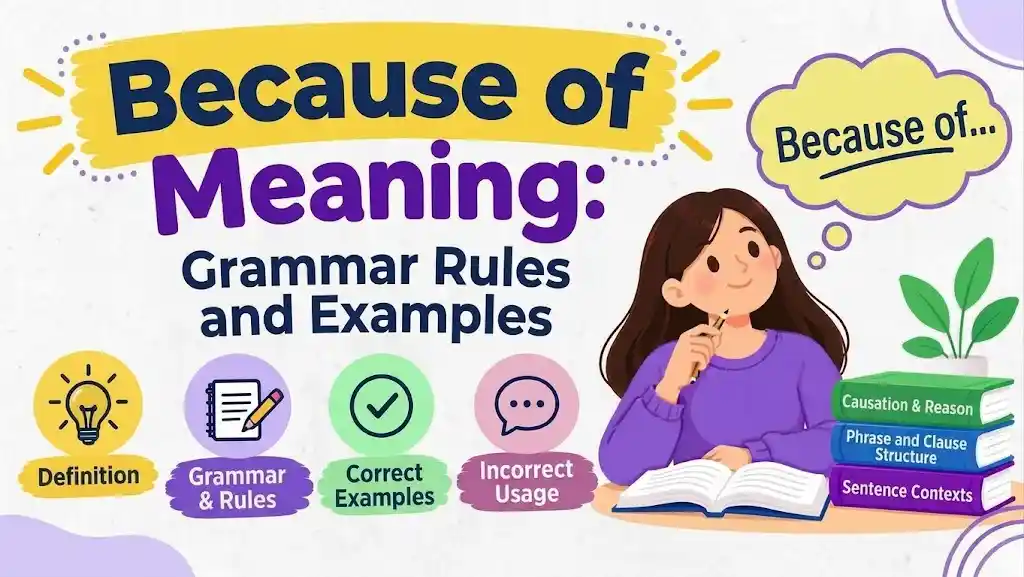
If you’re learning English grammar, because of meaning is important because it explains the reason something happens. The phrase tells readers about a cause, while keeping the reason in a noun-based form.
In this guide, you’ll learn how to use because of correctly with nouns, pronouns, and gerunds. You’ll also see how it differs from because, due to, and other expressions of cause.
Quick Answer
Because of means “as a result of” or “for the reason of.” Use it before a noun, pronoun, or noun phrase, as in “The game was canceled because of the rain.”
TL;DR
- Because of shows a cause or reason.
- It normally comes before a noun phrase.
- Because introduces a clause.
- Because of rain is correct.
- Because it rained is also correct.
- Both forms can express the same cause.
What Does Because of Mean?
Because of explains the reason behind an action, event, condition, or result. It answers the question “Why?”
For example, “The flight was delayed because of snow” tells us that snow caused the delay. The phrase can often be understood as “as a result of.”
- We stayed home because of the storm.
- She was late because of traffic.
- The meeting changed because of a scheduling problem.
- The store closed because of a power outage.
- He smiled because of the good news.
- The match stopped because of heavy rain.
- They moved because of a new job.
- I changed my plans because of the weather.
Is Because of a Preposition?
Yes. Because of functions as a two-word preposition. It introduces a noun phrase that gives the reason for something.
The key point is its structure. Unlike because, it does not normally introduce a regular clause containing its own subject and finite verb.
- because of the rain — noun phrase
- because of heavy traffic — noun phrase
- because of her — pronoun
- because of my mistake — noun phrase
- because of the unexpected delay — expanded noun phrase
- because of his decision — possessive noun phrase
- because she was late — clause, so use because
- because it rained — clause, so use because
What Comes After Because of?
A noun, pronoun, or noun phrase normally follows because of. The noun phrase can be very short or contain several modifiers.
Try looking immediately after because of when checking your sentence. If you see a normal subject followed by a finite verb, you probably need because instead.
- because of rain
- because of the rain
- because of heavy traffic
- because of the traffic jam
- because of my schedule
- because of her decision
- because of them
- because of the unexpected change
Because vs Because of
The biggest difference is grammar structure, not basic meaning. Because introduces a clause, while because of introduces a noun-based phrase.
| Structure | Example |
|---|---|
| because + subject + verb | We stayed home because it rained. |
| because of + noun phrase | We stayed home because of the rain. |
| because + subject + verb | She left because she was tired. |
| because of + noun phrase | She left because of her tiredness. |
A useful test is:
Subject + verb? Use because.
Noun phrase? Use because of.
How to Change Because Into Because of
You can often express the same cause in two different structures. The trick is to change the clause into a noun phrase.
This is useful when editing sentences or varying your writing.
- Because the roads were icy, school closed.
- Because of the icy roads, school closed.
- She stayed home because she felt sick.
- She stayed home because of her illness.
- We arrived late because traffic was heavy.
- We arrived late because of heavy traffic.
- The game stopped because it was raining.
- The game stopped because of the rain.
- They canceled the trip because the weather was dangerous.
- They canceled the trip because of dangerous weather.
Because of in a Sentence
Because of can appear at the beginning or end of a sentence. Its basic meaning stays the same.
An introductory phrase usually takes a comma before the main clause. Purdue OWL gives similar guidance for introductory because-of phrases.
- Because of the storm, the flight was delayed.
- Because of traffic, I missed the appointment.
- Because of a power outage, the store closed.
- The flight was delayed because of the storm.
- I missed the appointment because of traffic.
- The store closed because of a power outage.
- Because of a scheduling conflict, we moved the meeting.
- We moved the meeting because of a scheduling conflict.
Because of With Nouns
Nouns are the most common words after because of. You can use a single noun or a longer noun phrase.
Modifiers do not change the basic pattern. The entire noun phrase identifies the reason.
- because of rain
- because of the rain
- because of heavy rain
- because of the heavy rain
- because of my schedule
- because of her mistake
- because of a technical problem
- because of the unexpected delay
Because of With Pronouns
Because of can also come before a pronoun. In this position, use an object pronoun.
For example, because of her is standard, while because of she is not.
- because of me
- because of you
- because of him
- because of her
- because of us
- because of them
- The delay happened because of him.
- We changed our plans because of them.
Can Because of Be Followed by a Verb?
A normal finite clause should not directly follow because of. If the reason contains its own subject and finite verb, because is normally the better structure.
Compare these pairs:
- ❌ We stayed home because of it was raining.
- ✓ We stayed home because it was raining.
- ✓ We stayed home because of the rain.
- ❌ She left because of she felt sick.
- ✓ She left because she felt sick.
- ✓ She left because of her illness.
- ❌ They were late because of they missed the bus.
- ✓ They were late because they missed the bus.
Can Because of Be Used With a Gerund?
Yes. A gerund is an -ing form that functions like a noun, and a preposition can introduce a gerund phrase.
However, grammatical does not always mean most natural. Depending on the sentence, a noun or full clause may sound smoother.
- He was tired because of working late.
- She improved because of practicing every day.
- They succeeded because of working together.
- He was tired because of his late-night work.
- She improved because she practiced every day.
- They succeeded because they worked together.
The key is not to treat every -ing word as a verb clause. Its grammatical role matters.
When Should Because of Start a Sentence?
Starting with because of places the cause before the main event. This can be useful when the reason gives important background information.
Use a comma after the introductory phrase in standard sentence punctuation.
- Because of the storm, the airport closed early.
- Because of heavy traffic, I arrived late.
- Because of the power outage, the store closed.
- Because of the schedule change, the meeting moved online.
- Because of the cold weather, the game was postponed.
- Because of the road closure, drivers used another route.
- Because of her careful planning, the project finished early.
- Because of the sudden change, everyone needed new instructions.
When Should Because of End a Sentence?
Ending with because of puts the main event first. The cause then appears as a short explanation.
This structure is especially natural in everyday English because the reader receives the main information first.
- The game was canceled because of rain.
- We stayed home because of the storm.
- She was late because of traffic.
- The flight changed because of weather.
- They moved the meeting because of a conflict.
- I missed the call because of a weak signal.
- The store closed because of a power failure.
- He changed his plan because of new information.
Because of vs Due to
Because of and due to can both express cause. Modern English often uses them in overlapping ways, although traditional formal grammar distinguishes their functions.
The traditional distinction treats due to as an adjective phrase linked to a noun. Because of works naturally as a prepositional phrase explaining why an action or situation occurred. Modern style guidance recognizes that usage has become less rigid.
- The cancellation was due to heavy rain.
- The trip was canceled because of heavy rain.
- The delay was due to traffic.
- The flight was delayed because of traffic.
- Because of the storm, the flight was delayed.
- The delay was due to the storm.
For clear everyday writing, because of is often the most direct choice when you are explaining an action.
Because of vs Other Cause Expressions
English has several expressions for showing cause. They overlap in meaning, but their tone and emphasis can differ.
Because of is direct and common. Owing to and on account of can sound more formal, while as a result of places more emphasis on the resulting effect.
- because of the rain — direct and common
- owing to the rain — more formal
- on account of the rain — formal
- as a result of the rain — emphasizes the result
- because of a mistake — direct explanation
- as a result of a mistake — emphasizes the consequence
- because of her decision — everyday usage
- on account of her decision — more formal
Common Because of Mistakes
The most common error is using because of before a complete clause. Learners often recognize the meaning but miss the structural difference.
Check the words immediately after the phrase before deciding which form to use.
- ❌ Because of she was sick, she stayed home.
- ✓ Because she was sick, she stayed home.
- ❌ I was late because the traffic.
- ✓ I was late because of the traffic.
- ❌ Because of he missed the bus, he was late.
- ✓ Because he missed the bus, he was late.
- ❌ The game stopped because of it was raining.
- ✓ The game stopped because it was raining.
- ❌ She stayed home because of she felt tired.
- ✓ She stayed home because she felt tired.
- ❌ Because of him was late, we started without him.
- ✓ Because he was late, we started without him.
- ❌ Because the storm, the flight was delayed.
- ✓ Because of the storm, the flight was delayed.
Quick Practice With Because of
Choose the correct structure, then check your answers.
- We stayed inside because / because of the rain.
- We stayed inside because / because of it was raining.
- Because of / Because she was tired, she left early.
- Because / Because of the traffic, we arrived late.
- The match stopped because / because of the storm.
- She smiled because / because of she received good news.
- They were late because / because of they missed the bus.
- Because of / Because the weather, the event was postponed.
Answers
- because of
- because
- Because
- Because of
- because of
- because
- because
- Because of
The pattern is consistent: because + clause and because of + noun phrase.
FAQs
What does “because of” mean?
Because of means as a result of or for the reason of. It identifies the cause or reason behind an action, event, or situation.
Is “because of” a preposition?
Yes. Because of functions as a two-word preposition and normally introduces a noun phrase.
What is the difference between because and because of?
Because normally introduces a clause with a subject and verb. Because of normally introduces a noun, pronoun, or noun phrase.
Can because of come before an -ing word?
Yes, when the -ing form functions as a noun or part of a gerund phrase. For example, “because of working late” is possible, although another construction may sound more natural.
Can because of start a sentence?
Yes. “Because of the storm, the flight was delayed” is standard. An introductory because-of phrase normally takes a comma before the main clause.
Is because of the same as due to?
They can express the same general cause, and modern usage often overlaps. Traditional formal usage distinguishes them in some constructions, so clarity and sentence structure should guide your choice.
Can because of be used with a person?
Yes. Use a noun or object pronoun, such as because of Maria, because of him, or because of them.
Conclusion
Because of meaning is straightforward once you focus on sentence structure. Use because of to introduce a noun phrase that gives the cause, while because normally introduces a complete clause.
When you’re unsure, use the quick test: subject + verb means because; noun phrase means because of. Practice changing one structure into the other, and the difference will become much easier to recognize.