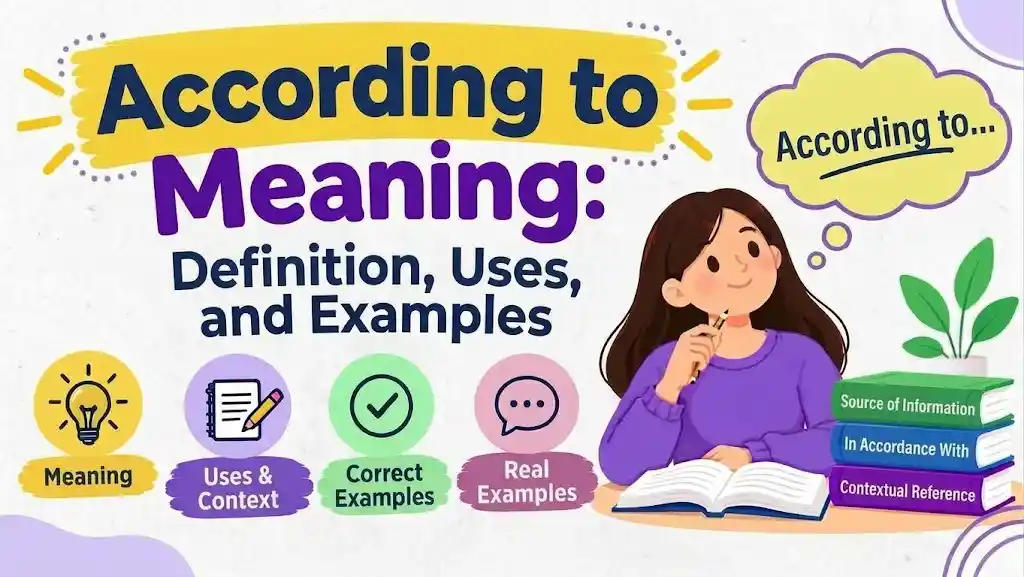
According to meaning as stated, reported, or explained by someone or something. It can also mean following a rule, plan, system, or standard, or changing in relation to a particular factor.
This guide explains the according to meaning, grammar, sentence patterns, common mistakes, and everyday uses. You’ll also learn the difference between according to, based on, in my opinion, in accordance with, and per.
Quick Answer
According to means “as stated by” a person or source, or “following” a rule, plan, or standard. It can also show that something changes in relation to another factor.
TL;DR
• According to often identifies the source of information.
• It can show that something follows a rule or plan.
• It can describe changes related to another factor.
• According to me is possible but usually sounds unnatural.
• Use I think for a normal personal opinion.
• Based on emphasizes evidence rather than its source.
What Does “According To” Mean?
The phrase according to has several closely related uses. The most common one identifies the person, document, report, or source behind information.
It can also show conformity with a rule, instruction, plan, or standard. In another common use, it describes something that changes or is arranged in relation to another factor.
| Use | Meaning | Example |
|---|---|---|
| Source | As stated by a source | According to the report, sales increased. |
| Rule or standard | Following something | Act according to the rules. |
| Relationship | In relation to a factor | Prices vary according to demand. |
A useful way to remember the phrase is to ask:
Who said it? What rule controls it? What factor affects it?
How Is “According To” Used in English?
According to is commonly followed by a noun or noun phrase that identifies the source, rule, plan, or factor. The complete phrase then works as part of the sentence.
The phrase can appear at the beginning or end of a sentence. When it introduces a sentence, a comma commonly follows the introductory phrase.
• According to Maria, the meeting starts at noon.
• The meeting starts at noon, according to Maria.
• According to the report, sales increased.
• Sales increased, according to the report.
• According to the rules, players must wear uniforms.
• Prices change according to demand.
• The files are arranged according to date.
• Everything happened according to plan.
“According To” for Sources and Information
The most familiar use of according to is source attribution. It tells readers that the information comes from another person, organization, document, report, or record.
This wording is especially useful when you want to separate someone else’s statement from your own claim. It does not, by itself, prove that the source is accurate.
• According to the teacher, the test begins at nine.
• According to the company, the update is now available.
• According to the report, production increased.
• According to the records, the payment was received.
• According to the study, the results changed over time.
• According to the map, the road continues east.
• According to the author, the character leaves later.
• According to the news report, the store will reopen.
What “According To” Tells the Reader
The phrase tells readers where the statement comes from, not necessarily whether they should accept it as fact.
Compare these sentences:
The store will reopen Friday.
This presents the statement directly.
According to the company, the store will reopen Friday.
This tells readers that the company is the source of the statement.
That small change can make writing more precise because it distinguishes reported information from the writer’s own assertion.
“According To” for Rules, Standards, and Instructions
You can use according to when an action follows a rule, instruction, policy, method, or standard. In this sense, the phrase is close to in accordance with or following.
This construction is common in workplace documents, school instructions, policies, manuals, and everyday directions.
• Employees must act according to company policy.
• Follow the steps according to the instructions.
• The game was played according to the official rules.
• Students were grouped according to their reading levels.
• The files were organized according to date.
• The procedure was completed according to the approved plan.
• The books are arranged according to subject.
• The form must be completed according to the directions.
According To Plan
According to plan is a common expression meaning that something happened as expected or intended.
Everything went according to plan.
It does not mean that a person or source gave information. Here, plan is the standard or intended arrangement being followed.
Other familiar expressions include:
• according to the rules
• according to the law
• according to the instructions
• according to policy
• according to schedule
• according to the agreement
• according to the plan
• according to the guidelines
“According To” for Changes and Relationships
A less obvious use of according to describes something that changes, varies, or is arranged in relation to another factor.
This meaning appears in sentences about prices, schedules, classifications, measurements, income, demand, ability, and other variables.
• Prices vary according to demand.
• Fees may change according to income.
• The groups were created according to ability.
• The schedule changes according to availability.
• Pay may differ according to experience.
• The amount depends on the number of participants.
• Products are sorted according to size.
• The response may vary according to the situation.
Here, according to is not identifying a person who said something. It describes a relationship between one thing and another.
Is “According To” a Preposition?
According to is commonly classified by dictionaries as a preposition. It usually introduces a noun phrase, such as according to the report or according to the rules.
In grammar analysis, the complete expression can function as a prepositional phrase within a larger sentence. The important point for learners is how the phrase behaves in real sentences.
• according to the teacher
• according to the report
• according to our records
• according to the rules
• according to the schedule
• according to demand
• according to the instructions
• according to company policy
A common mistake is leaving out to.
❌ According the report, sales increased.
✅ According to the report, sales increased.
According To Me: Is It Correct?
According to me can occur in English, but it is usually not the natural choice for expressing an ordinary personal opinion.
When you want to clearly state your own view, American English commonly uses I think, in my opinion, I believe, or in my view.
• Less natural: According to me, this answer is better.
• Natural: In my opinion, this answer is better.
• Natural: I think this answer is better.
• Natural: I believe this answer is better.
• Natural source use: According to my teacher, this answer is better.
• Natural source use: According to the guide, this answer is better.
The key distinction is simple: according to normally points toward another source, while in my opinion points toward your own judgment.
According To vs. In My Opinion
These phrases can appear in similar sentences, but they identify different sources of information.
According to attributes information to someone or something else. In my opinion explicitly presents the speaker’s or writer’s personal judgment.
• According to the survey, most readers prefer shorter articles.
• In my opinion, shorter articles are easier to read.
• According to the teacher, the answer is correct.
• In my opinion, the explanation needs more detail.
• According to the rules, phones are not allowed.
• In my opinion, that rule is reasonable.
• According to the data, demand increased.
• In my opinion, the new design looks better.
Quick Test
Ask yourself:
Am I reporting another source?
Use according to.
Am I giving my personal view?
Use I think or in my opinion.
According To vs. Based On
According to and based on sometimes appear in similar sentences, but they emphasize different relationships.
According to usually identifies the source of information. Based on emphasizes the evidence, information, or foundation used to reach a conclusion.
Compare:
According to the report, sales increased.
The report is being identified as the source.
Based on the report, we changed the forecast.
The report provided the basis for the decision.
More examples:
• According to the evidence, the timeline changed.
• Based on the evidence, investigators revised the explanation.
• According to the map, the road turns left.
• Based on the map, we chose the shorter route.
• According to the data, demand is rising.
• Based on the data, the company changed its plan.
The two expressions can overlap, but replacing one with the other can change the focus.
According To vs. In Accordance With
Both phrases can refer to rules or standards, but their emphasis differs.
According to can tell you what a rule, policy, or document says. In accordance with more strongly emphasizes that an action conforms to a rule or requirement.
• According to the policy, employees need approval.
• The procedure was completed in accordance with the policy.
• According to the instructions, the form requires two signatures.
• The form was completed in accordance with the instructions.
For ordinary conversation, according to is often more natural. In accordance with has a more formal tone.
According To vs. Per
Per can sometimes replace according to, especially in business or professional writing.
However, per is more compressed and can sound more formal, bureaucratic, or workplace-specific. It also has other meanings, so it is not always interchangeable with according to.
• According to the contract, payment is due Friday.
• Per the contract, payment is due Friday.
• According to the instructions, submit one form.
• Per the instructions, submit one form.
For general readers, according to is usually clearer.
Common Mistakes With “According To”
The phrase itself is easy to form, but learners often use the wrong preposition or choose it when another expression is more natural.
Check the examples below before using the phrase in your own writing.
• ❌ According the report, sales increased.
• ✅ According to the report, sales increased.
• ❌ According with the rules, phones are prohibited.
• ✅ According to the rules, phones are prohibited.
• ❌ According on the data, demand increased.
• ✅ According to the data, demand increased.
• ⚠️ According to me, this is the best option.
• ✅ In my opinion, this is the best option.
• ❌ According to the report says, sales increased.
• ✅ According to the report, sales increased.
• ❌ According to that prices change, demand increased.
• ✅ Prices change according to demand.
The most common structural mistake is adding another reporting verb after according to.
Is “According To” Formal or Informal?
According to works in both formal and informal English. You can use it in conversations, emails, school assignments, reports, news writing, and professional documents.
The surrounding vocabulary usually determines how formal the sentence sounds.
• Casual: According to Sam, we’re meeting at three.
• School: According to the article, the results changed.
• Workplace: According to company policy, approval is required.
• Professional: According to our records, the payment was received.
• Informational: According to the published report, demand increased.
There is no general rule that limits according to to formal writing.
How to Pronounce “According To” in American English
In American English, according to is commonly pronounced approximately /əˈkɔrdɪŋ tə/.
The final to is often reduced in natural speech, so it can sound closer to “tuh” than a strongly pronounced “too.”
• according to the teacher
• according to the report
• according to the rules
• according to the data
Focus the main stress on -cord- in according. Listening to the phrase in complete sentences can help you recognize its natural rhythm.
Alternatives to “According To”
There is no single perfect synonym for according to. The best alternative depends on whether you are reporting a source, referring to evidence, expressing an opinion, or describing compliance with a rule.
• as stated by — emphasizes a person’s or source’s statement
• as reported by — emphasizes reported information
• as noted by — highlights an observation
• in the opinion of — introduces another person’s opinion
• based on — emphasizes evidence or a foundation
• in accordance with — emphasizes conformity with a rule
• following — emphasizes adherence to instructions or rules
• per — provides a concise professional alternative in some contexts
Don’t replace according to automatically. First decide what relationship the sentence needs to express.
A Simple Way to Remember “According To”
Think of according to as a signpost. It points the reader toward the source, rule, plan, or factor connected to the statement.
This gives you a quick way to choose the phrase when writing or speaking.
• Source: According to the teacher…
• Report: According to the study…
• Rule: According to the policy…
• Instruction: According to the manual…
• Plan: Everything went according to plan.
• Factor: Prices change according to demand.
• Personal opinion: In my opinion…
• Evidence: Based on the evidence…
FAQs
What does “according to” mean?
According to usually means as stated or reported by someone or something. It can also mean following a rule, plan, or standard, or changing in relation to another factor.
What comes after “according to”?
According to is commonly followed by a noun or noun phrase, such as according to the report, according to Maria, or according to the rules.
Does “according to” mean something is true?
No. The phrase identifies the source or basis of a statement. It does not automatically confirm that the information is accurate.
Can I say “according to me”?
You can use according to me, but it is usually less natural for a personal opinion. I think or in my opinion is normally clearer.
Is “according to” a preposition?
Yes. Major English dictionaries classify according to as a preposition, while the complete expression can function as a prepositional phrase.
What is the difference between “according to” and “based on”?
According to usually identifies a source, while based on highlights evidence or information used as a foundation for a conclusion. They overlap in some contexts but are not identical.
Can “according to” describe a changing relationship?
Yes. For example, “Prices vary according to demand” means that prices change in relation to demand.
Conclusion
Understanding according to meaning becomes much easier when you identify what the phrase points to. It can introduce a source, show conformity with a rule or plan, or describe a relationship with a factor.
Use according to when you need to point readers toward information, standards, or conditions. For your own opinion, use I think or in my opinion, then practice by writing three different sentences with the phrase.