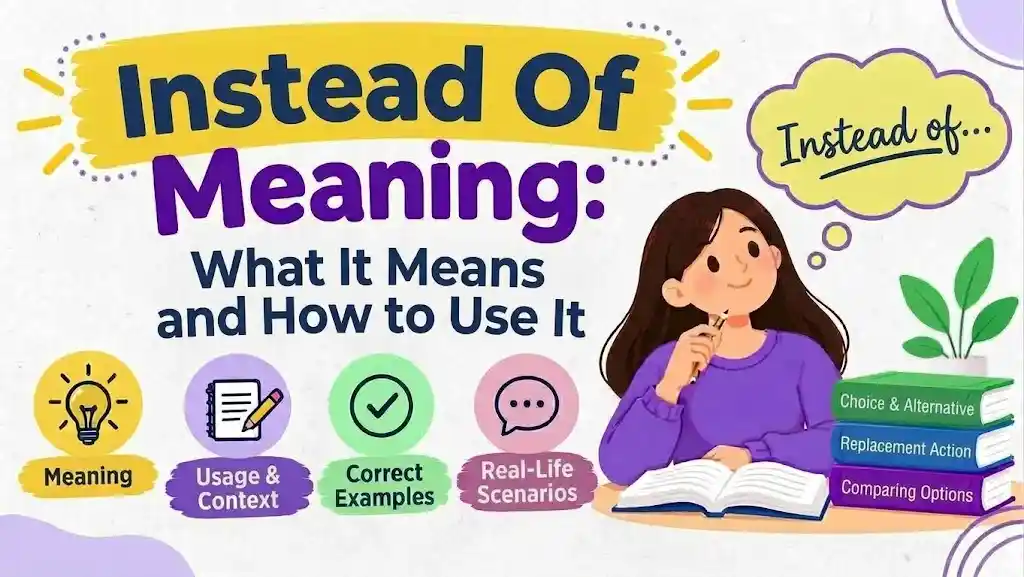
“Instead of meaning” is a common English phrase used to show that one person, thing, or action is chosen as a replacement for another. It often means “in place of” or “rather than.” In this guide, you’ll learn what “instead of” means, how to use it correctly, and see simple examples in everyday sentences.
Quick Answer
Instead of means “in place of” or “rather than.” It shows that one person, thing, or action is chosen as an alternative to another.
For example, “I walked instead of driving” means walking was chosen rather than driving.
TL;DR
- Instead of means “in place of” or “rather than.”
- Use it before a noun, pronoun, or -ing form.
- Say instead of driving, not usually “instead of drive.”
- Instead can stand alone without naming the alternative.
- Rather than often expresses a similar alternative.
- In place of can replace instead of in many sentences.
What Does Instead Of Mean?
The phrase instead of means “in place of” or “rather than.” It tells readers that one choice replaces another.
For example, “We had tea instead of coffee” means tea was chosen and coffee was not. The phrase can describe people, objects, activities, places, and other alternatives.
You will see instead of in everyday conversation, school assignments, workplace writing, and American English. Its basic meaning stays the same across these settings.
How Do You Use Instead Of?
Use instead of when you want to show a replacement or alternative. The thing after of identifies what was replaced.
The basic learner-friendly pattern is:
instead of + noun / pronoun / -ing form
Examples:
- I chose tea instead of coffee.
- She went instead of me.
- We walked instead of driving.
- They studied instead of watching TV.
The phrase can appear before or after the main part of a sentence.
- Instead of driving, we took the train.
- We took the train instead of driving.
What Can Come After Instead Of?
The most common structures use a noun, pronoun, or -ing verb after instead of.
The form depends on what you are replacing. A thing usually takes a noun, a person can take an object pronoun, and an activity normally takes an -ing form.
| Structure | Example |
|---|---|
| Instead of + noun | We chose tea instead of coffee. |
| Instead of + pronoun | She went instead of him. |
| Instead of + -ing | I walked instead of driving. |
| Instead of + noun phrase | We used a bus instead of a rental car. |
This pattern gives learners a reliable starting point for everyday English.
Instead Of + Noun
Use instead of + noun when one thing replaces another. This is one of the easiest ways to use the phrase.
The noun can be short or part of a longer noun phrase.
- We ordered pizza instead of burgers.
- She bought a notebook instead of a tablet.
- I drank water instead of soda.
- They chose the stairs instead of the elevator.
- We used a video call instead of an in-person meeting.
Notice that the two alternatives are usually easy to identify. One is selected, while the other is rejected or left unused.
Instead Of + Pronoun
Use an object pronoun after the preposition of when a person is being replaced.
Common object pronouns include me, you, him, her, us, and them.
- You can go instead of me.
- Sarah attended instead of him.
- They invited us instead of them.
- I spoke instead of her.
A common learner mistake is using a subject pronoun after of.
- ❌ She went instead of I.
- ✓ She went instead of me.
The pronoun me is the natural object form after the preposition.
Instead Of + -Ing
When instead of introduces an activity, the -ing form is the normal choice.
This structure is extremely common because English often uses a gerund after a preposition.
- I walked instead of driving.
- She read instead of watching TV.
- He called instead of texting.
- We cooked instead of ordering takeout.
- They studied instead of playing games.
Think of the structure as:
action A instead of action B-ing
For example:
I walked instead of driving.
Walking happened. Driving did not.
Can You Use Instead Of With a To-Infinitive?
For clear standard English, learners should normally avoid putting a bare infinitive directly after instead of.
The safest pattern is instead of + -ing:
- ✓ I walked instead of driving.
- ✓ She studied instead of watching TV.
- ✓ We cooked instead of ordering food.
However, English usage contains some informal constructions that do not fit this simple learner rule. American Heritage records variation involving instead of + bare verb, especially when the surrounding structure creates a parallel comparison.
Because these cases can be confusing, use the clearer form in formal or careful writing.
Instead vs. Instead Of
The difference between instead and instead of is mainly grammatical.
Instead is an adverb. It can stand alone when the alternative is already clear.
Instead of normally introduces the alternative being replaced.
Compare:
- I didn’t drive. I walked instead.
- I walked instead of driving.
In the first sentence, the reader already knows the alternative. In the second, instead of introduces it.
You can also begin a sentence with Instead:
I planned to drive. Instead, I took the train.
The comma helps separate the introductory adverb from the main clause.
Instead Of vs. Rather Than
Instead of and rather than often express similar choices. However, they do not always behave exactly the same way grammatically.
Compare:
- I walked instead of driving.
- I walked rather than drive.
Both can communicate a similar choice.
Rather than can be more flexible when connecting parallel verbs, nouns, or other structures. Instead of commonly takes a noun phrase or -ing form. American Heritage also notes that the two constructions overlap in many ordinary uses.
A useful rule for learners is:
Use instead of + -ing for a clear activity comparison.
Then use rather than when its structure fits the sentence more naturally.
Instead Of vs. In Place Of
In place of can often replace instead of without changing the basic meaning.
- We used honey instead of sugar.
- We used honey in place of sugar.
Both sentences describe substitution.
However, instead of is usually more natural in everyday American English. In place of may sound more formal or deliberate in some contexts.
Cambridge and Collins both define instead of in terms of being in the place of someone or something.
Common Mistakes With Instead Of
The most common errors involve leaving out of, using instead incorrectly, or choosing the wrong verb form.
Missing “of”
- ❌ We drank tea instead coffee.
- ✓ We drank tea instead of coffee.
Using a bare verb after “instead of”
- ❌ She walked instead of drive.
- ✓ She walked instead of driving.
Forgetting the -ing form
- ❌ He studied instead of watch TV.
- ✓ He studied instead of watching TV.
Using a subject pronoun
- ❌ She went instead of I.
- ✓ She went instead of me.
Using “instead” by itself incorrectly
- ❌ I went instead driving.
- ✓ I went instead of driving.
Confusing “instead” with “instead of”
- ✓ I didn’t drive. I walked instead.
- ✓ I walked instead of driving.
The key is to decide whether you are naming the alternative. If you are, instead of is usually the form you need.
Can You Start a Sentence With Instead Of?
Yes. Starting with instead of is completely natural.
When the phrase introduces the sentence, a comma usually separates it from the main clause.
- Instead of driving, we took the train.
- Instead of buying lunch, I packed a sandwich.
- Instead of complaining, she looked for a solution.
- Instead of staying home, they visited the museum.
This structure is especially useful when you want to emphasize what someone did not choose.
Instead Of in Questions and Negative Sentences
You can use instead of in questions, statements, and negative sentences.
Questions often ask why someone selected one option over another:
- Did you walk instead of driving?
- Why did she call instead of texting?
- Did they cook instead of ordering food?
Negative sentences can also contain the phrase:
- I didn’t choose coffee instead of tea.
- She didn’t stay home instead of going out.
The surrounding sentence determines the exact meaning, so read the whole sentence rather than treating instead of as a fixed replacement word.
Instead Of in Formal and Informal English
Instead of is acceptable in both formal and informal English. You do not need to replace it simply because you’re writing professionally or academically.
For example:
Everyday:
We walked instead of taking the bus.
Workplace:
The team used email instead of printed notices.
Academic:
The researchers examined direct responses instead of relying solely on indirect measures.
More formal alternatives such as rather than or in place of can work