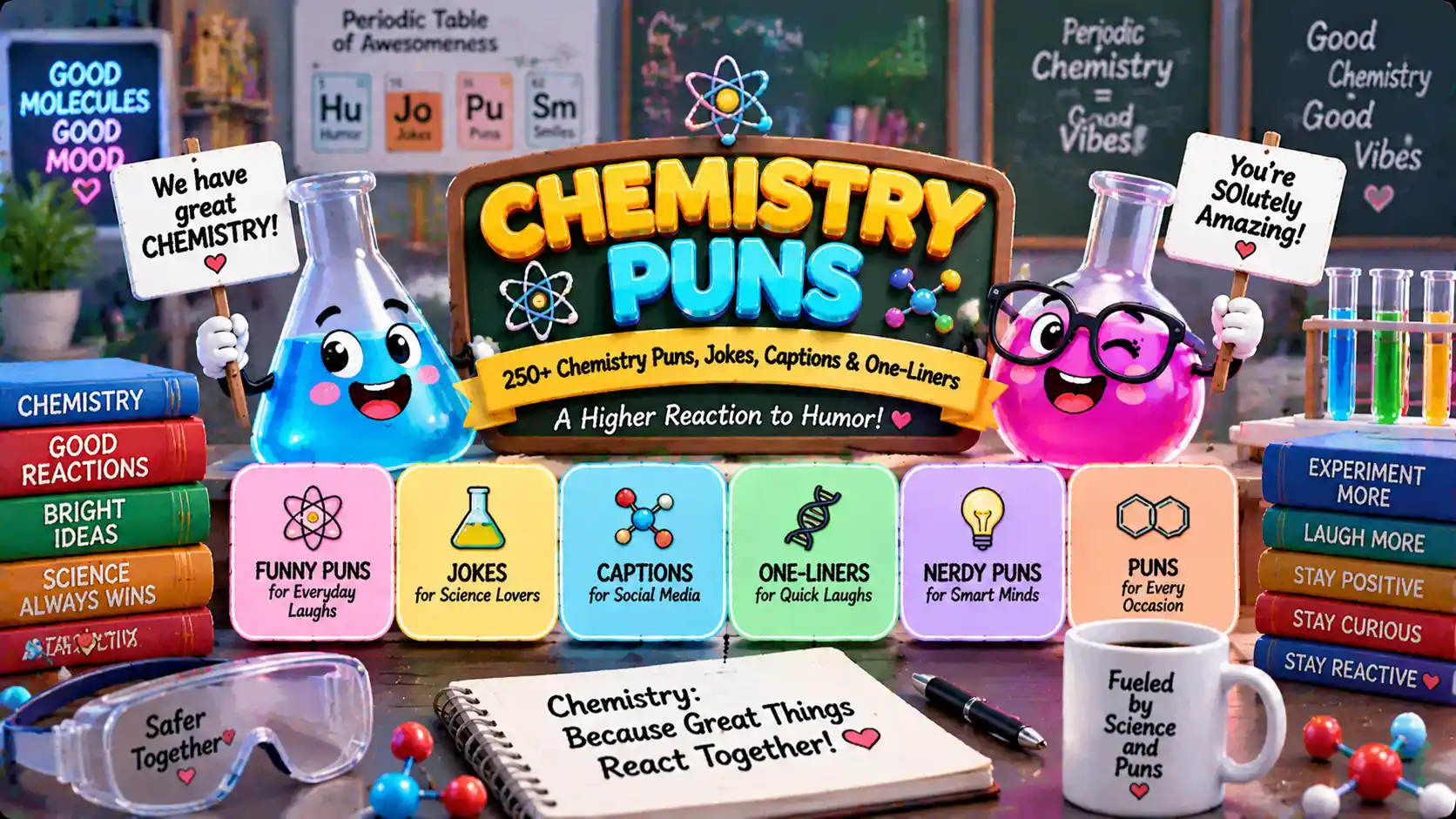
Chemistry can be serious business, but the language of atoms, bonds, reactions, and molecules is packed with opportunities for wordplay. Whether you need a joke for chemistry class, a caption for a lab photo, or a clever message for a science-loving friend, the right pun can make the subject much more memorable.
This collection brings together funny chemistry puns, clever one-liners, element jokes, lab humor, classroom jokes, organic chemistry puns, birthday messages, romantic lines, and clean jokes for kids. The goal is simple: give you lines you can actually use without forcing the science into awkward punchlines.
Quick Answer
Chemistry puns are jokes that play with chemical terms such as elements, reactions, bonds, molecules, acids, bases, atoms, and laboratory equipment. They work especially well for students, teachers, science fans, social captions, cards, and classroom activities.
The best chemistry puns combine a recognizable scientific idea with an everyday phrase, creating a punchline that works even before you open the textbook.
TL;DR
- Use element puns for quick science humor.
- Choose lab jokes for experiment photos.
- Try short lines for Instagram captions.
- Use clean jokes with younger students.
- Pick clever wordplay for science fans.
- Match birthday and holiday puns to the occasion.
Funny Chemistry Puns
Good chemistry humor does more than mention a random element. The strongest lines use a real chemistry idea and give it an everyday twist.
These jokes mix reactions, bonding, solutions, energy, and atoms with familiar situations. They are clean enough for classrooms but still work in group chats and casual conversations.
- My chemistry joke finally got a reaction, so I guess the experiment worked.
- I wanted a simple answer, but chemistry gave me several solutions.
- My friendship group has excellent chemistry, especially around snack time.
- I tried to avoid drama, but the situation became highly reactive.
- We didn’t become friends instantly; we needed the right reaction conditions.
- My chemistry notebook has plenty of ideas, but they are still developing.
- Some friendships are temporary mixtures; the best ones form strong bonds.
- I asked my lab partner for help, and they delivered a positive response.
- My science project had potential until the deadline caused a major reaction.
- I like chemistry because every problem eventually asks for a solution.
- My schedule is unstable, but at least my compounds are well organized.
- Chemistry class taught me that even small changes can produce a big reaction.
- I don’t overreact; I simply have excellent chemical sensitivity.
- My study group has enough chemistry to keep every conversation interesting.
- I brought my best chemistry joke to class, but it needed more substance.
Chemistry One-Liners
Chemistry one-liners are useful when you want something fast. They fit texts, classroom boards, science-club meetings, captions, and quick conversations.
A good one-liner should need almost no explanation. The scientific reference should be familiar enough for the punchline to land quickly.
- I’m having a positive-ion day.
- My plans reached equilibrium with absolutely no progress.
- I prefer stable compounds and reliable people.
- My patience just crossed its activation energy.
- Keep calm and let the reaction happen.
- I need a catalyst for my productivity.
- My mood is currently chemically balanced.
- Some conversations need more energy to get started.
- I’m not moody; I’m experiencing a phase change.
- Chemistry keeps me grounded, one molecule at a time.
- My homework has excellent potential but terrible reaction speed.
- I have a strong bond with science.
- My favorite answer is always a good solution.
- Today I’m operating at full lab energy.
- My schedule could use a little chemical equilibrium.
Periodic Table & Element Puns
The periodic table gives chemistry humor an enormous vocabulary. Element names, symbols, properties, and familiar sounds can all become clever setups.
The trick is not to force an element into every joke. A stronger line uses the element because its name or symbol genuinely improves the punchline.
- Gold always arrives confidently: it knows how to say “Au-some.”
- Sodium keeps conversations short: “Na, I’m good.”
- Neon makes every party brighter without even trying.
- Carbon has plenty of friends because it forms so many bonds.
- Helium never gets dragged into arguments; it simply rises above them.
- Iron has a strong personality and an even stronger Fe-ling.
- Copper is great at communication because it really knows how to conduct itself.
- Potassium keeps things moving with a cheerful little K.
- Argon avoids awkward conversations by remaining pleasantly inert.
- Oxygen is a supportive friend because everyone needs some air.
- Silver always brings a polished attitude to the table.
- Hydrogen likes keeping things light.
- Chlorine has a sharp sense of humor.
- Calcium makes a strong case for supporting the whole structure.
- Nitrogen stays cool because it makes up so much of the air around us.
Chemistry Captions for Instagram and TikTok
A science caption should complement the picture rather than compete with it. Short chemistry captions work particularly well with lab coats, experiments, graduation photos, science projects, and classroom snapshots.
For Instagram or TikTok, choose a line that makes sense on its own. Avoid stuffing a caption with technical terms just because they sound scientific.
- Just here for the good reactions.
- Found my element.
- Strong bonds, better memories.
- Currently feeling highly reactive.
- Lab coat, clear goals, questionable handwriting.
- Chemistry looks better with confidence.
- Making memories and molecules.
- Today’s experiment has serious potential.
- Keeping things scientifically interesting.
- My kind of social reaction.
- Science first, caption second.
- A little chemistry never hurts.
- Powered by curiosity and caffeine.
- One experiment closer to understanding the reaction.
- This moment has excellent chemical potential.
Short Chemistry Puns
Sometimes the best joke is only a few words long. Short chemistry puns work on sticky notes, notebooks, science posters, texts, cards, and quick captions.
Because these lines are so brief, each word needs to earn its place. These examples focus on compact chemistry references rather than generic science phrases.
- Bond happens.
- Stay reactive.
- Keep it elemental.
- Feeling ionic.
- Purely molecular.
- Reaction approved.
- Positive vibes only.
- Stable enough.
- Molecule mood.
- Lab life.
- Science in motion.
- Element of surprise.
- Fully charged.
- Solution found.
- Chemically connected.
Clever Chemistry Puns
Clever chemistry jokes are more satisfying when the punchline depends on an actual concept. Equilibrium, activation energy, solvents, bonds, and variables offer much better material than simply inserting the word “chemical.”
These lines are aimed at readers who enjoy science enough to appreciate the reference without needing a full chemistry lecture afterward.
- My argument couldn’t overcome the activation barrier.
- Our friendship reached equilibrium: nothing changed, but everything balanced.
- I wanted to settle the disagreement, but everyone was too reactive.
- The relationship had potential, but the conditions weren’t favorable.
- My study plan was balanced until several variables entered the equation.
- Some ideas dissolve quickly when placed in the right solvent.
- My deadline and I have reached an uncomfortable equilibrium.
- The best conversations need enough energy to overcome the awkward beginning.
- I asked for stability, and chemistry gave me dynamic equilibrium.
- My experiment wasn’t confused; it was simply dealing with multiple variables.
- Good chemistry requires the right conditions, not just the right ingredients.
- I tried to simplify the problem, but chemistry insisted on showing its work.
- The reaction wasn’t late; it was waiting for the correct conditions.
- My lab partner and I have excellent compatibility.
- The equation finally made sense after we balanced our expectations.
Cute Chemistry Puns
Cute chemistry puns are ideal for friends, classmates, science gifts, cards, and sweet captions. They use chemistry as a playful way to describe connection without becoming overly technical.
The most useful lines sound natural outside a laboratory. Think warm, simple, and easy to write in a card.
- You’re my favorite element of every good day.
- We make one adorable compound.
- Thanks for being a positive part of my life.
- Our friendship has some seriously strong bonds.
- You make my ordinary days react differently.
- You’re one of my favorite discoveries.
- Life is better with good chemistry.
- You bring the right energy to every experiment.
- Our connection has excellent bonding potential.
- Thanks for always being a stable part of the mixture.
- You make science feel a little sweeter.
- We clicked faster than atoms finding a bond.
- You’re the bright spot in my periodic table.
- Every good friendship needs a little chemistry.
- I’m glad our paths reacted in the right direction.
Chemistry Dad Jokes
Chemistry dad jokes are supposed to make people groan. That’s part of the fun.
These use classic setups, simple wordplay, and chemistry vocabulary. They’re great for parents, teachers, science clubs, family gatherings, and anyone who proudly tells terrible jokes.
- Why did the molecule get promoted? It had excellent bonding skills.
- Why did the chemist bring a ladder? The reaction needed more energy.
- Why did the atom bring luggage? It was ready for a change of state.
- Why did the beaker get invited back? It made a great impression.
- Why did the scientist smile at the equation? Everything finally balanced.
- Why did the flask feel confident? It could handle the pressure.
- Why did the chemist carry a pencil? To draw better reactions.
- Why did the molecule join the choir? It wanted better resonance.
- Why did the student bring a clock to chemistry? The reaction needed better timing.
- Why did the atom join the team? It wanted to contribute its charge.
- Why did the scientist organize the lab? Everything needed its proper place.
- Why did the chemistry book look tired? It had too many problems to solve.
- Why did the electron avoid the party? It didn’t want to lose its charge.
- Why did the chemist stay calm? They knew how to handle the reaction.
- Why did the beaker start smiling? Things were finally bubbling along.
Chemistry Puns for Students
Student chemistry humor should reflect real school life. Homework, exams, lab partners, equations, study groups, and deadlines give these jokes an immediate connection.
These are suitable for class group chats, notebooks, graduation posts, study sessions, and science-club activities. They stay clean while still acknowledging the struggle of learning chemistry.
- My chemistry homework has more steps than my morning routine.
- I studied the periodic table, but it still hasn’t memorized me.
- My lab partner and I formed a stable academic bond.
- The chemistry test changed my state of mind.
- My calculator understands the assignment better than I do.
- I balanced the equation and immediately felt unbalanced.
- My study plan needs a catalyst.
- I didn’t fail to react; I was waiting for the right conditions.
- Chemistry homework: where every answer has a reaction behind it.
- My notes contain more symbols than my password.
- I came for the grade and stayed for the molecules.
- My study group has excellent chemistry and questionable sleep schedules.
- The equation looked friendly until I had to balance it.
- My deadline has officially reached critical concentration.
- Graduation is the final product of many reactions.
Chemistry Puns for Teachers and Classrooms
Teachers can use chemistry jokes as lesson openers, board messages, science-club material, or quick transitions between activities.
The best classroom humor reinforces a concept students already recognize. A joke about pH, bonding, reactions, or equilibrium can be more memorable when it follows the related lesson.
- Welcome to chemistry, where every question deserves a reaction.
- Let’s form some strong academic bonds today.
- Keep your answers positive, like a proton.
- Today’s lesson has serious potential energy.
- Please keep your attitudes stable during the experiment.
- Your curiosity is the catalyst this classroom needs.
- If today’s topic feels basic, check the pH.
- Let’s separate the facts from the precipitate.
- Great questions produce the best classroom reactions.
- Today we’re mixing knowledge with a little enthusiasm.
- Don’t let one difficult problem change your entire state.
- A balanced equation is a beautiful thing.
- Chemistry class: where mistakes become data.
- Bring your curiosity; the molecules are already here.
- Let’s see what kind of reaction today’s lesson creates.
Clean Chemistry Puns for Kids
For younger readers, chemistry jokes should use simple concepts and familiar words. Atoms, molecules, bubbles, beakers, energy, and reactions are easier to understand than advanced terminology.
The best kids’ jokes can also encourage curiosity. A child doesn’t need to understand every scientific detail for the wordplay to start a conversation.
- Why did the atom smile? It found a positive friend.
- My beaker is bubbling with excitement.
- The molecule wanted to dance, so it found a partner.
- Science class is better when ideas start bubbling.
- My favorite element is the one that makes me smile.
- The atom was happy because it found its place.
- Our science team has a strong bond.
- The beaker had a bright idea.
- I’m having a positively great science day.
- Molecules make great dance partners because they know how to move.
- The lab coat said, “Let’s get experimental!”
- My science project has reached the fun stage.
- The little molecule wanted to make a connection.
- Chemistry makes my curiosity grow.
- This experiment has plenty of kid-sized potential.
Lab Chemistry Puns
Laboratory humor becomes much stronger when it uses real equipment and familiar lab situations. Beakers, flasks, test tubes, pipettes, goggles, samples, and notebooks all offer natural setups.
- My beaker and I have a clear understanding.
- The flask keeps its emotions bottled up.
- My test tube stays calm under pressure.
- The pipette has a very measured personality.
- My goggles make every experiment look official.
- The lab notebook contains several developing reactions.
- The beaker said the experiment was going smoothly.
- The test tube wanted more space, but it was already contained.
- Every lab needs someone with a good solution.
- The microscope and I are taking a closer look.
- My experiment started small and developed serious potential.
- The lab bench has heard some highly reactive conversations.
- My sample has a strong personality.
- The flask refuses to spill the details.
- My lab coat is dressed for the occasion.
Organic Chemistry Puns
Organic chemistry has its own vocabulary, which creates a different style of humor. Carbon chains, hydrocarbons, functional groups, isomers, and reaction mechanisms give science fans plenty of material.
These work particularly well for college students and chemistry majors because the references become funnier once the concepts are familiar.
- Carbon is the social butterfly of chemistry because it loves making connections.
- Organic chemistry has many branches, but carbon keeps them connected.
- My alkane is saturated with possibilities.
- I asked the carbon chain how it felt; it said it had plenty of bonds.
- Isomers are proof that molecules can have the same ingredients and different personalities.
- My organic chemistry notes have more structures than my social calendar.
- Carbon never struggles to make friends; it has four bonding options.
- I wanted a simple molecule, but organic chemistry added another functional group.
- My reaction mechanism has more twists than my weekend plans.
- Aromatic chemistry always knows how to make an impression.
- Organic chemistry is where carbon really gets connected.
- My hydrocarbons are keeping things strictly elemental.
- The carbon chain refused to settle down; it had too many possibilities.
- Organic chemistry taught me that structure changes everything.
- My molecule has a type: carbon-based and complicated.
Acid, Base, and pH Puns
Acids, bases, and pH are among the easiest chemistry concepts to turn into wordplay. Words such as neutral, basic, acidic, strong, weak, and balanced already have everyday meanings.
These jokes work particularly well in classrooms because the punchline can reinforce vocabulary students have recently learned.
- I tried to stay neutral, but everyone kept asking about my pH.
- My personality is basic, but my jokes are acidic.
- Strong acids have powerful personalities.
- I wanted a balanced conversation, so I brought the pH scale.
- My mood changes depending on the concentration.
- Don’t call me basic; I prefer chemically basic.
- Acidic personalities can really make a conversation react.
- I asked the solution to stay neutral, but it had other ideas.
- My pH is balanced, even when my schedule isn’t.
- This conversation needs less acid and more equilibrium.
- I like my jokes somewhere between clever and neutral.
- A good chemistry class knows when to stay balanced.
- My solution isn’t confused; it’s just checking its pH.
- Acids and bases may disagree, but they know how to react.
- Neutrality sounds peaceful until you meet a strong acid.
Chemistry Formula Puns
Chemical formulas turn tiny combinations of letters and numbers into useful wordplay. They are especially fun for students who already recognize common formulas such as H₂O, CO₂, NaCl, and NH₃.
Formula jokes work best when the notation adds something to the punchline. Don’t use symbols simply to make a line look scientific.
- H₂O is the original two-for-one deal.
- NaCl proves that opposites can make a pretty useful combination.
- CO₂ always brings two oxygen atoms to the conversation.
- H₂O and I have a great relationship; we’re both good at staying fluid.
- My favorite formula is the one that actually balances.
- Chemical formulas are chemistry’s way of saying more with less.
- I asked for the formula, and chemistry gave me the whole recipe.
- A balanced formula is basically mathematical peace.
- My notebook is full of formulas that refuse to explain themselves.
- H₂O may be simple, but it has a lot of personality.
- Chemical formulas are tiny stories written in symbols.
- I trust a formula with the right numbers.
- My equation and I finally reached a balanced relationship.
- Formula study is just organized molecular gossip.
- The molecule didn’t need a long explanation; it had a formula.
Chemistry Riddles and Q&A Jokes
Chemistry riddles are useful when you want readers to participate instead of simply reading a punchline. They can work during class, at science parties, or in group chats.
Give people a moment to guess before revealing the answer. The best riddle is simple enough to solve but surprising enough to feel rewarding.
- What does a chemist call a helpful friend? A good solution.
- What do you call a stable relationship between atoms? A strong bond.
- Why did the equation look happy? Everything was balanced.
- What does a chemist call a great conversation? A good reaction.
- Why did the atom join the group? It wanted to share its charge.
- What does a molecule say when it needs space? “I need to separate for a moment.”
- Why did the chemist bring a notebook? There were too many reactions to remember.
- What makes a chemistry joke successful? The right reaction conditions.
- Why did the scientist enjoy equilibrium? Everything stayed balanced.
- What does a lab partner bring to a difficult problem? A solution.
- Why did the molecule make friends? It wanted stronger connections.
- What happens when chemistry gets interesting? Someone has a reaction.
Chemistry Knock-Knock Jokes
Knock-knock jokes are a simple format for kids, classrooms, families, and science clubs. Chemistry gives the traditional setup a scientific twist.
Keep the exchanges short and easy to read aloud. If the scientific reference needs a long explanation, it probably isn’t the right joke for this format.
- Knock, knock. Who’s there? Ion. Ion who? Ion-ly came by to say hello.
- Knock, knock. Who’s there? Mole. Mole who? Mole time for another chemistry joke.
- Knock, knock. Who’s there? Beaker. Beaker who? Beaker with good jokes than bad ones.
- Knock, knock. Who’s there? Atom. Atom who? Atom your service.
- Knock, knock. Who’s there? Base. Base who? Base-ically, I brought another joke.
- Knock, knock. Who’s there? Acid. Acid who? Acid if you want another chemistry joke.
- Knock, knock. Who’s there? Electron. Electron who? Electron over for some science humor.
- Knock, knock. Who’s there? Carbon. Carbon who? Carbon in whenever you’re ready.
- Knock, knock. Who’s there? Helium. Helium who? Helium me finish this joke.
- Knock, knock. Who’s there? Solution. Solution who? Solution is easy: let me tell you another one.
- Knock, knock. Who’s there? Catalyst. Catalyst who? Catalyst the conversation and see what reacts.
- Knock, knock. Who’s there? Molecule. Molecule who? Molecule by so we can talk science.
Romantic Chemistry Puns
Romantic chemistry wordplay works because attraction, bonding, compatibility, and reactions already have both scientific and everyday meanings.
Keep the tone sweet and clean. These lines work for crush texts, anniversary cards, Valentine’s Day posts, and science-loving couples.
- I think we have chemistry worth exploring.
- You’re the reaction I didn’t see coming.
- Our bond keeps getting stronger.
- You bring positive energy into my life.
- I’d choose you in every possible compound.
- You make my heart react instantly.
- We have enough chemistry to fill a whole lab.
- You’re my favorite element in every equation.
- Our connection has serious bonding potential.
- I think we found the right reaction conditions.
- You and I make a surprisingly stable combination.
- My favorite experiment is seeing where our chemistry leads.
- You have excellent molecular compatibility.
- If chemistry is about attraction, I think we’re doing pretty well.
- You’re the missing variable in my favorite equation.
Birthday Chemistry Puns
Birthday messages become more personal when the science reference fits naturally. Birthday chemistry puns are especially useful for students, teachers, science majors, lab partners, and anyone who loves nerdy humor.
For cards, choose a warm message. For social posts, a shorter line usually works better.
- Hope your birthday produces an amazing reaction.
- Have an element-ary fantastic birthday.
- May your celebration be full of positive energy.
- You deserve a birthday with zero negative reactions.
- Hope your cake reaches maximum deliciousness.
- Another year older and still chemically fabulous.
- May your birthday bond everyone together.
- Wishing you explosive amounts of joy.
- Hope your celebration has excellent reaction conditions.
- Here’s to another year of strong bonds and great memories.
- May every birthday wish find the right solution.
- Your birthday deserves a positively great reaction.
- Age is just another variable in the equation.
- May your special day have the perfect mixture of fun.
- Consider this birthday officially chemically celebrated.
Holiday and Seasonal Chemistry Puns
Seasonal chemistry jokes are easiest when the holiday naturally connects with a scientific idea. Valentine’s Day, Halloween, Christmas, Thanksgiving, New Year’s, summer, and fall all provide different opportunities.
Use these for cards, classroom boards, party posts, or seasonal captions. Don’t force a chemistry reference when a simpler joke works better.
- Valentine’s Day is better when the chemistry is undeniable.
- You’re the spark in my Valentine’s reaction.
- Christmas is brighter when the chemistry is right.
- Santa must love chemistry because he delivers so many presents.
- Halloween chemistry is always a little more reactive.
- Thanksgiving is the perfect time to bond over good food.
- New Year’s resolution: create more positive reactions.
- Spring has arrived, and everything is ready to react.
- Summer chemistry comes with plenty of energy.
- Fall is the season of changing states and changing leaves.
- Winter calls for warm bonds and cozy reactions.
- Holiday parties become more stable when everyone finds their element.
- Valentine’s chemistry is all about attraction.
- Halloween needs a little more molecular mystery.
- Thanksgiving proves that strong bonds often form around a table.
Chemistry Puns for Cards, Gifts, and Parties
A card message should sound like something a real person would write. Warmth comes first, while the chemistry reference adds personality.
For a party or science-themed gift, shorter lines usually work better. Choose a joke that matches your relationship with the recipient rather than simply picking the most technical one.
- Thanks for being a positive force in my life.
- You make every day more chemically interesting.
- Our friendship has passed the strongest-bond test.
- You’re one of life’s best discoveries.
- Wishing you a celebration with the perfect mixture of joy.
- Thanks for always helping me find a solution.
- Our friendship has excellent compatibility.
- You bring the right energy to every room.
- Here’s to strong bonds and even stronger memories.
- You’re a rare element in an ordinary world.
- Thanks for making every reaction more fun.
- This gift comes with a scientifically proven good vibe.
- May your day contain plenty of laughter and zero unwanted reactions.
- You’re an essential part of my favorite formula.
- Some people are temporary mixtures; you’re a permanent bond.
Chemistry Puns for Science Lovers
Some readers don’t want a basic chemistry joke. They want science-specific wordplay that rewards actual knowledge.
These lines lean into concepts such as equilibrium, electrons, molecular structure, catalysts, stoichiometry, spectroscopy, and reaction mechanisms without turning the collection into a textbook.
- My electrons have a better social life than I do.
- Equilibrium is chemistry’s version of keeping the peace.
- A catalyst is the friend who gets everything moving.
- Stoichiometry proves that chemistry has opinions about proportions.
- My molecule changed shape and suddenly had a completely different attitude.
- Electron movement is basically chemistry’s version of changing your mind.
- Molecular geometry gives every compound its own personality.
- My reaction mechanism has more steps than my morning routine.
- Spectroscopy lets molecules tell their story through light.
- Chromatography is chemistry’s way of separating the good ideas from the crowded ones.
- Titration is just chemistry patiently asking, “Are we there yet?”
- The limiting reactant is the friend who says the party has to end early.
- Equilibrium doesn’t mean nothing happens; it means both sides keep doing their part.
- Activation energy is chemistry’s polite way of asking for motivation.
- Stoichiometry keeps chemistry from becoming a guessing game.
How to Choose the Right Chemistry Pun
The best pun depends on where you’re using it and who will read it. A joke that works in a college group chat may be too technical for an elementary classroom.
| Situation | Best Style | Good Topics |
|---|---|---|
| Instagram photo | Short and witty | Reactions, elements, bonding |
| TikTok caption | Very short | Lab life, reactions, energy |
| Classroom | Clean and educational | pH, atoms, equations |
| Kids | Simple and playful | Beakers, atoms, molecules |
| Birthday card | Warm and light | Bonds, reactions, solutions |
| Valentine’s Day | Sweet and clever | Attraction, bonding |
| Science major | Technical wordplay | Equilibrium, organic chemistry |
| Teacher gift | Warm and nerdy | Solutions, reactions, elements |
| Family group chat | Corny | Dad jokes, atoms, molecules |
| Lab photo | Specific | Beakers, pipettes, goggles |
For social media, shorter is usually better. For cards, warmth matters more than technical accuracy. For classrooms, choose jokes that reinforce terms students already know.
If a pun requires a five-minute explanation, save it for your chemistry friends.
FAQs About Chemistry Puns
What Makes a Good Chemistry Pun?
A good chemistry pun combines a real chemistry concept with a familiar word, phrase, or situation. The connection should be clear enough that readers can understand the punchline quickly.
The best examples feel natural rather than forced. Bonds, reactions, solutions, elements, pH, and energy are especially useful because they have everyday meanings too.
What Are Some Good Chemistry Puns for Instagram?
Choose short lines that connect directly to your photo. “Found my element,” “Strong bonds, better memories,” and “Just here for the good reactions” work well because they need little explanation.
For lab photos, mention equipment or experiments. For graduation photos, use bonding, solutions, or reaction-based wordplay.
Can Chemistry Puns Be Used in the Classroom?
Yes. Teachers can use them as lesson openers, board messages, science-club jokes, review activities, or quick transitions.
For younger students, keep the science simple. For older students, jokes about pH, equilibrium, organic chemistry, stoichiometry, or reaction mechanisms can add more depth.
What Are Some Chemistry Puns About Elements?
Element puns often use element names, chemical symbols, or properties. Examples include wordplay around gold’s “Au-some” name, sodium’s “Na,” or carbon’s ability to form many bonds.
The strongest element jokes use the element for a real reason instead of adding its name randomly.
What Is a Good Chemistry Pun for Mole Day?
Mole Day, celebrated on October 23, gives chemistry students a natural reason to use mole-related humor.
A simple line is: “Have a mole-velous Mole Day!” You can also create original jokes around Avogadro’s number, moles, measurements, or laboratory calculations.
Are Chemistry Puns Good for Kids?
Yes, provided the language matches the child’s age. Atom, molecule, beaker, reaction, energy, and bonding jokes are good starting points.
Avoid highly technical references unless an adult is helping explain them. The best kids’ science humor creates curiosity instead of making the joke dependent on advanced knowledge.
How Do You Write Your Own Chemistry Pun?
Start with one chemistry term that has an everyday meaning. Think about words such as reaction, solution, bond, attraction, neutral, basic, stable, charge, or energy.
Then create a normal sentence around that word and twist its meaning toward chemistry. Keep the final line short, clear, and easy to say aloud.
Conclusion
Chemistry puns can turn everything from atoms and elements to lab equipment and equations into memorable wordplay. Whether you’re writing a classroom joke, Instagram caption, birthday card, or message for a science-loving friend, the strongest line is the one that fits the moment.
Start with your audience, occasion, and chemistry topic, then choose a joke that feels natural. If you want to make your own, find a scientific term with an everyday meaning and build the punchline around that double meaning.