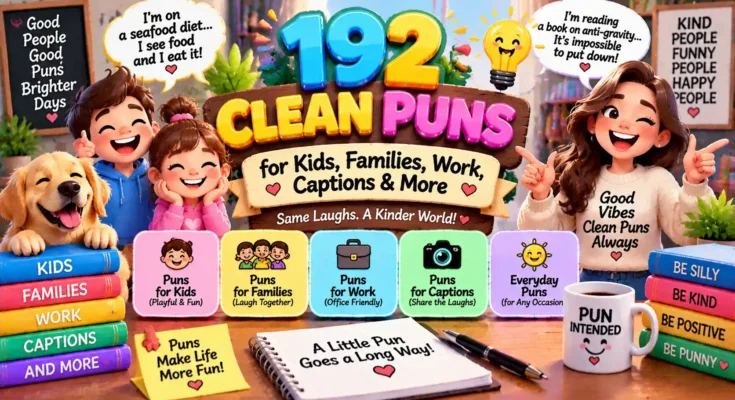
Clean puns give kids, families, friends, teachers, coworkers, and social-media users an easy way to add humor without crossing uncomfortable lines. This collection focuses on original, family-friendly wordplay that works in real conversations and everyday situations.
You’ll find funny, clever, cute, corny, and short puns, plus ideas for school, work, Instagram, TikTok, birthdays, holidays, cards, parties, animals, and food. Pick the style that fits your audience, copy a favorite, or use the writing tips near the end to create your own.
Editorial note: This collection was reviewed on September 12, 2026, with an emphasis on clear wordplay, family-friendly language, varied joke structures, and practical uses. Common joke patterns were avoided where possible, and lines were written specifically for this collection.
Quick Answer
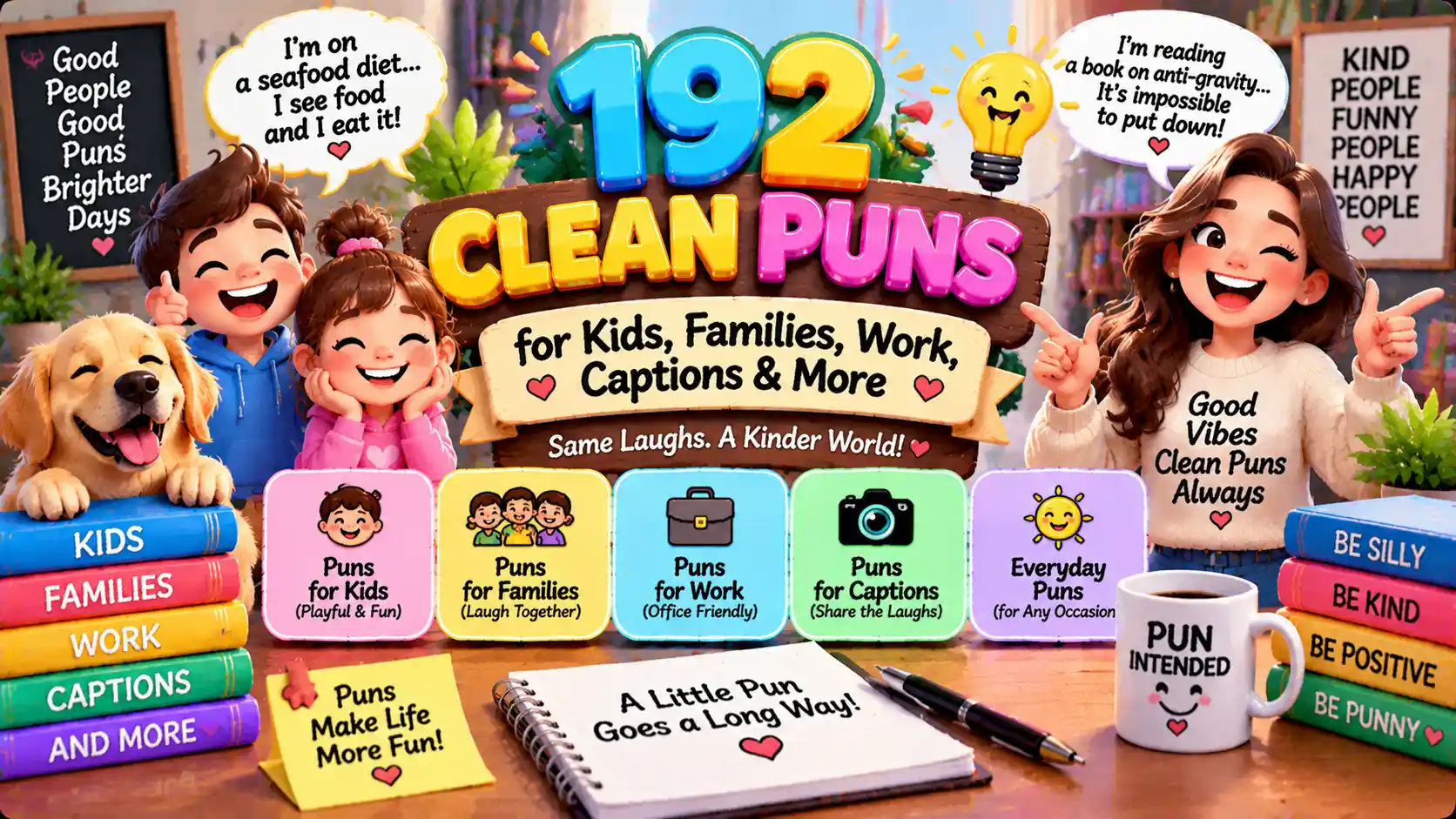
Clean puns are playful jokes built around double meanings, similar sounds, familiar phrases, or unexpected word choices without crude or offensive themes. Here you’ll find 192 ready-to-use puns for kids, families, work, school, captions, cards, birthdays, holidays, and parties.
TL;DR
- Use short puns for captions, texts, and quick replies.
- Choose simple wordplay for younger kids.
- Pick neutral jokes for coworkers and classrooms.
- Try clever puns when your audience enjoys layered humor.
- Use warm messages for cards and celebrations.
- Keep the punchline clear and easy to understand.
Clean Puns for Every Occasion
The best all-purpose pun can travel almost anywhere. It should work at the dinner table, in a group chat, on a note, or during a casual conversation.
These lines avoid personal targets and focus on familiar things, making them easy to share with mixed-age audiences. When you’re unsure which style to choose, start here.
My calendar has commitment issues; it keeps changing its dates.
I gave my notebook a compliment, and it took the praise one page at a time.
My backpack is great at keeping secrets because it carries everything quietly.
The elevator has a positive attitude because it always brings people up.
I asked my chair for support, and it didn’t let me down.
My umbrella handles criticism well because it can take a little rain.
The clock wanted a promotion, so it put in the hours.
My pencil joined the debate because it had a point to make.
The suitcase looked confident because it was ready for whatever came next.
My bookshelf is very social; it always has room for another story.
The lamp became a team leader because it knew how to lighten the mood.
My shoes started a conversation because they were both walking into the same issue.
Funny Clean Puns
Funny wordplay often starts with something completely ordinary. The trick is to take a familiar phrase and give it a harmless second meaning.
These are built for family chats, casual conversations, lunch tables, and social posts. They aim for a quick smile rather than a complicated setup.
I asked my refrigerator for advice, but it gave me the cold shoulder.
My blanket is a terrible secret keeper because it always covers everything.
I tried arguing with my toaster, but the conversation got too heated.
The door has become more confident lately; it’s finally opening up.
My socks started a support group after losing their other halves.
The bakery hired a new manager because someone had to rise to the occasion.
My phone needed a break, so I gave it some quality screen time.
The broom wanted a fresh start, so it swept the past away.
My sandwich became a team captain because everyone thought it brought something to the table.
The flashlight gave excellent advice because it always saw the bright side.
My suitcase refused to panic because it was already packed for anything.
The notebook joined the gym because it wanted to strengthen its spine.
Short Clean Puns and One-Liners
Sometimes the best joke is the one that fits inside a text bubble. Short puns are especially useful for captions, sticky notes, replies, and quick photo posts.
The lines below keep the setup tiny and the wordplay immediate. They are also easy to personalize without changing the punchline.
Stay pawsitive.
You’re tea-riffic.
Let’s taco ’bout it.
I’m feeling grate today.
Keep calm and carrot on.
You are totally un-be-leaf-able.
Donut worry; you’ve got this.
Life is gouda with good company.
That’s a pun-derful idea.
I’m having a berry good day.
You rock my socks off.
Have an egg-cellent adventure.
Clever Clean Puns
Clever puns usually depend on a word carrying two possible meanings. They can feel sharper than basic one-liners while remaining easy enough for everyday audiences.
Use them when you want something witty for a caption, note, presentation, conversation, or friendly message. The goal is surprise, not confusion.
The gardener stayed optimistic because every setback eventually grew into something useful.
My book club has strong opinions, but we usually meet on the same page.
The photographer handles pressure well because she knows how to develop her ideas.
The tailor gives thoughtful advice because she measures every word.
The musician stopped arguing when the conversation went completely off-key.
The chef stays calm under pressure because she knows how to handle the heat.
The architect never panics about problems; she simply works around the angles.
The librarian avoids drama because she prefers keeping things between the covers.
The scientist remained humble because she knew she was only one element of the team.
The map was everyone’s favorite travel companion because it always had a direction.
The editor enjoyed disagreements because they gave her something to revise.
The gardener made a great teammate because she knew when to plant an idea and when to let it grow.
Corny Clean Puns and Dad Jokes
A good dad joke doesn’t need sophistication. It needs confidence, timing, and just enough corniness to make everyone groan before smiling.
These jokes are ideal for road trips, family dinners, kids’ parties, and moments when someone has willingly accepted responsibility for the pun.
Why did the pencil bring a jacket? It was expecting a draft.
Why did the bicycle sit down? It needed to rest its pedals.
What do you call a bear who loves computers? A cyber bear.
Why did the tomato bring a notebook? It wanted to ketchup on its notes.
What did the zero say to the eight? Nice belt.
Why did the calendar go to therapy? It had too many dates to work through.
What do you call a sheep who knows karate? A lamb chop with skills.
Why did the cookie bring an umbrella? It heard there was a chance of sprinkles.
What do you call a rabbit who tells great stories? A real hare-raiser.
Why did the broom apply for a new job? It wanted a clean sweep.
What did the grape say after the race? Nothing; it just let out a little wine.
Why did the computer bring a pencil? It wanted to draw a better conclusion.
Clean Puns for Kids
Kids respond best to clear wordplay built around things they already know. Animals, food, books, school supplies, sports, and everyday objects give young readers plenty of familiar material.
For younger children, choose obvious wordplay. Older kids can handle more layered jokes, especially when the joke encourages them to notice how words can have multiple meanings.
Why did the pencil bring an eraser? It believed everyone deserved a second draft.
What do you call a dinosaur who loves books? A read-o-saurus.
Why did the banana join the school band? It had great appeal.
What does a bee say when it finds a good idea? “Honey, that’s brilliant.”
Why did the book wear a sweater? It wanted a warmer chapter.
What do you call a rabbit who wins a race? Hare-ly believable.
Why did the calculator feel confident? It knew it could count on itself.
What did the ocean say to the beach? Nothing; it just waved.
Why did the cookie visit the classroom? It wanted to become a smart cookie.
What do you call a sleepy dinosaur? A dino-snore.
Why did the student carry a ladder to math class? The problems were getting higher.
What did the crayon say after making a mistake? “I’ll color my way through it.”
Animal Clean Puns
Animal wordplay gives you a huge range of sounds, names, behaviors, and familiar expressions. It’s also one of the easiest categories for kids, classrooms, captions, and family jokes.
The trick is to avoid using the same animal-word formula repeatedly. These lines mix animal sounds, phrases, names, and unexpected situations.
My dog became a therapist because he was excellent at paws-and-effect thinking.
The cat opened a bakery because she kneaded a new career.
The owl started a podcast because it had plenty of wise words.
The turtle never rushes a decision; it likes to shell out careful thought.
The cow became a musician because she had a great moo-sical ear.
The penguin opened a café because it knew how to keep things cool.
The rabbit became a photographer because it loved capturing hare-raising moments.
The horse joined the theater because it was ready for a mane role.
The bee became a teacher because she was good at buzzing through the basics.
The fish stayed calm during every argument because it knew when to let things slide.
The squirrel started saving money because it was serious about its nest egg.
The goat became a comedian because it always knew how to get a baa-lanced reaction.
Food Clean Puns
Food puns are easy to share because almost everyone understands the ingredients and phrases involved. They work especially well for menus, party signs, captions, texts, lunch notes, and casual jokes.
Good food wordplay should still sound like a sentence someone might naturally say. That keeps the joke from feeling like a random ingredient with a pun attached.
I asked the pancake for advice, but it kept flipping the situation.
The potato stayed calm because it knew how to keep things grounded.
The orange became a motivational speaker because it knew how to add zest.
My sandwich started a business because it wanted to make more bread.
The pickle was a great friend because it never left anyone in a dill of a situation.
The corn joined the band because it had a-maize-ing rhythm.
The mushroom got invited everywhere because it was a fun-guy.
The carrot became a coach because it always encouraged people to root for themselves.
The waffle loved weekends because it finally had time to catch up on its batter.
The apple stayed humble because it didn’t want to make a big core of itself.
The popcorn was confident because it knew how to handle pressure.
The lemon opened a shop because it wanted to make the world a little zestier.
Clean Puns for Work and Coworkers
Office humor should make work feel lighter without putting a coworker in an uncomfortable position. Projects, coffee, deadlines, meetings, spreadsheets, and teamwork are safer targets than people’s personalities.
These lines fit team chats, newsletters, presentations, desk notes, and casual workplace conversations. When in doubt, choose the most neutral option.
Our project is moving forward, so I guess we’re making progress in the right direction.
The spreadsheet and I finally found common cells.
I asked the deadline for some space, but it kept getting closer.
My coffee and I have a strong working relationship.
The meeting had a lot of points, but not all of them were well appointed.
Our team is great at collaboration because everyone brings something to the table.
The printer has a complicated relationship with paper; things keep getting jammed.
I finished the report, so I guess that’s one more chapter closed.
The calendar is the busiest person here; it has dates with everyone.
Our brainstorming session was productive because nobody was afraid to think outside the box.
I wanted to take a shortcut through the project, but the long route had better documentation.
The office plant is the best coworker because it never complains and always grows with the team.
Clean Puns for School and Classrooms
Classroom humor can make lessons more memorable when it supports the subject instead of distracting from it. Math, science, books, spelling, art, and school supplies offer plenty of safe material.
Teachers can use these on boards, worksheets, newsletters, or reward notes. Students can also use them in projects, presentations, and friendly conversations.
The math student stayed calm because every problem had a solution.
The science book had great chemistry with the class.
The dictionary never gets lost because it always knows where to look.
The geometry teacher was popular because she had so many good angles.
The pencil got elected class leader because it always made a point.
The history book was tired because it had been through a lot.
The spelling bee won first place because it knew how to buzz through the competition.
The calculator felt prepared because it could count on itself.
The art student was confident because she always saw things from another perspective.
The reading group was successful because everyone knew how to turn the page.
The homework asked for attention, but the student needed a little space.
The ruler loved math class because everything finally measured up.
Clean Puns for Instagram and Social Captions
A social caption has limited space, so the best wordplay usually lands quickly. Short, visual, and natural lines work better than jokes that need a paragraph of setup.
Use these for food photos, pets, travel shots, everyday moments, celebrations, and casual posts. They can also work as text overlays when the wording is short enough.
Current mood: pun and done.
Serving looks with a side of wordplay.
Just having a grate day.
This view is tree-mendous.
Feeling berry good about this moment.
Life looks better with a little zest.
Taking life one pun at a thyme.
Weekend plans are looking a-peel-ing.
Good vibes are always in season.
Caught a beautiful moment with zero reel effort.
Finding joy in the little things and the big puns.
Picture this: one good view and absolutely no bad vibes.
Clean Birthday Puns
Birthday humor should celebrate the person instead of making them uncomfortable. That’s especially important when you’re writing for a coworker, relative, child, or someone whose age you don’t know well.
Use these in birthday cards, texts, cake photos, party signs, invitations, and social captions. A warm pun usually works better than an age joke.
Hope your birthday is absolutely cake-tastic.
Have a slice day!
Birthdays are always batter with cake.
You’re the icing on today’s celebration.
Hope your big day is frosting over with good memories.
Wishing you a year that’s sweet from the first bite to the last.
Have an egg-cellent birthday filled with sunny surprises.
Today deserves a round of a-paws.
Another year around the sun looks good on you.
May your birthday plans rise beautifully to the occasion.
Eat cake, make memories, and don’t crumb under pressure.
Hope your celebration is one for the gift-ory books.
Clean Holiday and Seasonal Puns
Seasonal humor works because the occasion provides the subject for you. The best holiday puns feel like a natural part of the celebration rather than a forced attempt to turn every word into a joke.
These lines fit holiday cards, family messages, classroom activities, party signs, and social captions. Keep the tone warm when you’re sharing them with a mixed audience.
Have a snow-much-fun holiday season.
Hope your Christmas is tree-mendous.
Have a spook-tacular Halloween.
Wishing you a gourd-geous fall.
Have an egg-cellent Easter.
May your Thanksgiving be filled with grate-ful moments.
Spring has sprung, and my pun game has too.
Summer is looking sun-sational already.
Winter is snow joke when there’s hot cocoa nearby.
May your holiday plans be merry and bright.
Hope your autumn is full of good leaves and better memories.
Wishing you a season that is simply un-fir-gettable.
Clean Puns for Friends, Cards, Texts, and Parties
A good message needs more than a punchline. Cards and personal texts should still sound warm, while party humor should be easy for a whole group to understand.
The lines below cover appreciation, congratulations, friendship, encouragement, and celebrations. Add a person’s name or a shared detail when you want the message to feel more personal.
Thanks a latte for always being there.
You’re one in a melon, and that’s no small compliment.
Our friendship is pretty grape.
You make ordinary days feel a little butter.
Thanks for sticking with me through every twist and turn.
You’re paws-itively one of my favorite people.
Congratulations on a grate achievement!
You deserve a round of a-paws for all your hard work.
Here’s to a friendship that keeps getting batter.
Thanks for being the zest part of my day.
Let’s taco ’bout how good this party is going.
Donut leave the party before dessert makes its grand entrance.
Clean Knock-Knock Jokes and Q&A Puns
Knock-knock jokes are a classic format because the audience gets to participate. They’re especially useful for kids, family gatherings, classroom breaks, and casual party games.
Question-and-answer puns are just as handy when you want a complete joke in a single exchange. Keep the setup short, make the answer clear, and don’t overcomplicate the wordplay.
Knock, knock. Who’s there? Olive. Olive who? Olive having a good time with you!
Knock, knock. Who’s there? Lettuce. Lettuce who? Lettuce have another joke!
Knock, knock. Who’s there? Canoe. Canoe who? Canoe believe how good that pun was?
Knock, knock. Who’s there? Orange. Orange who? Orange you glad I brought snacks?
Knock, knock. Who’s there? Boo. Boo who? Don’t cry; it’s only a pun!
Knock, knock. Who’s there? Tank. Tank who? You’re welcome!
What do you call a very polite vegetable? A courteous carrot.
What do you call a dog who loves taking pictures? A snapshot hound.
What do you call a pencil that tells the truth? Straight to the point.
Why did the calendar win the argument? It had all the dates.
Why did the chef bring a ladder? The recipe called for something on a higher level.
Why did the book refuse to gossip? It didn’t want to reveal its plot.
How to Make Your Own Clean Puns
Writing a strong pun starts with a familiar word or phrase, not with trying to sound funny. Look for words with multiple meanings, similar sounds, common expressions, or phrases that can be interpreted literally.
The best original puns usually become shorter during editing. Build several possibilities, read them aloud, and keep the version where the wordplay feels natural rather than forced.
A Simple Four-Step Method
-
Pick a familiar subject.
Start with something ordinary, such as coffee, homework, pets, weather, birthdays, or travel.
-
List related words.
Write down verbs, nouns, phrases, sounds, and expressions connected to the subject.
-
Look for a wordplay hinge.
Find a word that has another meaning or sounds like a different word.
-
Cut the setup.
Remove anything the reader doesn’t need. A clean pun usually becomes stronger when the punchline arrives quickly.
Example
Suppose your subject is coffee.
You might brainstorm:
- brew
- grounds
- roast
- bean
- cup
- perk
- mug
Then look for everyday phrases involving those words.
Instead of forcing several coffee terms into one sentence, choose one strong connection:
“I told my coffee I needed space, but it kept mugging me for attention.”
It works because “mugging” connects the ordinary phrase with a coffee mug.
Quick Quality Test
Before sharing your new pun, ask:
- Is the meaning clear?
- Does the wordplay arrive quickly?
- Would a child or mixed-age group understand it?
- Does it avoid targeting someone personally?
- Does it sound natural when spoken?
- Is the punchline different from nearby jokes?
- Can you remove a few words without weakening it?
If the answer is yes, you’ve probably got a keeper.
FAQs
What Are Clean Puns?
Clean puns are wordplay jokes that avoid crude, offensive, or inappropriate subjects. They often use double meanings, homophones, literal interpretations, or familiar phrases to create a harmless punchline.
They can work for families, children, classrooms, workplaces, cards, parties, and social posts.
Are Clean Puns the Same as Dad Jokes?
Not exactly. A pun describes the wordplay, while a dad joke describes a style of humor that is often simple, predictable, and deliberately corny.
A dad joke can contain a pun, but not every pun is a dad joke.
Are Clean Puns Good for Kids?
Yes, when the wording matches the child’s age and reading level. Animals, food, school, books, toys, and everyday objects are usually safe starting points.
For younger children, choose obvious wordplay. Older kids can enjoy jokes with more than one possible meaning.
Can I Use Clean Puns at Work?
Yes, but keep the subject neutral. Meetings, deadlines, coffee, teamwork, calendars, projects, and office supplies are safer than jokes about a coworker’s appearance, personality, mistakes, or private life.
If you’re unsure about the audience, choose a short joke that doesn’t single anyone out.
How Do I Make a Good Clean Pun?
Start with a familiar topic and brainstorm related words. Look for similar sounds, multiple meanings, idioms, compound words, and phrases that can be read literally.
Then shorten the setup until the punchline lands naturally. Reading the joke aloud is one of the easiest ways to spot awkward wording.
What Makes a Pun Actually Funny?
A strong pun usually has a clear setup, a recognizable wordplay hinge, and an unexpected interpretation. Clarity matters more than complexity.
If readers need an explanation before they understand the punchline, the wording probably needs another edit.
Conclusion
The best clean puns don’t need complicated setups or edgy subjects. A familiar word, a small twist, and good timing can be enough to make a family dinner, classroom, work chat, birthday card, or social post more memorable.
Use the short lines for captions and texts, the warmer options for cards, and the cornier jokes when your audience enjoys a good groan. Pick a line that fits the moment, personalize it when you can, and let the wordplay speak for itself.