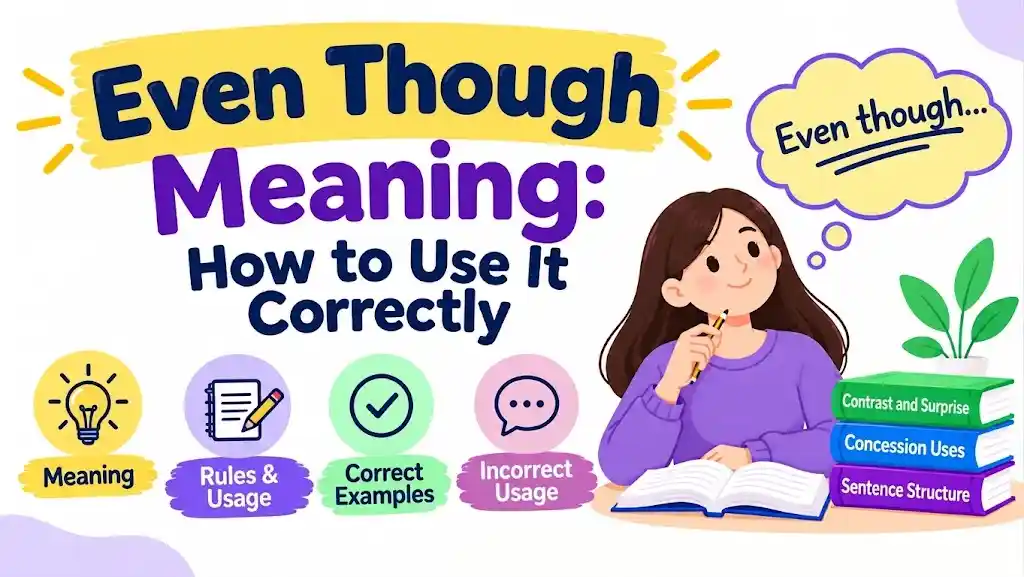
English learners often ask about even though meaning because the phrase looks similar to several other contrast expressions. This guide explains what it means and how to use it naturally.
You’ll learn the main grammar rule, sentence patterns, punctuation, common mistakes, comparisons, and practical examples. You’ll also see when even though works better than similar expressions.
Quick Answer
Even though means “although” or “despite the fact that.” It introduces a contrast between two ideas, usually with a subject and verb after it.
TL;DR
- Even though introduces a contrast.
- It normally comes before a complete clause.
- It can begin or appear inside a sentence.
- Use a comma after an opening dependent clause.
- Even if usually describes a possibility.
- Despite normally takes a noun or -ing form.
What Does Even Though Mean?
Even though shows that one fact is surprising when compared with another fact. It often means although or despite the fact that.
The phrase highlights a contrast between expectation and reality. It is common in both everyday American English and formal writing.
• Even though it was cold, we went outside.
• She smiled even though she was nervous.
• Even though he was tired, he finished the project.
• I enjoyed the movie even though it was long.
• Even though the store was busy, we found a seat.
• They continued walking even though it started raining.
• She passed even though the test was difficult.
• We stayed even though the weather changed.
How Even Though Works in a Sentence
Even though is followed by a dependent clause containing a subject and verb. That clause gives the contrasting information.
The other part is the main clause. Together, the two clauses create one complete sentence with a clear contrast.
• Even though + subject + verb, main clause
• Even though it rained, we played outside.
• Even though she was busy, she called me.
• Main clause + even though + subject + verb
• We played outside even though it rained.
• He called me even though he was busy.
• Keep the subject and verb after even though.
• Do not treat even though like a noun phrase.
Even Though at the Beginning of a Sentence
You can begin a sentence with even though. This position clearly introduces the contrast before the main idea.
When the dependent clause comes first, place a comma before the main clause. The same sentence can usually be reversed.
• Even though I was tired, I studied.
• Even though the road was busy, we crossed safely.
• Even though she disagreed, she listened.
• I studied even though I was tired.
• We crossed safely even though the road was busy.
• She listened even though she disagreed.
• Beginning with the phrase is grammatically acceptable.
• The comma separates the opening dependent clause.
Even Though in the Middle of a Sentence
Even though can also connect two clauses in the middle of a sentence. This position often keeps the main idea first.
A comma is usually unnecessary when the dependent clause follows the main clause closely.
• I studied even though I was tired.
• We left even though the meeting continued.
• She smiled even though she felt nervous.
• He went jogging even though it was cold.
• They stayed even though the room was crowded.
• I called even though it was late.
• The sentence remains complete without an extra comma.
• Use punctuation based on the sentence structure.
Even Though vs. Although
Although and even though both introduce contrast and can be followed by a full clause.
Even though often gives the contrast more emphasis. The choice depends on how strongly the speaker wants to highlight the unexpected result.
• Although it was raining, we walked home.
• Even though it was raining, we walked home.
• Both sentences are grammatically correct.
• Although can sound more neutral.
• Even though can sound more emphatic.
• Both normally take a subject and verb.
• Both can appear at the beginning.
• Both can appear before a dependent clause in the middle.
Even Though vs. Though
Though can work like although and can also appear at the end of a sentence. Even though is mainly used as a contrast connector before a clause.
This makes though more flexible in casual conversation. Even though is useful when you want clearer emphasis.
• Though I was tired, I continued.
• Even though I was tired, I continued.
• I was tired, though.
• The final-position use belongs to though, not even though.
• Though is common in everyday speech.
• Even though emphasizes the contrast.
• Both can introduce a dependent clause.
• Choose the form that matches your sentence structure.
Even Though vs. Even If
Even though generally introduces a fact or situation presented as true. Even if introduces a possibility, condition, or hypothetical situation.
The difference can change the meaning of a sentence, especially when discussing future events.
• Even though it is raining, we are leaving.
• Even if it rains, we are leaving.
• The first sentence presents rain as a fact.
• The second treats rain as a possibility.
• Even though focuses on contrast with reality.
• Even if focuses on a condition.
• Both are followed by a subject and verb.
• Do not use them automatically as interchangeable phrases.
Even Though vs. Despite and In Spite Of
Despite and in spite of also express contrast, but their normal structures differ.
They usually take a noun, pronoun, or -ing form rather than a full clause directly.
• Even though it was raining, we walked.
• Despite the rain, we walked.
• In spite of the rain, we walked.
• Despite being tired, she continued.
• Even though she was tired, she continued.
• Do not write despite it was raining in standard usage.
• Use despite the fact that it was raining when a clause is needed.
• In spite of is always written as three words.
Common Mistakes With Even Though
Most mistakes happen when learners mix the structures of different contrast expressions.
The safest approach is to check what follows the connector. If you see a subject and verb, even though can be a suitable choice.
• Incorrect: Even though of the rain, we left.
• Correct: Even though it was raining, we left.
• Incorrect: Even though the rain, we left.
• Correct: Despite the rain, we left.
• Incorrect: Even although it was late, we stayed.
• Correct: Even though it was late, we stayed.
• Incorrect: Even though it may rain, we stayed yesterday.
• Check whether the sentence describes fact, possibility, or contrast.
Even Though and Commas
Punctuation depends mainly on where the dependent clause appears.
An opening even though clause is normally followed by a comma. A closely connected clause at the end usually does not need one.
• Even though I was late, I joined the meeting.
• I joined the meeting even though I was late.
• Opening dependent clause: use a comma.
• Main clause first: usually no comma.
• Do not add a comma immediately after even though.
• Incorrect: Even though, I was tired, I studied.
• Correct: Even though I was tired, I studied.
• Read the sentence aloud to check the natural pause.
Even Though in Formal and Informal English
Even though works in everyday conversation, school writing, workplace writing, and many formal contexts.
It is not restricted to casual speech. The surrounding vocabulary and sentence structure usually determine the overall formality.
• Even though the deadline was close, we completed the report.
• Even though I disagree, I understand your point.
• It works in emails and professional explanations.
• It works in essays when the sentence is appropriate.
• It works naturally in conversation.
• Avoid repeating it in every paragraph.
• Use although when a more neutral tone fits.
• Use despite when its noun-based structure is more concise.
Even Though Sentence Patterns
Learning a few patterns makes the phrase easier to use correctly.
Start with the structure, then replace the subjects, verbs, and situations with your own ideas.
• Even though + subject + verb, main clause.
• Even though she was tired, she kept working.
• Main clause + even though + subject + verb.
• She kept working even though she was tired.
• Even though + present clause, present result.
• Even though + past clause, past result.
• Even though + reason, unexpected result.
• Keep both clauses logically connected.
How to Use Even Though in Everyday English
Use even though when the first fact might make readers expect a different result.
This makes the relationship between ideas clearer and helps your writing sound more connected.
• Even though I was hungry, I skipped breakfast.
• Even though traffic was heavy, we arrived early.
• Even though she practiced daily, she felt nervous.
• Even though the phone was old, it worked well.
• Even though he apologized, she remained upset.
• Even though the class was difficult, I enjoyed it.
• Even though they disagreed, they stayed respectful.
• Use it when the contrast matters to your meaning.
Practice: Choose the Correct Form
Practice helps you notice the structural difference between similar connectors.
Choose even though, even if, or despite based on the meaning and grammar.
• ___ it was expensive, I bought it.
• ___ it gets cold, we will continue.
• ___ the high price, I bought it.
• ___ she was nervous, she gave the speech.
• ___ he apologizes, she may remain upset.
• ___ being tired, he finished the work.
• Answer: Even though it was expensive, I bought it.
• Answer: Even if it gets cold, we will continue.
Quick Reference: Even Though and Similar Expressions
The easiest way to choose correctly is to check both meaning and grammar structure.
Use even though for a factual contrast, even if for a possibility, and despite before a noun or -ing form.
• Even though + subject + verb
• Even if + subject + verb
• Despite + noun/pronoun/-ing
• In spite of + noun/pronoun/-ing
• Although + subject + verb
• Though + subject + verb
• Even though usually adds stronger emphasis than although.
• Though can also appear at the end of a sentence.
FAQs
What does “even though” mean?
It means although or despite the fact that. It introduces a contrast between two ideas.
Is “even though” a conjunction?
Yes. It functions as a subordinating conjunction and introduces a dependent clause.
Can I start a sentence with “even though”?
Yes. For example: Even though it was late, we continued working.
What comes after “even though”?
A clause normally follows it, meaning a subject and a verb. For example: even though she was tired.
Is “even though” the same as “even if”?
Not always. Even though normally presents a fact, while even if introduces a possibility or condition.
Is there a comma before “even though”?
When the even though clause comes first, use a comma after that clause. When it follows the main clause closely, a comma is usually unnecessary.
Conclusion
Understanding even though meaning becomes easier when you remember one main idea: it introduces a contrast between two clauses. It often highlights something unexpected.
Use even though + subject + verb, and compare it carefully with although, even if, despite, and in spite of. Next, practice creating five sentences from your own daily experiences.