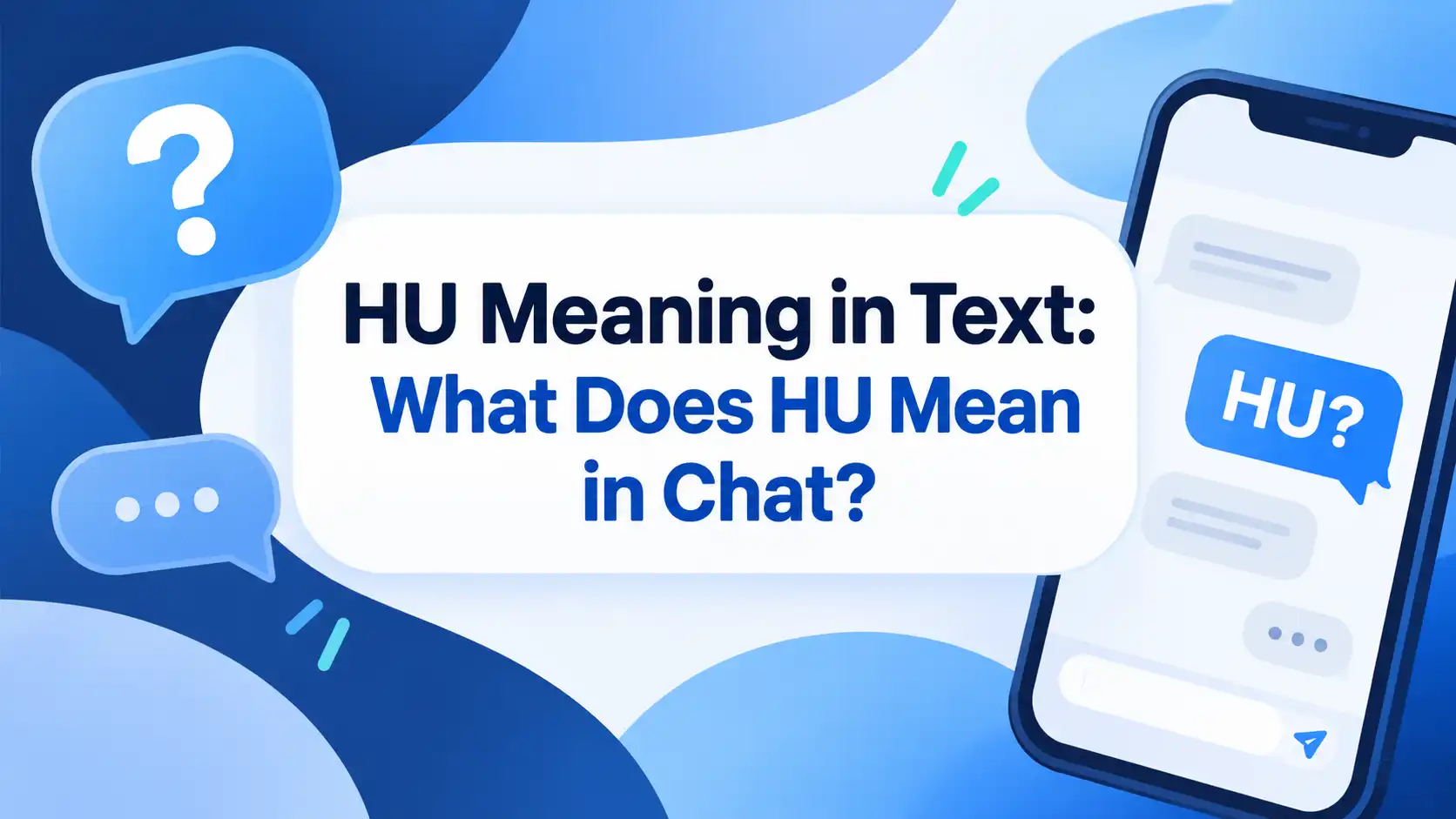
This guide helps English learners understand HU meaning in text without guessing from the letters alone. Short texting forms can change meaning based on the conversation, punctuation, and words around them.
You’ll learn the most common interpretations, see realistic message examples, and compare HU with similar shortcuts. You’ll also learn when it is better to avoid abbreviations and write the phrase clearly.
Quick Answer
HU can have different meanings in texts, depending on context. It may refer to “how about you?” or “hold up,” so the surrounding message matters.
TL;DR
- HU can have more than one casual texting meaning.
- Context usually reveals the intended meaning.
- “How about you?” is conversational.
- “Hold up” signals a pause or interruption.
- HU is better for casual digital chats.
- Formal writing should use the full phrase.
What Does HU Mean in Text?
HU is a short form used in casual digital communication. It does not have one fixed meaning, so reading the complete message is important.
The most useful interpretations are conversational phrases such as “how about you?” and “hold up.” The same two letters can mean different things in different chats.
- “I’m good, HU?” can mean “How about you?”
- “HU, I’m not ready yet” can mean “Hold up.”
- A question-like message often suggests a conversational meaning.
- A pause or interruption suggests “hold up.”
HU as “How About You”
When HU follows a personal statement or question, it can mean “how about you?” It asks the other person to share their answer or experience.
This use keeps a conversation moving quickly. It is most natural in casual texts between people who already understand each other.
- “I’m staying home tonight, HU?”
- “My class went well. HU?”
- “I love that movie. HU?”
- “I’m from Texas. HU?”
HU as “Hold Up”
In some messages, HU may be used for “hold up.” Here, the speaker wants someone to pause, wait, or slow down.
The surrounding words usually make this meaning clearer. A message that sounds like an interruption is more likely to use HU this way.
- “HU, what did you just say?”
- “HU, I need to check something.”
- “HU before you leave.”
- “HU, I’m almost ready.”
How to Tell Which Meaning HU Has
Context is the safest way to understand HU. Look at the words before and after it rather than treating the abbreviation as a dictionary definition.
The conversation can usually tell you whether the sender wants your opinion or wants you to pause.
- After a personal statement: “how about you?” may fit.
- Before a reaction: “hold up” may fit.
- With a question: consider the conversational meaning first.
- With a request to wait: “hold up” is more likely.
- When unclear: ask the sender what they meant.
HU in Text Conversations
HU works best when both people are comfortable with casual abbreviations. It can make a short exchange faster, but it can also create confusion.
A clear conversation gives you useful clues. Read the complete message before deciding what the sender intended.
- “I had a busy day, HU?”
- “HU, are you serious?”
- “I’m watching TV. HU?”
- “HU, let me finish.”
HU on Social Media and DMs
Social media messages often use shortened language because conversations are quick and informal. HU may appear in DMs, comments, or private chats when users already understand the context.
It is less reliable in a public post with no surrounding conversation. In those cases, writing the full phrase can prevent confusion.
HU Meaning in Dating and Flirty Chats
In personal conversations, HU can appear as a short way to continue a discussion. Still, the abbreviation alone does not prove that a message is romantic or flirtatious.
The tone comes from the complete conversation. Look at the other person’s words, questions, and previous messages before reading extra meaning into HU.
- “I’m free tonight, HU?”
- “I miss talking to you. HU?”
- “HU, are you actually coming?”
- “HU, give me a second.”
HU Meaning in Group Chats
Group chats can make short abbreviations harder to interpret. A sender may be asking everyone a question or telling the group to pause.
The message before HU usually provides the strongest clue. If several people are talking at once, asking for clarification is often the easiest solution.
- “I’m ordering pizza, HU?”
- “HU, everyone! Read this first.”
- “I’m going at six, HU?”
- “HU, we need to decide first.”
HU vs HBU vs WBU
HU, HBU, and WBU can look similar, but they are not always used in the same way. HBU and WBU are more clearly associated with “how about you?” or “what about you?”
HU has greater ambiguity because people may use it for another phrase, such as “hold up.”
- HBU? = “How about you?”
- WBU? = “What about you?”
- HU? = context-dependent.
- Use HBU or WBU when you want clearer meaning.
Is HU a Standard English Abbreviation?
HU is best treated as informal digital language, not standard formal English. It belongs in settings where abbreviations and shorthand are already accepted.
For work emails, school assignments, formal requests, and professional documents, writing the full phrase is clearer. Casual texts are more flexible.
HU Examples in Real Messages
Seeing HU inside complete messages makes its meaning easier to identify. The key is to connect the abbreviation with the speaker’s immediate purpose.
These examples show why context matters more than the letters themselves.
- “I’m tired today, HU?” → likely “how about you?”
- “HU, that was fast!” → likely an interruption or reaction.
- “I’m free Saturday, HU?” → likely a conversational question.
- “HU, wait for me!” → likely “hold up.”
- “My weekend was great, HU?” → likely “how about you?”
- “HU, I need the address first.” → likely “hold up.”
Common Mistakes With HU
The biggest mistake is assuming HU always has one meaning. Short forms can be unclear when people use them without enough context.
Another problem is using HU with people who do not know the abbreviation. A full phrase is usually safer when clarity matters.
- Do not assume one fixed definition.
- Read the entire conversation.
- Check whether HU sounds like a question or command.
- Avoid HU in formal writing.
- Ask for clarification when the meaning is unclear.
- Prefer clearer abbreviations when possible.
How to Reply to HU
Your response should match the likely meaning. When HU means “how about you?”, answer the same question; when it means “hold up,” respond to the request to pause.
When the message is unclear, a quick question can prevent a misunderstanding. You do not need to guess.
- If it means “how about you?” → answer with your own details.
- If it means “hold up” → pause and respond.
- If unclear → “Do you mean how about you?”
- Another option → “What do you mean by HU here?”
When Not to Use HU
HU is not ideal when the reader needs precise information. It may confuse coworkers, teachers, customers, or people unfamiliar with texting shorthand.
Use the complete phrase when the message needs to be clear, professional, or permanent. Shorter is not always better.
American English and HU Usage
For readers in the United States, HU should be understood as casual texting shorthand, not a normal replacement for full English phrases. Its meaning depends heavily on context and personal texting habits.
American digital conversations commonly use abbreviations, but usage varies by person and platform. That makes context especially important with short forms like HU.
Related Texting Abbreviations
Knowing similar expressions can help you understand digital conversations faster. Many abbreviations are clearer than HU because they usually point to one common phrase.
Learning the full expression alongside the shortcut is the best way to remember it.
- HBU = How about you?
- WBU = What about you?
- BRB = Be right back.
- BTW = By the way.
- IDK = I don’t know.
- OMG = Oh my gosh.
- IMO = In my opinion.
- TBH = To be honest.
FAQs
What does HU usually mean in text?
HU can have more than one casual meaning. Context may show whether it means “how about you?” or “hold up.”
Does HU mean how about you?
It can. This interpretation makes sense when the sender is asking for your answer after sharing their own information.
Does HU mean hold up?
It can also mean “hold up” in some casual messages. Words such as “wait,” “stop,” or an interruption can make that meaning clearer.
Is HU a common texting abbreviation?
HU is not as universally clear as some common texting shortcuts. Because it can be ambiguous, the surrounding conversation matters.
Should I use HU in a professional message?
Usually, writing the full phrase is safer in professional communication. Informal abbreviations can create confusion or look too casual.
What is the difference between HU and HBU?
HBU commonly means “how about you?” HU can have that meaning, but HU may also be interpreted differently depending on context.
Conclusion
Understanding HU meaning in text requires more than memorizing two letters. Look at the surrounding words, the conversation, and whether the sender is asking a question or requesting a pause.
When the meaning is unclear, ask instead of guessing. For formal communication, write the full phrase and choose clarity over shorthand.