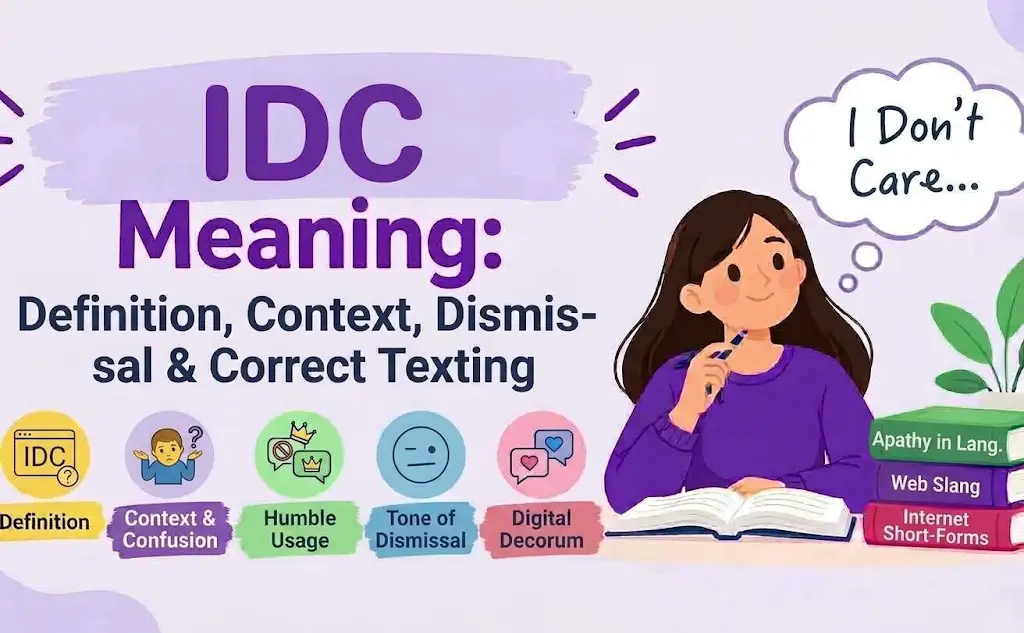
Have you seen IDC in a text message or social media comment and wondered what it means? This common abbreviation appears in everyday chats, online discussions, and messages between friends.
IDC stands for “I Don’t Care.” People use it to express that something does not matter to them or that they have little interest in a particular situation. Depending on the context, IDC can sound casual, neutral, dismissive, or even rude.
What Does IDC Mean in Text?
In texting, IDC means “I Don’t Care.” It is an informal abbreviation people use when they want to show that a choice, situation, or topic does not matter to them.
For example:
- “IDC what we eat tonight.”
- “IDC about the final score.”
- “IDC which movie we watch.”
In these examples, the sender is saying that the particular choice or outcome does not matter to them.
However, IDC can sometimes sound insensitive if someone is discussing something important or emotional.
What Does IDC Stand For?
IDC stands for I Don’t Care. It is commonly used in text messages, social media conversations, gaming chats, and other informal online communication.
People may use IDC when they:
- Have no preference between two options.
- Are not interested in a particular topic.
- Do not feel concerned about an outcome.
- Want to express indifference.
- Are responding casually to a question.
The meaning is usually straightforward, but the sender’s tone depends on the conversation.
How to Use IDC in a Sentence
IDC can appear at the beginning or within a sentence. It is most appropriate for casual conversations where the other person understands your tone.
Examples:
- “IDC which restaurant we choose.”
- “IDC what people think about my outfit.”
- “Honestly, IDC about that argument.”
- “IDC if we arrive a little early.”
- “IDC what game we play tonight.”
When using IDC, consider whether the other person might interpret your message as dismissive.
IDC Meaning on Social Media
On platforms such as Instagram, TikTok, Snapchat, Facebook, and X, IDC is often used in comments, captions, and direct messages.
Examples:
- “IDC what the haters say.”
- “IDC about the latest trend.”
- “IDC if this song is popular; I love it.”
- “IDC what anyone thinks of my style.”
In these situations, IDC may express confidence, independence, or a lack of interest in other people’s opinions.
However, the abbreviation can also communicate frustration, depending on the words around it.
IDC Meaning in Chat With Friends
Friends often use IDC when they do not have a preference or want to show that a particular choice is unimportant to them.
Example conversation:
Alex: “Should we order pizza or burgers?”
Sam: “IDC. I’m happy with either.”
Here, Sam means that both options are acceptable.
Another example:
Friend: “Do you care if we meet at 6 instead of 5?”
You: “IDC, 6 works for me.”
In this context, IDC is casual and does not necessarily sound rude.
What Does IDC Mean From a Girl or a Guy?
IDC has the same basic meaning regardless of who sends it: “I Don’t Care.” However, the emotional meaning can vary with the situation.
For example:
- “IDC which color you choose.” — The sender has no preference.
- “IDC what they say about me.” — The sender may be showing confidence or indifference.
- “IDC anymore.” — Depending on the conversation, the sender may sound frustrated, upset, or emotionally exhausted.
IDC alone does not prove that someone is angry, uninterested in you, or ending a relationship. Consider the surrounding messages before drawing conclusions.
IDC vs. IDK: What’s the Difference?
IDC and IDK look similar, but they have different meanings.
| Abbreviation | Full Form | Meaning |
|---|---|---|
| IDC | I Don’t Care | Expresses indifference or lack of concern |
| IDK | I Don’t Know | Expresses uncertainty or lack of knowledge |
IDC example: “IDC which restaurant we visit.”
IDK example: “IDK which restaurant is open.”
The first person has no preference. The second person does not know which restaurant is open.
IDC vs. IMO: What’s the Difference?
IDC and IMO serve different purposes in online conversations.
- IDC means “I Don’t Care” and expresses indifference.
- IMO means “In My Opinion” and introduces a personal viewpoint.
Examples:
- “IDC which phone you buy.”
- “IMO, this phone has a better camera.”
The first statement says the choice does not matter to the sender. The second gives a personal opinion about the phones.
Is IDC Rude or Disrespectful?
IDC can sound rude, but it is not always disrespectful. Its tone depends on the context, the relationship between the people, and the way the message is written.
Casual example: “IDC where we sit. Anywhere is fine.”
Potentially rude example: “IDC about your problems.”
The first message communicates flexibility, while the second may sound insensitive because it dismisses another person’s concerns.
If you want to sound polite, consider using phrases such as:
- “Either option works for me.”
- “I don’t have a preference.”
- “It’s up to you.”
- “I’m okay with whatever you choose.”
These alternatives express indifference without sounding unnecessarily harsh.
Is IDC Formal or Informal?
IDC is primarily an informal abbreviation. It is common in personal messages, casual conversations, and social media posts.
In professional emails, workplace discussions, or formal writing, it is usually better to write the full phrase or choose a more diplomatic alternative.
Informal: “IDC which time we choose.”
More professional: “I don’t have a preference regarding the meeting time.”
Choosing the right wording helps you communicate clearly without accidentally sounding dismissive.
Common Examples of IDC in Text Messages
Here are more examples showing how IDC is used in everyday conversations:
- “IDC what we watch tonight.”
- “IDC about the final score.”
- “IDC if it rains tomorrow.”
- “IDC which color looks better.”
- “IDC what strangers think of me.”
- “IDC where we go for lunch.”
- “IDC if you choose the other option.”
- “IDC about that silly argument.”
- “IDC whether we leave now or later.”
- “IDC what everyone else is wearing.”
These examples show that IDC can express a lack of preference, concern, or interest depending on the situation.
Other Text Abbreviations Similar to IDC
If you are learning common texting slang, these abbreviations are also useful:
- IDK: I Don’t Know
- IMO: In My Opinion
- IMHO: In My Humble Opinion
- TBH: To Be Honest
- NGL: Not Gonna Lie
- IKR: I Know, Right?
- BTW: By the Way
- FYI: For Your Information
- WYD: What You Doing?
Each abbreviation has a different meaning, so use the one that matches your intended message.
FAQs About IDC Meaning in Text
1. What does IDC mean in texting?
IDC means “I Don’t Care.” It is used in text messages and online chats to express indifference, a lack of preference, or a lack of concern about something.
2. What does IDC mean on Instagram?
On Instagram, IDC usually means “I Don’t Care.” People use it in comments, captions, and direct messages to express independence, indifference, or a lack of interest in a topic.
3. What does IDC mean from a girl?
When a girl uses IDC, she is generally saying “I Don’t Care.” Depending on the context, she may have no preference, feel indifferent, or be expressing frustration. The abbreviation alone does not reveal her exact feelings.
4. What does IDC mean from a guy?
When a guy sends IDC, it usually means “I Don’t Care.” He may be saying that a choice does not matter to him, but the tone of the conversation helps clarify his intention.
5. Is IDC rude in a text message?
IDC can sound rude when it dismisses someone’s feelings or concerns. However, it can be neutral when someone simply has no preference between options.
6. What is the difference between IDC and IDK?
IDC means “I Don’t Care,” while IDK means “I Don’t Know.” IDC expresses indifference, whereas IDK expresses uncertainty or a lack of information.
7. What can I say instead of IDC?
You can say “I don’t have a preference,” “Either option works for me,” or “It’s up to you.” These alternatives often sound more considerate in personal and professional conversations.
Conclusion
IDC means “I Don’t Care” in text messages, social media, and online conversations. People use it to express indifference, show that they have no preference, or communicate that something does not matter to them.
Although IDC is common in casual chats, its tone can sometimes seem rude or dismissive. Consider the situation and your audience before using it, especially when discussing sensitive topics. If you want to sound more polite, phrases such as “Either option works for me” can communicate the same idea more gently.