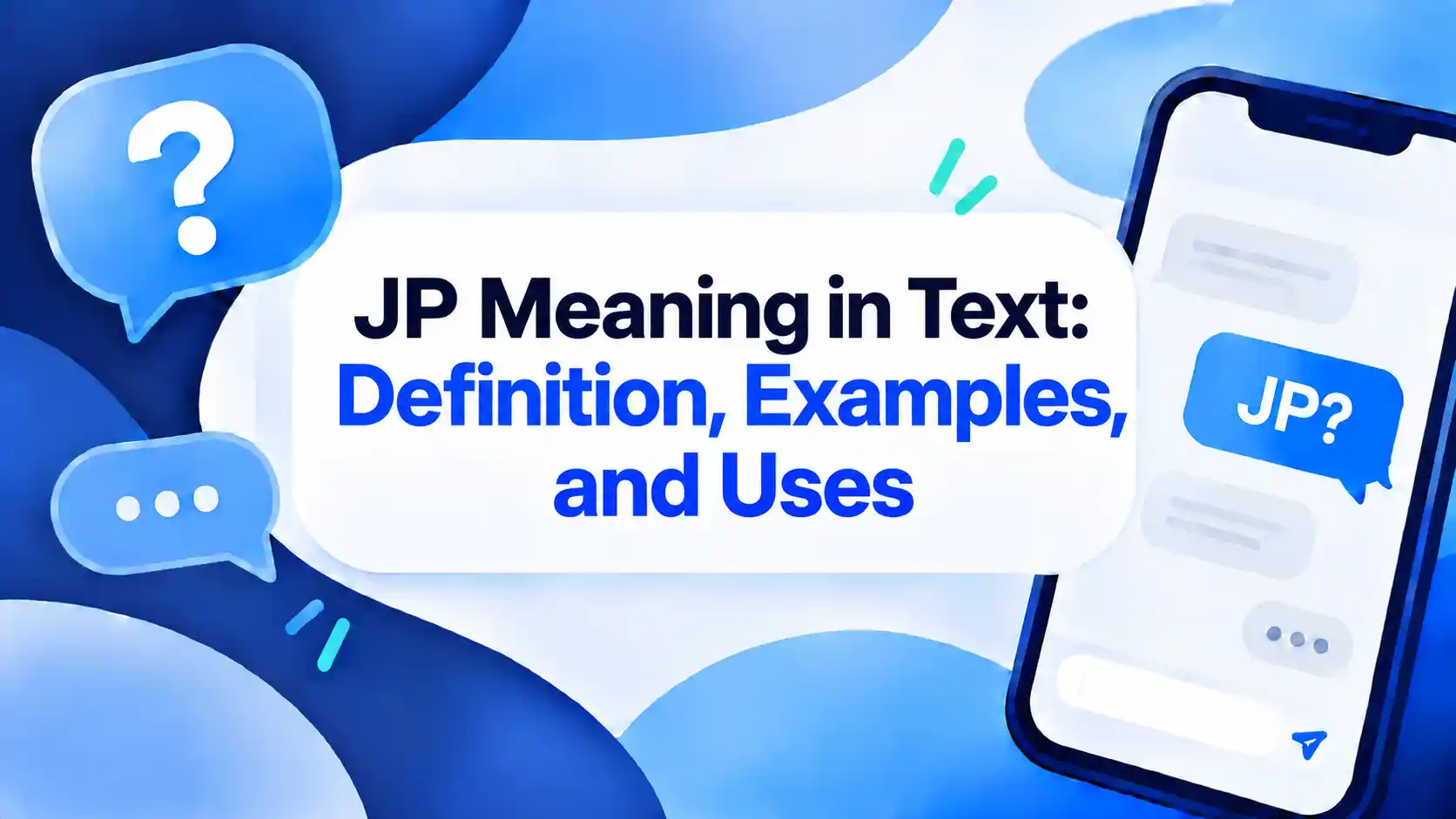
If you’re a student, parent, English learner, or everyday texter, JP meaning in text is usually easy to understand once you look at the surrounding message. In casual chats, JP most commonly means “Just Playing,” telling someone that a previous comment was playful, teasing, or not meant seriously.
But JP can have other meanings. It may refer to Japan, someone’s initials, or Justice of the Peace in a formal context. This guide shows how to identify the intended meaning, use JP naturally, avoid misunderstandings, and choose clearer alternatives when needed.
Quick Answer: What Does JP Mean in Text?
JP usually means “Just Playing” in casual texting. People often add it after a joke, tease, exaggerated statement, or playful comment to show they aren’t being serious.
For example:
“You’re buying pizza for everyone. JP 😂”
Here, JP tells the reader that the speaker was only joking.
What Does JP Stand For?
In casual texting, JP stands for “Just Playing.” The letters come from the first letters of Just and Playing.
In this expression, “playing” does not usually mean playing a sport or video game. It means messing around, teasing, or joking with someone.
You may see the abbreviation as JP or jp. Capitalization usually reflects typing style rather than a different slang meaning.
JP at a Glance
| JP Meaning | Typical Context | Example |
|---|---|---|
| Just Playing | Texts, DMs, group chats | “I’m blocking you. JP!” |
| Japan | Travel, gaming, culture | “The JP version launches first.” |
| Justice of the Peace | Legal or official contexts | “The ceremony was performed by a JP.” |
| Initials | Names and personal messages | “JP called earlier.” |
| Other field-specific uses | Specialized conversations | Meaning depends on the subject |
The important point is that “Just Playing” is the casual texting meaning, while the other meanings depend heavily on context.
When Does JP Mean “Just Playing”?
Look at what appears immediately before JP. If the message contains a joke, playful insult, exaggeration, or fake threat, “Just Playing” is usually the natural interpretation.
JP often works as a quick tone marker. Written messages do not show facial expressions or voice tone, so a sender may add JP to make playful intent clearer.
Common examples include:
• “You’re officially banned from my house. JP 😂”
• “I’m telling everyone your secret. JP!”
• “You really believed me? JP.”
• “You’re the worst teammate ever. JP 😆”
• “I’m taking your last slice. JP.”
The abbreviation can soften a teasing statement, but it does not automatically make rude wording harmless. If the original comment could genuinely hurt someone, clearer wording may be better.
How to Tell Which JP Meaning Someone Intended
Context is more useful than the abbreviation itself. Ask what the conversation is about and whether “Just Playing” actually makes sense.
A quick context check can help:
• A joke or tease: JP probably means Just Playing.
• Travel or geography: JP may refer to Japan.
• A game region or version: JP may refer to Japan or Japanese content.
• A person’s name: JP may simply be someone’s initials.
• A legal document: JP may mean Justice of the Peace.
• A workplace conversation: JP could be a field-specific abbreviation.
• A movie discussion: JP can sometimes refer to Jurassic Park.
• An unclear message: Ask the sender instead of guessing.
This approach is more reliable than memorizing every possible expansion of two letters.
JP Meaning on Social Media and in Group Chats
You may see JP in comments, DMs, group chats, and social media replies. Its casual meaning does not change simply because the message appears on a particular platform.
What changes is the surrounding conversation. A playful comment may use JP as “Just Playing,” while a gaming or travel discussion may use the same letters differently.
Examples by context
Snapchat:
“I’m posting that embarrassing photo. JP 😂”
TikTok:
“You actually thought I believed that. JP!”
Instagram:
“I’m unfollowing you after that. JP 😭”
Group chat:
“Nobody invite Alex next time. JP.”
Gaming chat:
“I’m quitting ranked forever. JP.”
The key is simple: the platform does not determine the meaning by itself. The words around JP do.
JP in Gaming, Travel, and Japan-Related Conversations
Gaming can create confusion because JP may refer to Japan or Japanese versions of a game rather than “Just Playing.”
For example:
“The JP version gets the update tomorrow.”
Here, “Just Playing” clearly does not fit. The conversation is about a regional game version, so JP refers to Japan-related content.
Travel and cultural discussions can work the same way:
“I’m flying to JP next month.”
In that sentence, the surrounding travel context makes a country reference much more plausible than texting slang.
Compare the two meanings
“I’m beating you this round. JP 😂”
→ Just Playing
“The JP server is offline.”
→ Japan/Japanese regional reference
“I’m visiting JP next summer.”
→ Japan
The same two letters can have completely different meanings because context controls interpretation.
JP vs. JK vs. “I’m Joking”
JP and JK are similar, but they are not the same abbreviation.
JP means “Just Playing.”
JK usually means “Just Kidding.”
Both can tell someone that a previous statement was not serious. However, JK is more directly tied to the idea of kidding or joking, while JP can sound more like playful teasing.
| Expression | Meaning | Typical effect |
|---|---|---|
| JP | Just Playing | Playful teasing |
| JK | Just Kidding | Directly signals a joke |
| I’m joking | Full phrase | Very clear |
| I was only teasing | Full phrase | Clearly explains playful intent |
For example:
“You’re buying dinner tonight. JP 😂”
sounds like playful teasing.
“I deleted the file. JK!”
more directly tells the reader that the statement was a joke.
If there’s a real chance of confusion, “I’m joking” is clearer than either abbreviation.
Does JP Have a Romantic or Flirty Meaning?
JP does not automatically mean flirting or romantic interest. Its basic slang meaning remains “Just Playing.”
A person may use JP during a playful or flirty conversation, but the romantic meaning comes from the overall conversation, not the abbreviation itself.
For example:
“You’re trouble, you know that? JP 😄”
could be friendly teasing or flirting. You cannot determine romantic interest from JP alone.
Look at the wider conversation, the relationship between the people, and the surrounding language before interpreting the tone.
How to Use JP Naturally
Use JP in casual conversations when the other person is likely to understand texting abbreviations. It works especially well after a playful statement that could otherwise sound serious.
Good examples include:
• “You’re paying for lunch today. JP 😂”
• “I’m never talking to you again. JP!”
• “That was the worst movie choice ever. JP.”
• “I’m stealing your hoodie. JP 😆”
• “You’re officially my rival now. JP.”
Avoid relying on JP when your message involves a serious issue, sensitive topic, or unfamiliar audience.
When a full phrase is better
Use “I’m joking” when:
• The recipient may not know texting slang.
• The original message could sound insulting.
• You’re speaking to a teacher, client, manager, or unfamiliar person.
• The conversation involves a serious misunderstanding.
• You need your intention to be unmistakably clear.
Is JP Appropriate in Formal English?
JP is informal texting language, so it generally does not belong in academic essays, formal reports, business letters, or official documents when you mean “Just Playing.”
For professional writing, choose a complete phrase instead:
• “I’m joking.”
• “I was only kidding.”
• “I was only teasing.”
• “I didn’t mean that seriously.”
There is one important exception: JP can be a formal abbreviation for Justice of the Peace. Cambridge Dictionary lists JP as an abbreviation for that legal title. In the U.S., a justice of the peace can serve as a public officer handling certain local legal matters and marriage ceremonies.
So the letters themselves are not informal. The meaning “Just Playing” is informal.
Common Mistakes When Understanding JP
The biggest mistake is assuming that every JP means “Just Playing.” Short abbreviations are highly dependent on context.
Avoid these common errors:
• Don’t interpret JP without reading the surrounding message.
• Don’t assume JP always refers to a joke.
• Don’t confuse JP with JK.
• Don’t treat JP as proof that someone is flirting.
• Don’t use JP to dismiss a serious concern.
• Don’t assume capitalization creates a new meaning.
• Don’t use slang with readers who may not recognize it.
• Don’t interpret a legal JP as texting slang.
A useful rule is: if “Just Playing” makes the sentence sound strange, look for another context-based meaning.
What Should You Reply When Someone Says JP?
If someone uses JP after an obvious joke, a casual response is usually enough.
You could reply:
• “Haha, you got me.”
• “I knew you were joking.”
• “Okay, you got me 😂”
• “LOL, fair enough.”
• “I figured you were playing.”
If you’re unsure, ask directly:
“Wait, what do you mean by JP?”
That’s better than making a confident guess when the conversation is unclear.
JP Examples: Realistic Text Conversations
Seeing JP inside a complete conversation makes its function much clearer.
Example 1: Playful teasing
Alex: “You’re buying dinner tonight.”
Sam: “Why me?”
Alex: “Because I said so. JP 😂”
Meaning: Alex is joking and isn’t actually demanding dinner.
Example 2: Fake threat
Alex: “I’m deleting your number.”
Sam: “Seriously?”
Alex: “JP! You’re stuck with me.”
Meaning: The first statement was playful rather than serious.
Example 3: Gaming
Alex: “I’m quitting this game forever.”
Sam: “See you tomorrow.”
Alex: “JP 😆”
Meaning: Alex was exaggerating for fun.
Example 4: Japan-related use
Alex: “Which version are you downloading?”
Sam: “The JP version.”
Meaning: Here, JP refers to the Japan-related version, not “Just Playing.”
Example 5: Legal context
Alex: “Who performed the ceremony?”
Sam: “A JP.”
Meaning: In this formal context, JP means Justice of the Peace.
What Does JP Mean in Different Contexts?
A quick comparison makes the distinction easier to remember.
| Context | Likely Meaning | How to Recognize It |
|---|---|---|
| Casual text | Just Playing | Follows a joke or tease |
| Group chat | Just Playing | Used after playful banter |
| Social media | Just Playing | Appears after an exaggerated comment |
| Gaming | Just Playing / Japan | Check whether the message concerns a game region |
| Travel | Japan | Country or destination is being discussed |
| Personal message | Initials | Refers to someone’s name |
| Legal context | Justice of the Peace | Appears with legal or official language |
| Movie discussion | Jurassic Park | Dinosaur or film context |
This table is the fastest way to avoid the most common interpretation mistake: assuming JP has only one meaning.
Is JP Still Used in Texting?
JP appears in current online slang references as an abbreviation for “Just Playing,” although it is informal and not every texter will use or recognize it. Current texting references continue to list “Just Playing” as a casual meaning.
That means you should treat JP as informal shorthand, not as a universal English abbreviation.
If your audience is unfamiliar with texting slang, writing the full phrase is safer and clearer.
FAQs About JP Meaning in Text
What does JP mean after a joke?
JP usually means “Just Playing” when it appears after a joke, tease, or exaggerated statement. It tells you the sender was not being completely serious.
Does JP mean the same thing as JK?
Not exactly. JP means “Just Playing,” while JK means “Just Kidding.” Both can signal that a previous message was a joke.
Can JP mean Japan?
Yes. JP can refer to Japan or Japanese-related content in travel, gaming, and cultural conversations. The surrounding topic tells you whether that meaning fits.
Does JP mean flirting?
Not by itself. Someone may use JP during a flirty conversation, but the abbreviation does not prove romantic interest.
What does JP mean in a legal context?
In legal or official writing, JP can mean “Justice of the Peace.” Cambridge Dictionary lists JP as the abbreviation for this title.
Is JP appropriate in professional messages?
If you mean “Just Playing,” it is usually better to avoid JP in formal or professional communication. Use “I’m joking” or another clear phrase instead.
What should I say if I don’t understand JP?
Ask the sender what they mean. A simple “What do you mean by JP here?” is clearer than guessing from two letters.
Conclusion
JP meaning in text usually refers to “Just Playing,” especially when it appears after a joke, tease, exaggerated comment, or playful statement. It is casual shorthand, so its meaning depends on the conversation.
When JP appears in travel, gaming, legal, or personal contexts, consider other meanings such as Japan, Japanese-related usage, initials, or Justice of the Peace. When the context is unclear, read the full message or ask the sender for clarification.