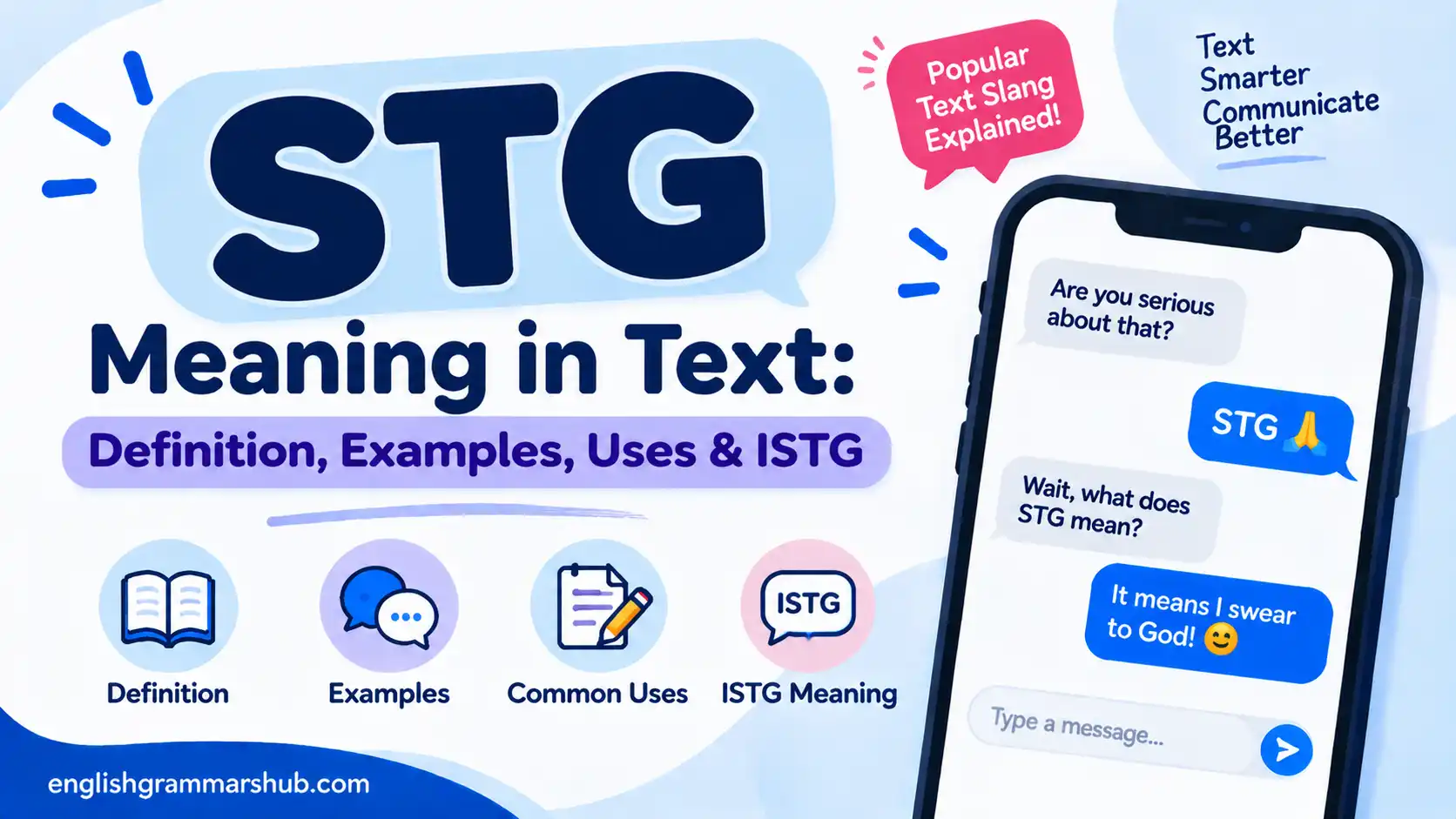
People searching for STG meaning in text usually want to understand a slang abbreviation they saw in a message, comment, or social media post. Online conversations often use shortened phrases, and the meaning can change depending on the situation.
STG commonly means “Swear To God.” People use it to show that they are being serious, telling the truth, expressing strong feelings, or emphasizing an opinion. However, the tone depends on the conversation and the relationship between the speakers.
This guide explains what STG means, how people use it, what it means on social media, examples, related slang, and when to avoid using it.
Quick Answer
STG means “Swear To God” in texting and online conversations. People use it to emphasize honesty, surprise, frustration, or strong opinions.
The meaning depends on context. In casual chats, it usually works as an expression of emphasis rather than a literal promise.
TL;DR
• STG means “Swear To God” in text messages.
• It shows honesty, emphasis, surprise, or frustration.
• The meaning depends on the conversation tone.
• STG is informal and mainly used online.
• ISTG is a stronger version meaning “I Swear To God.”
• Avoid using STG in professional or formal writing.
What Does STG Stand For in Texting?
STG stands for “Swear To God.” It is an informal abbreviation commonly used in texting, social media comments, gaming chats, and private conversations.
The phrase is used when someone wants to make their statement sound more serious or believable. Instead of writing the complete phrase, users shorten it to three letters for faster communication.
Common meanings include:
• Showing that someone is telling the truth
• Adding emotional emphasis
• Expressing frustration or excitement
• Making a strong statement
Examples:
• “STG, I didn’t touch your phone.”
Meaning: The person strongly claims they are telling the truth.
• “STG this restaurant has the best burgers.”
Meaning: The person strongly emphasizes their opinion.
The phrase comes from everyday speech, where people sometimes say “swear to God” to stress honesty. Online users later shortened it into STG as texting became faster and more casual.
How Is STG Used in Text Messages?
STG is mostly used as an emotional expression. It does not always mean someone is making a serious promise. Often, it simply adds extra strength to a statement.
The meaning changes based on the speaker’s emotion, punctuation, and surrounding words.
Common uses include:
• Honesty or confirmation
Example:
“STG I already sent the file.”
Meaning:
The person wants the other person to believe them.
• Surprise or excitement
Example:
“STG that movie was incredible.”
Meaning:
The person strongly expresses their opinion.
• Frustration or annoyance
Example:
“STG if this app crashes again, I’m deleting it.”
Meaning:
The person is showing irritation.
• Strong agreement
Example:
“STG, that was the funniest video ever.”
Meaning:
The person strongly agrees or supports an idea.
STG Meaning Based on Tone and Context
The same abbreviation can feel different depending on the situation. Understanding tone is important because texting removes facial expressions and voice cues.
| Situation | Meaning of STG | Example |
|---|---|---|
| Serious statement | Strong honesty | “STG, I told you the truth.” |
| Excited reaction | Strong approval | “STG this song is amazing.” |
| Frustration | Emotional emphasis | “STG this homework is difficult.” |
| Argument | Trying to prove a point | “STG I wasn’t there.” |
A message like “STG I love this” sounds positive, while “STG I’m done with this” shows frustration.
The abbreviation itself is not positive or negative. The surrounding words create the meaning.
STG Meaning on Snapchat, TikTok, and Social Media
On platforms like Snapchat, TikTok, Instagram, and Discord, STG is usually used as casual internet slang.
Social media users often use abbreviations because they make conversations quicker and more expressive.
Common social media examples:
• “STG this trend is everywhere.”
• “STG my friend is hilarious.”
• “STG I watched this video ten times.”
On these platforms, STG often works like phrases such as:
• “Honestly”
• “I’m serious”
• “For real”
• “I promise”
However, slang changes quickly. A person’s age, online community, and personal style can affect how they use abbreviations.
STG Examples in Real Conversations
Real examples make the meaning clearer because slang depends heavily on context.
Example 1: Friends Talking
Friend: “Did you really finish the entire series today?”
Reply: “STG, I watched all eight episodes.”
Meaning: The person emphasizes that they are telling the truth.
Example 2: Talking About Food
Friend: “Is that restaurant actually good?”
Reply: “STG, their pizza is amazing.”
Meaning: The person strongly recommends something.
Example 3: During an Argument
Person A: “You deleted my message.”
Person B: “STG, I didn’t delete anything.”
Meaning: The speaker is strongly denying the accusation.
Example 4: Social Media Comment
“STG this video made me laugh so much.”
Meaning: The person strongly emphasizes their reaction.
STG vs ISTG: What Is the Difference?
STG and ISTG have similar meanings, but they are not exactly the same. Both expressions come from the phrase “Swear To God,” but the extra letter changes the sentence structure.
STG is a shortened form of the phrase, while ISTG means “I Swear To God.” ISTG directly includes the speaker, making it sound more personal.
| Abbreviation | Full Meaning | Common Use |
|---|---|---|
| STG | Swear To God | General emphasis or strong statement |
| ISTG | I Swear To God | Personal promise, frustration, or strong reaction |
Examples:
STG:
“STG this is the best game ever.”
Meaning:
The person strongly expresses an opinion.
ISTG:
“ISTG I didn’t take your charger.”
Meaning:
The person personally insists they are telling the truth.
In everyday texting, many people use both terms casually. The difference is usually about emphasis rather than a completely different meaning.
STG vs Other Similar Texting Abbreviations
Modern texting uses many short expressions to show emotions quickly. STG belongs to a group of abbreviations that add emphasis or show a reaction.
Understanding similar slang can prevent confusion.
| Slang | Meaning | How It Is Used |
|---|---|---|
| STG | Swear To God | Shows honesty or strong feelings |
| ISTG | I Swear To God | Personal emphasis |
| FR | For Real | Shows agreement or seriousness |
| NGL | Not Gonna Lie | Introduces an honest opinion |
| TBH | To Be Honest | Shares a personal thought |
| OMG | Oh My God | Shows surprise or excitement |
| IDK | I Don’t Know | Shows uncertainty |
Examples:
• “FR, that was amazing.”
Meaning: “Seriously, that was amazing.”
• “NGL, I expected better.”
Meaning: “Honestly, I expected better.”
• “STG, I wasn’t joking.”
Meaning: “I’m seriously telling the truth.”
These expressions often overlap because texting slang focuses more on emotion and tone than strict grammar rules.
Is STG a Bad Word or Offensive?
STG is not usually considered a bad word, but some people may find it inappropriate depending on their beliefs or situation.
The phrase behind STG includes a reference to God, which can matter to people who consider religious expressions serious. Some users write it casually without intending disrespect, while others may avoid it for personal reasons.
The appropriateness of STG depends on:
• The audience
• The relationship between speakers
• The conversation topic
• Personal beliefs about religious language
Casual Situations Where STG Is Common
• Texting friends
• Social media comments
• Gaming conversations
• Informal group chats
Situations Where It May Not Be Suitable
• Professional emails
• Job applications
• Formal reports
• Academic writing
A more neutral alternative could be:
• “Honestly”
• “Seriously”
• “I promise”
• “I truly mean that”
STG Meaning From a Girl or Guy
People sometimes search for “STG meaning from a girl” or “STG meaning from a guy.” However, STG does not have a different meaning based on gender.
A girl or guy using STG is usually expressing the same ideas:
• They want to emphasize honesty
• They feel strongly about something
• They are reacting emotionally
• They want someone to believe them
The real meaning depends on the conversation.
Examples:
“STG I miss you.”
Possible meaning:
The person is strongly expressing their feelings.
“STG I didn’t do it.”
Possible meaning:
The person is defending themselves.
The relationship between the people matters more than who uses the abbreviation.
When Should You Use STG?
STG works best in relaxed conversations where slang is expected. It can make messages sound more emotional and natural between friends.
Good situations for using STG:
• Casual conversations with friends
• Social media replies
• Online gaming chats
• Personal messages
• Informal discussions
Examples:
• “STG that was the funniest thing today.”
• “STG I need coffee right now.”
• “STG this update changed everything.”
Before using it, consider whether the other person understands texting slang. Some people may not recognize abbreviations, especially in mixed-age conversations.
When Should You Avoid Using STG?
Although STG is common online, it is not appropriate for every type of communication.
Avoid using STG in:
• Workplace messages
• Business communication
• School assignments
• Formal presentations
• Official documents
Instead of:
“STG, I completed the task.”
Use:
“I confirm that I completed the task.”
Instead of:
“STG this information is correct.”
Use:
“I can confirm that this information is accurate.”
Formal writing usually requires clear language rather than internet abbreviations.
Common Mistakes When Understanding STG
Many misunderstandings happen because people read slang without considering context.
Common mistakes include:
• Assuming STG always means a serious promise
• Thinking STG is always negative
• Using it in formal writing
• Confusing STG with ISTG
• Ignoring the tone of the conversation
• Believing slang has one fixed meaning everywhere
• Forgetting that online language changes over time
• Using abbreviations with people who may not understand them
A useful rule:
Always read the complete message before deciding what a slang abbreviation means.
The same abbreviation can express different emotions depending on the situation.
How to Reply When Someone Says STG
The best reply depends on why the person used STG.
If Someone Is Proving They Are Honest
Message:
“STG I didn’t delete it.”
Possible replies:
• “Okay, I believe you.”
• “Alright, thanks for explaining.”
• “Got it.”
If Someone Is Sharing Excitement
Message:
“STG this song is amazing.”
Possible replies:
• “I agree!”
• “Same, I love it too.”
• “I need to listen to it.”
If Someone Is Complaining
Message:
“STG this app keeps crashing.”
Possible replies:
• “That sounds frustrating.”
• “Yeah, I noticed that too.”
• “Hopefully they fix it soon.”
There is no single correct response. The best reply matches the person’s emotion and the conversation.
Why Do People Use STG in Online Conversations?
People use abbreviations like STG because digital communication is fast and emotion-focused. Short forms help users express feelings without typing longer phrases.
STG can make a message feel:
• More personal
• More emotional
• More dramatic
• More conversational
Text messages do not include facial expressions or voice tone, so people often use slang to add emotion.
For example:
“This movie is good.”
sounds neutral.
“STG this movie is amazing.”
shows stronger excitement.
However, slang should support communication, not replace clear meaning. Good communication depends on knowing your audience.
STG Meaning for English Learners
English learners may find texting abbreviations confusing because they often do not appear in traditional grammar lessons or dictionaries.
Understanding slang helps learners follow:
• Social media posts
• Online conversations
• Movies and shows
• Casual messages
When learning slang:
• Learn the full phrase first
• Study examples in context
• Notice the speaker’s emotion
• Avoid using slang before understanding it
• Remember that informal language changes quickly
STG is not a grammar rule. It is an example of informal English used in digital communication.
STG Meaning: Quick Summary and Final Tips
The most important points to remember:
• STG means “Swear To God” in texting.
• It is used to show honesty, emphasis, or strong emotions.
• The meaning changes depending on context.
• It is common in casual online conversations.
• ISTG means “I Swear To God” and is closely related.
• It is usually not suitable for formal writing.
• Always consider the audience before using slang.
Learning internet expressions like STG can help you understand modern conversations, but clear communication should always come first.
Frequently Asked Questions About STG Meaning in Text
What does STG mean in texting?
STG means “Swear To God” in texting and online messages. People use it to emphasize that they are being honest or serious.
The exact feeling can change depending on the situation, such as excitement, frustration, or agreement.
What does STG mean on Snapchat?
On Snapchat, STG usually means “Swear To God.” Users often add it to messages or captions when they want to strongly emphasize a statement.
It is mainly used in casual conversations.
Is STG the same as ISTG?
No. STG and ISTG are related but slightly different.
STG means “Swear To God,” while ISTG means “I Swear To God.” ISTG includes the speaker directly, making it sound more personal.
Can STG be used in formal writing?
No. STG is informal internet slang and should generally be avoided in professional or academic writing.
Formal communication should use complete phrases such as “I confirm,” “honestly,” or “I assure you.”
What does STG mean from a girl or guy?
STG has the same meaning regardless of who uses it. A girl or guy using STG is usually expressing honesty, emphasis, or a strong reaction.
The conversation context matters more than the speaker’s gender.
Why do people say STG online?
People use STG online because it quickly adds emotion and emphasis to messages.
It helps users show that they are serious, surprised, excited, or trying to prove a point.
Conclusion
STG meaning in text is simple: it usually stands for “Swear To God” and is used to add emphasis in casual conversations. The meaning depends on the speaker’s tone, situation, and relationship with the reader.
Understanding slang like STG helps you follow modern online communication, but knowing when to use it matters. Use informal abbreviations with the right audience and choose clear language for important conversations.