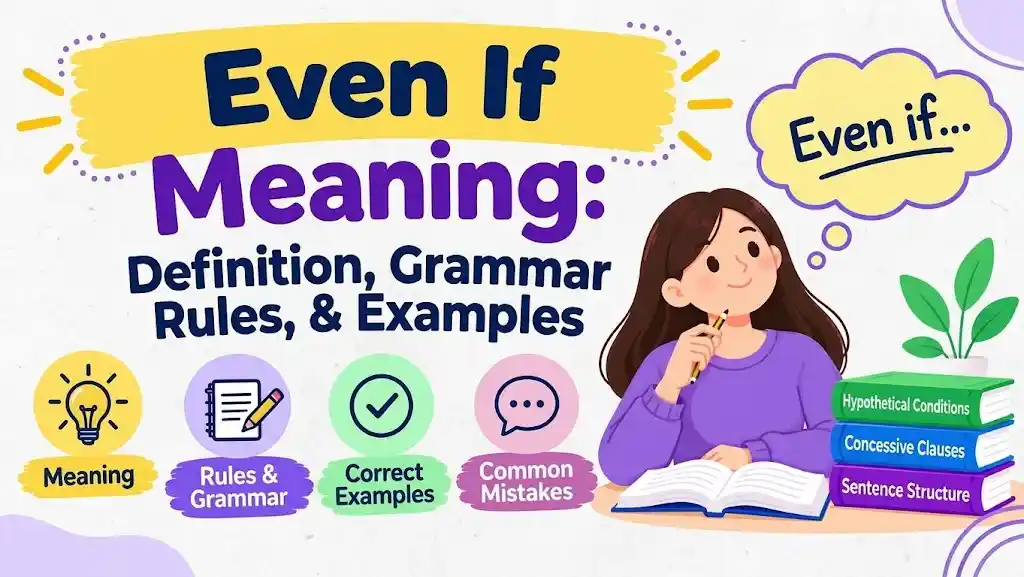
If you are learning English grammar, understanding even if Meaning can help you express conditions more clearly. The phrase shows that something will remain true or happen despite a possible condition.
In this guide, you’ll learn the even if meaning, how to use it correctly, and how it differs from if, even though, although, even when, and even so. You’ll also find sentence patterns, punctuation rules, common mistakes, and practical examples.
Quick Answer
Even if means “whether or not” something happens. It introduces a condition that does not change the main result.
For example, “Even if it rains, we will go” means the rain will not change our decision.
TL;DR
• Even if means “whether or not.”
• It introduces a condition that does not change the outcome.
• If usually makes the result depend on a condition.
• Even though usually introduces a known fact.
• Future conditions commonly use present tense after even if.
• Use a comma after an opening even-if clause.
What Does Even If Mean?
Even if is used when a condition might happen, but that condition will not change the main result. It often has a meaning similar to “whether or not.”
Consider this sentence:
Even if the weather gets worse, we will continue the trip.
The weather getting worse is a possibility. However, the speaker has already decided to continue.
That is the main idea behind even if: the condition does not control the outcome.
Simple Examples
• Even if I am tired, I will finish my homework.
• Even if the store is crowded, we will go inside.
• I will help you even if you make a mistake.
• Even if she disagrees, she will respect your decision.
How Do You Use Even If in a Sentence?
Even if introduces a condition and connects it to a main result. The condition can appear at the beginning or end of the sentence.
The most common pattern is:
Even if + condition, + main result.
Example:
Even if the train is late, I will wait.
You can reverse the order:
I will wait even if the train is late.
Both sentences have the same basic meaning. The difference is mainly in emphasis and punctuation.
Common Sentence Patterns
| Pattern | Example |
|---|---|
| Even if + present, will + verb | Even if it rains, we will leave. |
| Even if + past, would + verb | Even if I had time, I would not go. |
| Even if + past perfect, would have + past participle | Even if she had called, I would have left. |
| Main clause + even if + condition | We will leave even if it rains. |
Even If vs. If: What’s the Difference?
The difference becomes clear when you ask whether the condition changes the result.
With if, the condition can control what happens:
If it rains, we will stay home.
Here, rain changes the plan.
With even if, the result stays firm:
Even if it rains, we will go.
Here, rain does not change the plan.
A Quick Test
Ask yourself:
Does the condition change the result?
- If yes, if may be appropriate.
- If no, even if may be the better choice.
For example:
If I finish early, I will call you.
Finishing early affects the decision.
Even if I finish early, I will not call you.
Finishing early does not change the decision.
This distinction is one of the easiest ways to understand the difference between if and even if.
Even If vs. Even Though
Even if and even though look similar, but they do not normally express the same type of situation.
Use even if for a possible or hypothetical condition.
Even if it rains tomorrow, we will play.
The rain is possible.
Use even though for a fact or situation treated as real.
Even though it rained yesterday, we played.
The rain actually happened.
Compare Them
| Expression | Main idea | Example |
|---|---|---|
| even if | Possible condition | Even if it rains, we will go. |
| even though | Known fact | Even though it rained, we went. |
A useful memory trick is:
If = condition.
Even though = fact.
This is not an absolute rule for every possible context, but it works well for ordinary learner examples.
Even If vs. Although and Though
Although and though generally introduce a contrast involving a situation presented as real or established.
Although she was tired, she finished the report.
The speaker presents her tiredness as a fact.
Compare:
Even if she becomes tired, she will finish the report.
Now tiredness is a possible condition.
Though can also be more conversational than although, especially in everyday speech. The choice depends on the sentence and tone.
Even If vs. Even When
The difference between even if and even when is subtle but useful.
Even if focuses on a condition.
Even if I feel nervous, I will give the speech.
Feeling nervous may or may not happen.
Even when often focuses on a time or recurring situation.
She stays calm even when she feels nervous.
This suggests that the situation happens repeatedly.
Remember the Difference
• even if → condition or possibility
• even when → time or recurring situation
The two can sometimes overlap, so context matters.
Even If vs. Even So
These expressions perform different jobs.
Even if introduces a condition:
Even if the exam is difficult, I will take it.
Even so usually means “despite that” or “nevertheless.”
The exam was difficult. Even so, I passed.
Notice the structure. Even if is part of a conditional clause, while even so connects an idea to something already stated.
How to Use Even If for Future Situations
When even if introduces a future condition, English commonly uses the present tense inside the condition clause.
Use:
Even if it rains tomorrow, we will go.
Not:
Even if it will rain tomorrow, we will go.
The future meaning comes from the entire sentence, so will is usually unnecessary inside the condition clause.
More Examples
• Even if she arrives late, we will start the meeting.
• Even if traffic gets worse, we will leave on time.
• Even if the price increases, they will buy the house.
• Even if I feel nervous, I will give the presentation.
This pattern is especially useful when writing about plans, predictions, promises, and decisions.
How to Use Even If for Hypothetical Situations
Even if can introduce an imagined or unlikely situation.
A common pattern is:
Even if + past form, + would + base verb
For example:
Even if I had more money, I would not buy that car.
Here, had does not necessarily refer to the past. It creates distance from reality and presents an imagined situation.
Another example:
Even if she knew the answer, she would not tell us.
The speaker is imagining the situation and explaining what the result would be.
Important Point
A past verb after even if does not always mean the event happened in the past.
Compare:
Even if I had enough money, I would save it.
This discusses a hypothetical situation now.
Even if I had saved enough money, I would have bought it.
This discusses an imagined past situation.
How to Use Even If for Past Hypotheticals
For an unreal past condition, English commonly uses a past perfect condition followed by a result with would have.
The pattern is:
Even if + had + past participle, + would have + past participle
Example:
Even if I had studied harder, I would not have passed.
The speaker is imagining a different past condition and its possible result.
More examples:
• Even if she had called, I would have left.
• Even if they had arrived earlier, they would have missed the announcement.
• Even if we had known about the problem, we could not have fixed it.
The exact modal can vary with meaning. Would have expresses an imagined result, while could have can express an imagined possibility or ability.
Where Does the Comma Go With Even If?
When the even-if clause comes first, place a comma before the main clause.
Even if the weather changes, we will continue.
When the main clause comes first, a comma is normally unnecessary.
We will continue even if the weather changes.
Do not put the comma immediately after even if.
❌ Even if, the weather changes, we will continue.
✅ Even if the weather changes, we will continue.
The comma separates the dependent clause from the main clause.
Common Even If Mistakes
Using Even Though for a Future Possibility
❌ Even though it rains tomorrow, we will go.
✅ Even if it rains tomorrow, we will go.
The second sentence treats tomorrow’s rain as a possible condition.
Using Will Inside a Normal Future Condition
❌ Even if it will rain, we will go.
✅ Even if it rains, we will go.
The present form rains can express a future condition here.
Confusing If With Even If
If the store closes, we will leave.
The store closing affects the result.
Even if the store closes, we will stay.
The store closing does not change the result.
Writing “If Even”
❌ If even it rains, we will go.
✅ Even if it rains, we will go.
The standard expression is even if.
Assuming Even If Means an Impossible Situation
Even if can describe a realistic possibility.
Even if traffic is heavy, we should arrive by six.
Heavy traffic is a real possibility. The phrase does not automatically make the condition imaginary.
Even If Examples in Everyday English
You will often see even if when someone describes a decision that will not change.
School and Learning
• Even if the test is difficult, I will stay calm.
• She will submit her assignment even if she needs extra time.
Work
• Even if the deadline changes, we can adjust the schedule.
• I will finish the report even if I have to work late.
Travel
• Even if traffic is heavy, we will leave at six.
• We will take the trip even if the weather changes.
Relationships
• Even if we disagree, I will listen to your opinion.
• I will support you even if your plan changes.
Everyday Decisions
• Even if the restaurant is crowded, we can wait.
• I will call you even if I get home late.
These examples all share the same idea: the condition does not overturn the main decision.
Is Even If Formal or Informal?
Even if is standard English and is neither strongly formal nor strongly informal.
You can use it in:
• everyday conversation
• text messages
• school writing
• workplace emails
• reports
• presentations
• formal writing
The phrase itself does not make a sentence casual or formal. The surrounding vocabulary and sentence structure determine the overall tone.
For example:
Even if you’re busy, give me a call.
This sounds conversational.
Even if circumstances change, the policy will remain in effect.
This sounds more formal.
A Simple Way to Remember Even If
When you are unsure whether to use if or even if, focus on the result.
Step 1: Find the condition
Ask what might happen.
It might rain.
Step 2: Find the result
Ask what will happen because of it.
We will go hiking.
Step 3: Ask whether rain changes the decision
If rain changes the decision:
If it rains, we will stay home.
If rain does not change the decision:
Even if it rains, we will go hiking.
This condition-versus-result test is often easier than memorizing a grammar definition.
Practice: Choose If, Even If, or Even Though
Complete each sentence with if, even if, or even though.
- _____ it rains tomorrow, we will still play.
- _____ she was tired, she finished the report.
- _____ you leave now, you may arrive on time.
- _____ I disagree with you, I will respect your opinion.
- _____ I had more money, I would still save most of it.
Answers
- Even if it rains tomorrow, we will still play.
- Even though she was tired, she finished the report.
- If you leave now, you may arrive on time.
- Even if I disagree with you, I will respect your opinion.
- Even if I had more money, I would still save most of it.
The key is to identify whether you have a condition, a fact, or a condition that does not change the result.
FAQs About Even If
What does “even if” mean in English?
Even if means that something will happen or remain true regardless of whether a particular condition occurs. It is often similar to “whether or not.”
For example, “Even if she says no, I will ask” means her possible refusal will not change the speaker’s decision.
Is “even if” the same as “whether or not”?
They often have very similar meanings, but they are not interchangeable in every sentence.
Even if focuses strongly on a condition, while whether or not can emphasize two possible alternatives.
Can “even if” be used for the future?
Yes. Even if commonly introduces future conditions.
Even if it rains tomorrow, we will go.
The condition clause normally uses the present tense, while the main clause can use a future form.
Is “even if” a subordinating conjunction?
Yes. Even if functions as a subordinating conjunction because it introduces a dependent clause.
For example:
Even if I am busy, I will help.
The bold clause depends on the main clause to form a complete idea.
Can I use “would” after even if?
Would is commonly used in the main clause of hypothetical sentences.
Even if I had more time, I would not change the plan.
The exact verb form depends on the type of conditional and the meaning you want to express.
Does “even if” always describe something unlikely?
No. Even if can describe a realistic possibility.
Even if traffic is heavy, we will arrive before noon.
Heavy traffic may be quite possible. The phrase simply shows that the condition will not change the expected result.
Conclusion
The clearest way to remember the even if meaning is to focus on the relationship between the condition and the result. If the condition happens but the result stays firm, even if is usually the right expression.
Use if when a condition affects the outcome, even though when you are contrasting a known fact, and even when when the focus is a recurring or time-based situation. Once you learn this distinction, even if becomes much easier to use naturally in everyday and formal English.