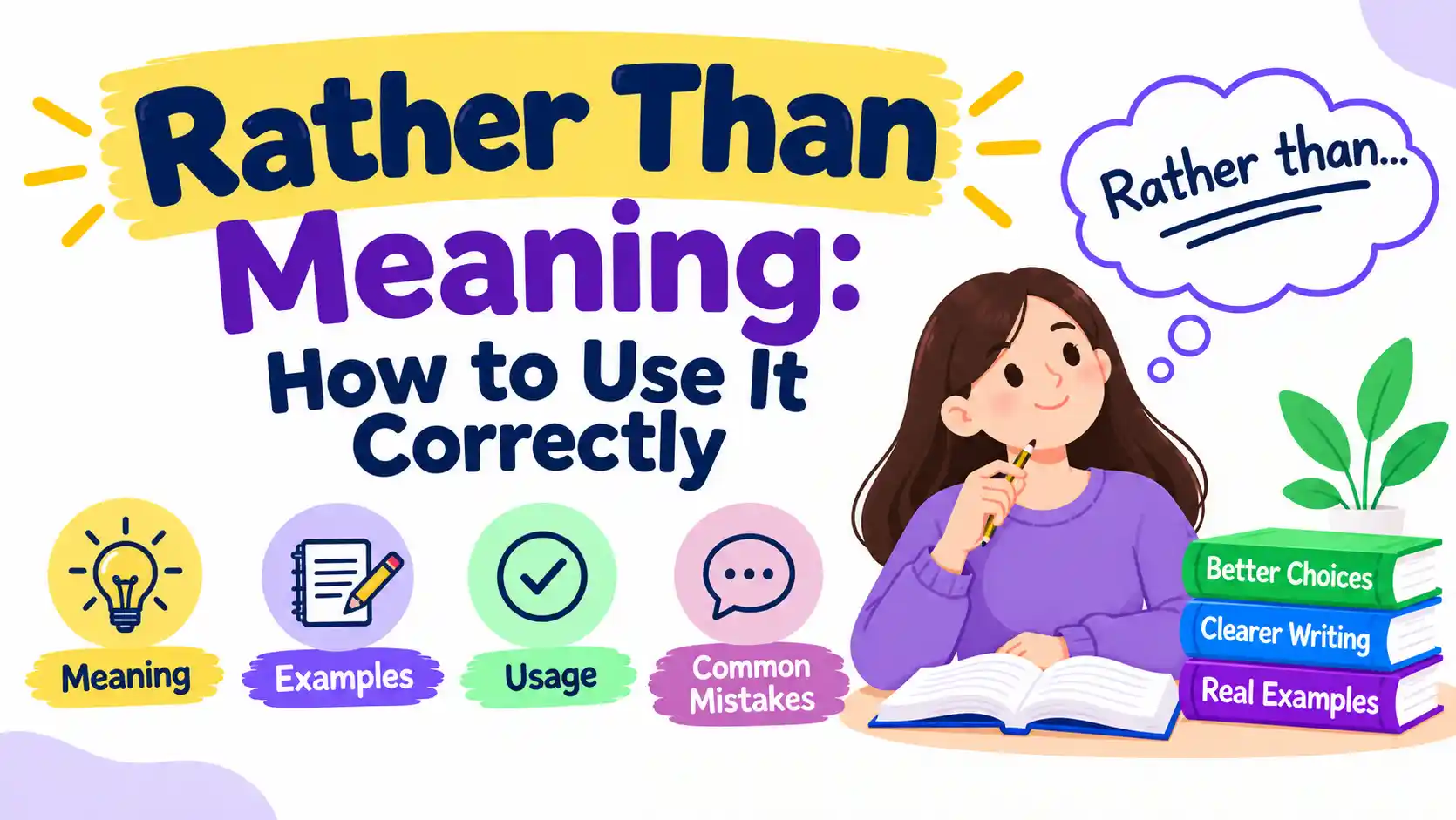
This guide explains rather than meaning, sentence patterns, verb forms, and common mistakes.
You’ll also learn how rather than compares with instead of and would rather in American English.
If you’re learning English, understanding rather than meaning can make comparison sentences much easier to read and write. The phrase commonly introduces an alternative or shows that one option is preferred.
This guide explains the main grammar patterns without unnecessary jargon. You’ll see clear examples, common mistakes, verb rules, comparisons, and short practice questions.
Quick Answer
Rather than means instead of or in preference to. It connects two alternatives and shows which option is chosen, preferred, or contrasted.
TL;DR
• Rather than introduces an alternative or preferred option.
• It can connect nouns, phrases, verbs, and clauses.
• A base verb can follow rather than.
• An -ing form can also follow it.
• Instead of often has a similar meaning.
• Don’t normally use to after rather than.
What Does Rather Than Mean?
Rather than usually means instead of or in preference to. It is used when two options are compared.
For example, “We walked rather than drove” tells us that walking was chosen instead of driving. “She chose tea rather than coffee” compares two things.
The phrase does not always express a strong personal preference. It can simply show a contrast between two alternatives.
How Do You Use Rather Than?
Use rather than when you want to connect two alternatives. The alternatives can be things, actions, descriptions, places, or larger ideas.
Examples:
• She chose tea rather than coffee.
• We walked rather than drove.
• He focused on accuracy rather than speed.
• They met online rather than in person.
• I listened rather than interrupted.
• Rather than wait, we left.
• Rather than argue, she asked a question.
• He repaired the chair rather than replacing it.
The phrase can appear in the middle or at the beginning of a sentence.
Rather Than for Preferences
Rather than often shows that one option is preferred over another. This is especially clear when the sentence contains verbs such as choose, prefer, decide, or want.
Consider these examples:
• I chose water rather than soda.
• She decided to walk rather than drive.
• We prefer quiet places rather than crowded ones.
• He wanted to study rather than play games.
• They chose quality rather than speed.
• I would choose the train rather than the bus.
• She decided to call rather than text.
• We preferred staying home rather than going out.
With prefer, remember that prefer X to Y is also a standard structure.
Rather Than vs Instead Of
Rather than and instead of often express the same basic alternative. For example, these sentences have very similar meanings:
We walked rather than drove.
We walked instead of driving.
The main difference is often grammatical structure rather than basic meaning. Instead of is commonly followed by a noun, pronoun, or -ing form. Rather than has more flexibility and can introduce a base verb in many constructions.
Choose the form that makes the sentence clear and natural.
What Comes After Rather Than?
Several structures can follow rather than. The correct form depends on what you are comparing.
Common Patterns
• Noun + rather than + noun: She chose tea rather than coffee.
• Pronoun + rather than + pronoun: They invited me rather than him.
• Verb + rather than + base verb: We decided to walk rather than drive.
• Rather than + base verb: Rather than wait, we left.
• Rather than + -ing: Rather than waiting, we left.
• Phrase + rather than + phrase: We met online rather than at the office.
• Adjective + rather than + adjective: The result was surprising rather than disappointing.
• Clause + rather than + clause: He apologized rather than defend his decision.
The important point is to look at the structure surrounding the phrase.
Rather Than + Base Verb
A base verb can follow rather than. This pattern is especially common when two actions are being compared.
Examples:
• She decided to stay rather than leave.
• We chose to walk rather than drive.
• He listened rather than argue.
• I waited rather than complain.
• They stopped rather than continue.
• She smiled rather than react angrily.
• We checked the facts rather than guess.
• He apologized rather than defend himself.
Do not normally insert to immediately after rather than in these constructions.
Natural: Rather than wait, we left.
Not standard: Rather than to wait, we left.
Rather Than + -Ing
An -ing form is also possible after rather than, especially when the phrase functions as an introductory or modifying phrase.
Examples:
• Rather than waiting, we left.
• Rather than driving, she took the train.
• Rather than arguing, they listened.
• Rather than buying another phone, he repaired his old one.
• Rather than rushing, check your work.
• Rather than complaining, offer a solution.
• Rather than staying home, we visited friends.
• Rather than guessing, read the instructions.
Both rather than wait and rather than waiting can be natural. The surrounding sentence determines which structure fits best.
Rather Than With Nouns, Adjectives, and Adverbs
You can use rather than to compare more than actions. It can connect nouns, adjectives, adverbs, and other phrases.
Examples:
• She chose tea rather than coffee.
• The room was quiet rather than crowded.
• He spoke calmly rather than angrily.
• They wanted quality rather than quantity.
• We focused on accuracy rather than speed.
• The change was helpful rather than harmful.
• She worked carefully rather than quickly.
• He became a teacher rather than an engineer.
The comparison should make logical sense to the reader.
Rather Than With Longer Phrases and Clauses
Longer structures work when the reader can easily identify the two alternatives.
For example:
We decided to meet online rather than at the office.
The comparison is between meeting online and meeting at the office.
Another example is:
She chose to explain the problem rather than blame someone else.
The comparison is between explaining and blaming.
When sentences become longer, keep the relationship between the alternatives clear.
Parallel Structure With Rather Than
Parallel structure means using similar grammatical forms for related ideas. It often makes comparisons easier to read.
Compare these useful patterns:
• Noun + noun: accuracy rather than speed
• Adjective + adjective: useful rather than confusing
• Adverb + adverb: carefully rather than quickly
• -ing + -ing: reading rather than watching
• Base verb + base verb: walk rather than drive
• Phrase + phrase: online rather than in person
Parallel structure is a useful writing principle, not a reason to declare every different-looking construction wrong. Natural English allows several structures with rather than.
Rather vs Rather Than
The words rather and rather than have different uses.
Rather can mean to some degree:
The movie was rather long.
Here, rather modifies the adjective long.
Rather than introduces an alternative:
We watched the movie rather than the show.
The phrase can also appear in or rather, which corrects or makes a previous statement more precise:
She is a teacher, or rather, a school administrator.
Rather Than vs Would Rather
Would rather expresses what someone prefers to do. Its common pattern is:
would rather + base verb
Examples:
• I would rather stay home.
• She would rather walk.
• They would rather wait.
• He’d rather read than watch television.
By comparison:
I stayed home rather than go out.
This sentence compares two actions. The two structures are related, but they are not interchangeable in every sentence.
Is Rather Than Formal or Informal?
Rather than works in everyday English and formal writing. It does not belong exclusively to either style.
You might see it in a conversation:
I walked rather than drove.
You can also see it in professional writing:
The report emphasizes accuracy rather than speed.
Your choice should depend on the sentence and the tone you need.
Does Rather Than Need a Comma?
A comma is not automatically required before rather than.
Short comparisons usually do not need one:
We chose the train rather than the bus.
An introductory phrase may be followed by a comma:
Rather than wait, we left.
Longer sentences may use punctuation when it helps the reader understand the structure. Avoid treating the comma as a fixed rule that applies to every use.
Common Mistakes With Rather Than
These mistakes usually involve the wrong verb form or an unclear comparison.
• Wrong: Rather than to wait, we left.
• Better: Rather than wait, we left.
• Awkward: She enjoys reading rather than watch movies.
• Better: She enjoys reading rather than watching movies.
• Wrong: He chose tea rather than to coffee.
• Better: He chose tea rather than coffee.
• Better: We decided to walk rather than drive.
• Better: Rather than complain, she offered a solution.
• Better: They focused on quality rather than speed.
• Better: Rather than rushing, check your work.
Rather Than Examples and Practice
Use the following examples as quick practice. First identify the two alternatives, then check whether the sentence sounds natural.
• I chose water rather than soda.
• She walked rather than drove.
• We stayed home rather than go out.
• Rather than argue, he listened.
• They worked online rather than in person.
• She studied rather than watched television.
• Rather than buying another laptop, he repaired his old one.
• We checked the instructions rather than guessing.
Practice
Choose the best word or phrase:
I decided to walk ______ take the bus.
Rather than ______, she asked for help.
They chose tea ______ coffee.
We stayed home rather than ______ out.
Answers
rather than
argue
rather than
go
The key is to identify what the phrase connects. Then choose a form that fits the surrounding structure.
FAQs
What does rather than mean?
Rather than usually means instead of or in preference to. It introduces an alternative or comparison.
Can rather than be followed by a verb?
Yes. A base verb can follow it in many constructions, such as “rather than wait” or “rather than drive.”
Can rather than be followed by an -ing form?
Yes. You can say rather than waiting, rather than driving, or rather than arguing. The surrounding sentence determines the most natural construction.
Is rather than the same as instead of?
They often have similar meanings. However, their grammatical patterns differ in some constructions, so you cannot always replace one with the other word for word.
Can rather than start a sentence?
Yes. For example, “Rather than complain, she offered a solution.” This pattern is common and natural.
Is “rather than to” correct?
Usually not when rather than directly introduces a verb. Use the base form instead: rather than go, not rather than to go.
What is the difference between rather and rather than?
Rather can mean “to some degree,” while rather than commonly introduces an alternative. For example, “rather difficult” and “rather than difficult” have different functions.
Conclusion
Rather than means instead of or in preference to and helps compare choices, actions, descriptions, and alternatives. It can work with nouns, phrases, clauses, base verbs, and -ing forms.
When you use it, identify the two alternatives first and check that the sentence is clear. For more practice, compare rather than, instead of, and would rather in your own sentences.