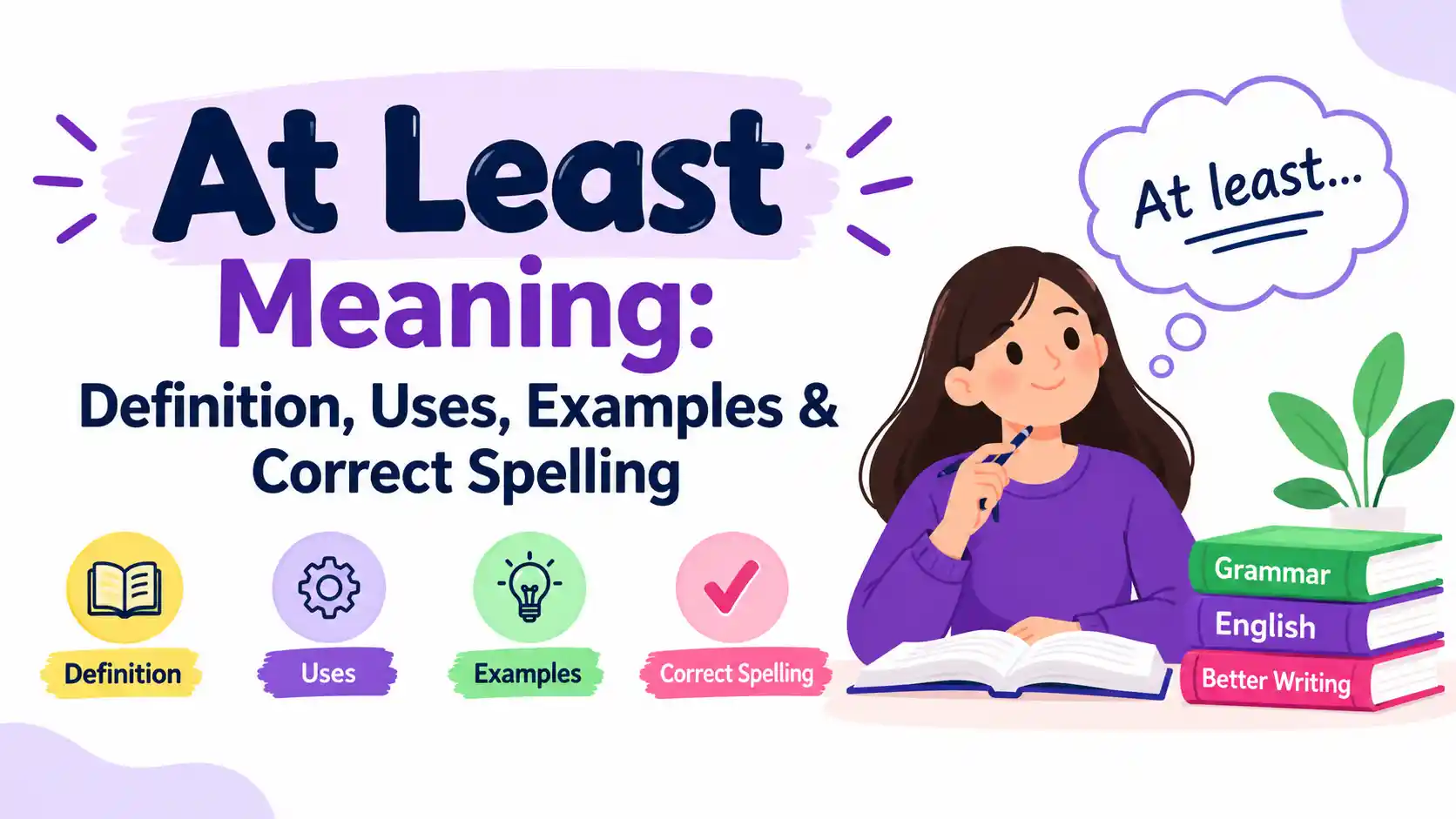
At least meaning is a common English phrase that usually means “no less than” or “a minimum of.” For example, “You need at least three days” means you need three days or more.
But at least is not limited to numbers. You can also use it to express a minimum expectation, point out something positive in a bad situation, or soften and correct something you have just said.
This guide explains the at least meaning, correct spelling, grammar, common uses, differences from similar expressions, and practical examples so you can use the phrase naturally in both everyday and formal English.
At Least or Atleast: Which Is Correct?
The correct form is at least, written as two separate words.
Atleast is a common misspelling, but it is not the standard written form of the expression.
| Form | Correct? | Example |
|---|---|---|
| at least | ✅ Yes | We need at least five volunteers. |
| atleast | ❌ No | We need atleast five volunteers. |
The mistake is easy to understand because at least can sound like one smooth unit when spoken quickly. That does not change its standard written form.
Easy way to remember the spelling
Think of the phrase as two parts:
- at
- least
They stay separate even when they appear together frequently.
You will also see the longer expressions at the least and at the very least, which reinforce the fact that least does not combine with at into one standard word.
Correct: “I need at least an hour.”
Incorrect: “I need atleast an hour.”
For standard English writing—including schoolwork, professional communication, websites, and academic work—use at least.
What Does “At Least” Mean?
The basic at least meaning is a minimum or lower limit. If something is “at least 10,” the number could be 10, 11, 20, or any higher amount.
However, context can give at least several related functions.
The four main uses are:
| Use | Meaning | Example |
|---|---|---|
| Minimum | No less than a stated amount | Bring at least five copies. |
| Minimum expectation | A basic thing someone should do | You could at least call. |
| Positive point | One good thing in a difficult situation | At least nobody was hurt. |
| Qualification | Limits or corrects a previous statement | He lives nearby, at least I think so. |
This four-part distinction is important because simply memorizing “at least means minimum” does not explain many of the ways native speakers actually use the phrase. Cambridge and Collins both recognize these broader uses.
How “At Least” Shows a Minimum
The most common use of at least is to establish a minimum amount, number, or degree.
Think of it as setting a floor.
If a teacher says:
“You need at least 70% to pass.”
The floor is 70%. You can score 70%, 75%, 90%, or 100%, but anything below 70% does not meet the stated minimum.
More examples
- You need at least three references for the assignment.
- The journey will take at least two hours.
- We should arrive at least 15 minutes early.
- The apartment costs at least $1,200 a month.
- She has at least five years of experience.
- Please bring at least one form of identification.
- The box weighs at least 10 pounds.
- He visits his parents at least once a month.
The key idea is simple:
At least X = X or more
The actual amount may be greater than X.
At Least in Numbers, Time, Money, and Quantity
At least works naturally with numbers and measurements.
Numbers
At least 10 people attended the meeting.
This means 10 or more people attended.
Time
I need at least 30 minutes to finish the report.
The speaker needs 30 minutes or possibly longer.
Money
The repair will cost at least $500.
The expected cost is $500 or more.
Age
You must be at least 18 years old to apply.
The minimum age is 18.
Quantity
We need at least two liters of water.
Two liters is the minimum; more is acceptable.
A useful mathematical shortcut
You can think of:
At least 5 = ≥ 5
So these all follow the same pattern:
- At least 1 = 1 or more
- At least 10 = 10 or more
- At least 100 = 100 or more
- At least 50% = 50% or more
- At least 18 years old = 18 or older
This is one of the easiest ways to distinguish at least from at most.
“At Least” Can Describe a Minimum Expectation
Sometimes at least does not describe a number at all. Instead, it identifies the smallest action or effort someone expects.
This use is common in conversation and can carry a tone of disappointment, annoyance, or criticism.
For example:
You could at least text me.
The speaker may have expected more, but they believe sending a text was the minimum reasonable thing to do.
Compare these:
You should call me.
This is a general request.
You could at least call me.
This suggests that calling is the bare minimum the speaker expected.
More examples
- You could at least say thank you.
- She could at least explain what happened.
- They should at least let us know.
- He could at least apologize.
- You could at least give it a try.
- Please at least check the address before leaving.
Here, at least means something close to “if you do nothing else, do this.”
“At Least” Can Highlight One Good Thing
Another common use appears when something negative or disappointing has happened, but there is one positive fact worth mentioning.
For example:
The hotel was small, but at least it was clean.
The hotel being small is negative or disappointing. Its cleanliness is the positive point.
This use does not mean “a minimum of” in a numerical sense. Instead, at least draws attention to a benefit that remains despite a problem.
Examples
- The flight was delayed, but at least we arrived safely.
- I lost my notes, but at least I had a backup.
- The weather was cold, but at least it stayed dry.
- We missed the bus, but at least we weren’t late.
- The test was difficult, but at least I finished it.
- The room was small, but at least it had a window.
- The plan changed, but at least everyone agreed on the new one.
A useful replacement here is:
“One good thing is…”
For example:
The flight was delayed, but at least we arrived safely.
≈
The flight was delayed, but one good thing is that we arrived safely.
“At Least” Can Qualify or Correct a Statement
You can also use at least when you want to soften, qualify, or correct something you just said.
This is especially common when the speaker realizes that the original statement was too definite.
For example:
She lives in Chicago—or at least I think she does.
The speaker is no longer completely certain that she lives in Chicago.
Another example:
The meeting is tomorrow, at least according to my calendar.
The speaker is giving the information but also showing that it may not be completely certain.
Common patterns
You will often see:
- or at least…
- at least, I think…
- at least according to…
- at least for now
- at least as far as I know
Examples
- He knows the answer—or at least he says he does.
- The store should be open, at least according to its website.
- I think the package arrived yesterday, or at least recently.
- She agreed to help, at least that’s what she told me.
- The problem is solved, at least for now.
- I can finish it tomorrow, at least I hope so.
In these sentences, at least reduces the certainty or scope of the statement rather than setting a numerical minimum.
Where Does “At Least” Go in a Sentence?
The position of at least depends on what you want it to modify.
Before a number or amount
We need at least five chairs.
Here, it directly marks the minimum number.
Before a time expression
Give me at least an hour.
The speaker needs an hour or more.
Before an action
You could at least call.
Here, it identifies the minimum expected action.
After a statement
The plan worked, at least for now.
Here, it limits the scope of the claim.
At the beginning
At least nobody was injured.
Here, it introduces a positive point.
After “or”
She’ll arrive tomorrow—or at least that’s what she said.
Here, it qualifies the previous statement.
The important point is that position and context work together. The phrase does not have only one grammatical function.
At Least vs At Most
The easiest comparison is:
At least = minimum
At most = maximum
| Expression | Meaning | Example |
|---|---|---|
| At least 5 | 5 or more | Bring at least 5 copies. |
| At most 5 | 5 or fewer | Bring at most 5 copies. |
Imagine a boundary:
- At least 5 → 5 is the floor
- At most 5 → 5 is the ceiling
Compare these sentences
You need at least five people.
You need 5 or more.
You need at most five people.
You need 5 or fewer.
This distinction is especially useful in instructions, applications, measurements, mathematics, and formal writing.
At Least vs At Last
These phrases look similar, but they have completely different meanings.
| Phrase | Meaning | Example |
|---|---|---|
| At least | A minimum; a positive point; or a qualification | We need at least three people. |
| At last | Finally, after waiting or expecting something | At last, the bus arrived. |
Easy memory trick
Least → think minimum.
Last → think finally.
Compare:
We need at least three volunteers.
= We need three or more.
At last, we found the missing file.
= We finally found it.
Do not substitute one for the other.
At Least vs At the Least
At least and at the least can both express a minimum, and dictionaries recognize at the least as a related form. However, they do not always sound equally natural in every sentence.
In everyday English, at least is usually the straightforward choice.
Compare
It will take at least three days.
This is the natural everyday form.
It will take three days at the least.
This is possible, but the wording and emphasis are different.
You may also encounter:
At the least, we need some additional information.
Here, the phrase can function as an emphatic minimum.
For learners, the safest general rule is:
Use “at least” as the normal form unless the context specifically calls for “at the least.”
At Least vs At the Very Least
At the very least is an emphatic version of at least.
The word very strengthens the idea that something is the absolute minimum.
Compare
You should at least call her.
This identifies calling as a basic expectation.
You should at the very least call her.
This puts stronger emphasis on the fact that calling is the absolute minimum.
More examples:
- Bring at least two copies.
- Bring at the very least two copies.
- The trip will take at least three hours.
- The trip will take three hours at the very least.
- You could at least apologize.
- You could at the very least apologize.
The second version generally sounds more emphatic.
At Least vs At Minimum vs No Less Than
These expressions can overlap when describing a minimum, but they are not identical in tone.
| Expression | Basic meaning | Typical feel |
|---|---|---|
| At least | A minimum | Natural and flexible |
| At minimum | A minimum | Often more formal or technical |
| No less than | Not below a stated amount | More emphatic |
Examples
You need at least three references.
You need a minimum of three references.
You need no less than three references.
All three can communicate a lower limit, but at least is generally the most natural choice for ordinary conversation and writing.
No less than can also sound more emphatic:
The project required no less than 500 hours of work.
That wording draws attention to the surprisingly large amount.
Common Mistakes With “At Least”
Mistake 1: Writing “atleast”
❌ We need atleast four people.
✅ We need at least four people.
Mistake 2: Confusing “at least” with “at last”
❌ At least, the waiting is finally over.
If you mean finally, use at last.
✅ At last, the waiting is over.
Mistake 3: Confusing “at least” with “at most”
❌ “At least five” means five or fewer.
✅ “At least five” means five or more.
Mistake 4: Assuming “at least” always refers to numbers
It doesn’t.
You could at least call.
There is no numerical minimum here. The phrase identifies a minimum expected action.
Mistake 5: Treating “at least” and “at the very least” as completely different ideas
They share the same basic minimum concept.
At the very least simply adds emphasis.
Examples of “At Least” in Everyday English
Here are examples across different situations.
School
You need at least 80% to pass the course.
Work
Please arrive at least 10 minutes before the meeting.
Shopping
The jacket costs at least $75.
Travel
The journey will take at least four hours.
Family
You could at least call your parents.
Conversation
I think he lives nearby—or at least that’s what I remember.
Difficult situation
We lost the game, but at least we played well.
Formal writing
Applicants must have at least two years of relevant experience.
These examples show why the phrase is so versatile: the same two words can express a quantity, requirement, expectation, positive point, or qualification.
A Simple Test for Choosing the Right Meaning
When you see at least, ask what job the phrase is doing.
Step 1: Is there a number or measurable amount?
If yes, it probably means a minimum.
We need at least 20 chairs.
= 20 or more.
Step 2: Is someone asking for a basic action?
It may mean “if nothing else, do this.”
You could at least apologize.
Step 3: Is the situation mostly negative?
It may be introducing one positive point.
The car broke down, but at least nobody was injured.
Step 4: Is the speaker correcting or weakening a previous claim?
It may be qualifying the statement.
She knows him—or at least she says she does.
This four-step test is often more useful than memorizing a dictionary definition because it helps you understand why the speaker chose “at least” in that particular sentence.
Quick Practice: Can You Use “At Least” Correctly?
Choose the best interpretation of at least in each sentence.
1. “We need at least six volunteers.”
Answer: A minimum number.
Six is the minimum; more volunteers are acceptable.
2. “You could at least tell me what happened.”
Answer: A minimum expectation.
The speaker considers telling them the basic thing the other person should do.
3. “The restaurant was expensive, but at least the food was good.”
Answer: A positive point.
The food being good is one advantage in an otherwise negative situation.
4. “The meeting is Friday—or at least that’s what I was told.”
Answer: A qualification.
The speaker is reducing the certainty of the previous statement.
5. “At last, the package arrived.”
Answer: Not at least.
The correct phrase is at last because the sentence means finally.
FAQs About At Least
What does “at least” mean in simple English?
At least usually means a minimum or no less than. It can also introduce a positive point, express a minimum expectation, or qualify a statement.
Does “at least 5” include 5?
Yes. “At least 5” means 5 or more. The number 5 itself is included.
Is “atleast” one word?
No. The standard spelling is at least, with a space.
What is the opposite of “at least”?
When talking about a numerical limit, at most is the usual opposite.
At least 10 = 10 or more.
At most 10 = 10 or fewer.
Is “at least” formal or informal?
At least is standard English and works in both formal and informal writing. You can use it in conversation, emails, academic writing, instructions, and professional documents.
Does “at least” always mean a minimum number?
No. It can express a minimum action, a positive point, or a qualification.
What does “at the very least” mean?
At the very least means the absolute minimum and usually adds emphasis.
What is the difference between “at least” and “at last”?
At least usually expresses a minimum or related idea. At last means finally.
What is the difference between “at least” and “at most”?
At least sets a minimum; at most sets a maximum.
Can I use “at least” without a number?
Yes.
You could at least try.
Here, it expresses a minimum expected action rather than a numerical amount.
Is “at least” an idiom?
At least is commonly treated as a fixed phrase/idiomatic expression in dictionaries. Its meaning depends on context, especially when it is used for a minimum, qualification, expectation, or positive contrast.
Conclusion
The easiest way to remember at least is to think of it as setting a minimum.
At least five means five or more. But the phrase does more than describe numbers. It can identify a minimum expectation, highlight something positive in a difficult situation, or qualify a statement.
And when you’re checking the spelling, remember one simple rule:
At least is always written as two words in standard English.
If you can recognize which of its four main functions is being used—minimum, expectation, positive point, or qualification—you can understand and use at least naturally in almost any context.