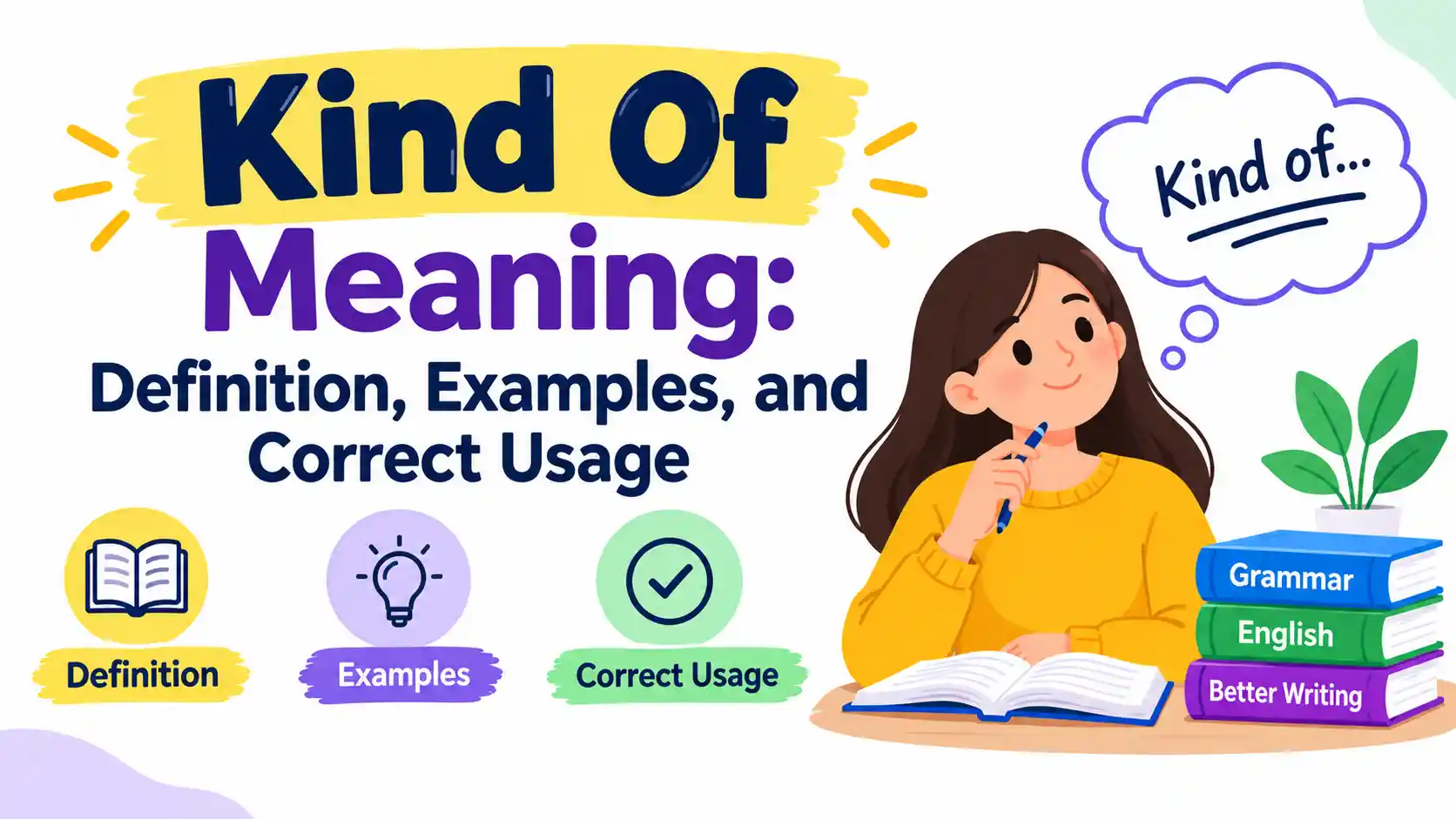
English learners often see or hear the phrase “kind of meaning ” in conversations, movies, and messages. The meaning can be confusing because it does not always refer to a “type” or “category.”
The phrase kind of meaning usually refers to two common uses: “somewhat/to a degree” and “a type or category of something.” Understanding the context helps you choose the correct meaning.
This guide explains how to use kind of in English, including examples, grammar rules, common mistakes, and differences between similar expressions like sort of, type of, and somewhat.
Quick Answer
Kind of has two main meanings in English. It can mean “somewhat” or “a little” when softening a statement, or it can mean **“a type of” or “a category of” something.
Example:
- “I’m kind of tired.” = I’m somewhat tired.
- “A dolphin is a kind of animal.” = A dolphin is a type of animal.
TL;DR
• Kind of can mean “somewhat” or “a type of something.”
• It is very common in casual American English conversations.
• Kind of often makes opinions sound softer and less direct.
• Kinda is an informal spoken spelling of kind of.
• Use type of when talking about categories.
• Use formal alternatives like somewhat in professional writing.
What Does Kind Of Mean in English?
The phrase kind of changes meaning depending on the sentence. In everyday speech, it often means “somewhat,” “rather,” or “to a certain degree.”
For example:
“The movie was kind of interesting.”
This does not mean the movie was extremely interesting. It means the speaker found it interesting to some extent.
The phrase can also describe a category or group. In this use, kind of means “a type of” or “a variety of.”
Examples:
- “A rose is a kind of flower.”
- “Jazz is a kind of music.”
The surrounding words usually make the meaning clear.
• Somewhat meaning:
“I’m kind of nervous.”
(I feel nervous, but not extremely.)
• Category meaning:
“A laptop is a kind of computer.”
(A laptop belongs to the computer category.)
The Two Main Uses of Kind Of
Understanding the two meanings of kind of helps avoid confusion. The same phrase can express an idea or describe a category.
The first use appears mostly in conversations. Speakers use it to make statements softer or less direct.
The second use is more literal. It describes what group something belongs to.
Use 1: Kind Of Meaning “Somewhat”
When kind of comes before an adjective, it often means a little, somewhat, or slightly.
Examples:
• “The test was kind of difficult.”
• “She looks kind of tired today.”
• “I’m kind of excited about the trip.”
The speaker is not saying something is completely true. Instead, the phrase reduces the strength of the statement.
Compare:
- “The food is bad.” → Strong opinion.
- “The food is kind of bad.” → Softer opinion.
Use 2: Kind Of Meaning “Type Of”
When kind of refers to a group or category, it means a type of something.
Examples:
• “A whale is a kind of animal.”
• “A sedan is a kind of car.”
• “English is a kind of language.”
In this meaning, kind of is similar to:
- type of
- category of
- variety of
How To Use Kind Of in Sentences
The position of kind of depends on the meaning you want to express. In everyday English, it commonly appears before adjectives and verbs.
Common sentence patterns include:
• Subject + be + kind of + adjective
Example:
- “The book is kind of boring.”
• Subject + kind of + verb
Example:
- “I kind of understand the idea.”
• A + kind of + noun
Example:
- “This is a kind of traditional music.”
More Examples
• “I’m kind of hungry, but I can wait.”
• “She kind of forgot about the meeting.”
• “That sounds kind of strange.”
• “A penguin is a kind of bird.”
Kind Of as a Softening Expression
Native English speakers often use kind of to make their words sound less direct. This is called a softening expression.
People use it when they want to be polite, uncertain, or careful with their opinions.
For example:
Direct:
“Your idea is wrong.”
Softer:
“Your idea is kind of difficult to apply.”
The second sentence sounds less harsh.
Common situations where speakers use kind of:
• Giving opinions
• Expressing uncertainty
• Making polite criticism
• Avoiding very strong statements
• Explaining feelings
Examples:
“I kind of disagree with that point.”
Meaning:
The speaker disagrees but wants to sound respectful.
“I’m kind of worried about the result.”
Meaning:
The speaker feels worried, but the phrase makes the emotion softer.
Kind Of Meaning in Casual Conversation
In American English, kind of is extremely common in everyday speech. You will hear it in conversations, interviews, movies, and social media.
It often shows that the speaker is thinking, explaining, or choosing careful words.
Example conversation:
Person A: Did you enjoy the restaurant?
Person B: Yeah, it was kind of nice.
Meaning:
The restaurant was enjoyable, but the speaker does not want to say it was amazing.
Another example:
Person A: Are you ready for the presentation?
Person B: I’m kind of ready.
Meaning:
The person is partly prepared but may still feel uncertain.
In informal speech, kind of can show:
• A mild opinion
• A mixed feeling
• Uncertainty
• A polite response
• A careful explanation
Kind Of vs Sort Of: Key Differences
Kind of and sort of are very similar. Both can mean “somewhat” and are often interchangeable in casual English.
Examples:
- “I’m kind of confused.”
- “I’m sort of confused.”
Both sentences mean the person is somewhat confused.
However, kind of is often more common in American English, while sort of is also very common, especially in British English.
| Phrase | Meaning | Example |
|---|---|---|
| Kind of | Somewhat or a type of | “I’m kind of tired.” |
| Sort of | Somewhat or a category | “It’s sort of unusual.” |
When talking about categories, both can work, but kind of is usually more natural:
- “A whale is a kind of animal.” ✓
- “A whale is a sort of animal.” ✓ but less common
Kind Of vs Type Of: Grammar Difference
The biggest difference between kind of and type of is formality and usage.
Type of sounds more specific and is common in technical or formal explanations.
Examples:
- “What type of computer do you use?”
- “What kind of music do you like?”
Both are correct, but what kind of is often more natural in everyday questions.
Compare:
Kind of:
“What kind of food do you like?”
Meaning:
What category or style of food?
Type of:
“What type of software is this?”
Meaning:
A more specific classification.
Kind Of vs A Kind Of: Usage Rules
Many learners confuse “kind of” and “a kind of” because the small word “a” changes the meaning.
When kind of means “somewhat,” it does not use an article.
Example:
“I’m kind of tired.”
Meaning:
I am somewhat tired.
However, when kind of means “a type of,” it often appears as “a kind of.”
Example:
“A tiger is a kind of animal.”
Meaning:
A tiger belongs to the animal category.
Compare the Difference
| Phrase | Meaning | Example |
|---|---|---|
| kind of + adjective | somewhat | “The movie was kind of funny.” |
| a kind of + noun | a type/category | “A violin is a kind of instrument.” |
Common Mistake
Incorrect:
“She is a kind of tired.”
Correct:
“She is kind of tired.”
Why?
Because tired is an adjective, not a category.
Incorrect:
“A dolphin is kind of animal.”
Correct:
“A dolphin is a kind of animal.”
Why?
Because animal is a category.
Is Kind Of Formal or Informal?
The phrase kind of is grammatically correct, but its level of formality depends on how it is used.
In everyday conversations, it is extremely common. Native speakers use it naturally when sharing opinions, feelings, and uncertainty.
Examples:
• “I’m kind of busy right now.”
• “That answer is kind of confusing.”
• “The project is kind of difficult.”
In formal writing, kind of may sound too conversational when it means “somewhat.”
More Formal Alternatives
| Casual Phrase | Formal Alternative |
|---|---|
| kind of difficult | somewhat difficult |
| kind of unusual | relatively unusual |
| kind of important | somewhat important |
| kind of similar | slightly similar |
Example:
Casual:
“The results are kind of surprising.”
Formal:
“The results are somewhat surprising.”
When Kind Of Works Well
Use it in:
• Daily conversations
• Emails with a casual tone
• Social media posts
• Personal writing
• Friendly discussions
Avoid overusing it in:
• Academic writing
• Legal documents
• Professional reports
• Formal presentations
Kinda Meaning and Correct Usage
Kinda is an informal spelling of “kind of.”
People use it to represent natural speech, especially in:
• Text messages
• Online conversations
• Songs
• Informal writing
Examples:
“I’m kinda tired.”
Meaning:
“I’m kind of tired.”
“That’s kinda funny.”
Meaning:
“That’s somewhat funny.”
Is Kinda Correct English?
Yes, kinda is understood by native speakers, but it is considered informal.
Use:
✓ Text messages
✓ Casual chats
✓ Informal posts
Avoid:
✗ School essays
✗ Business reports
✗ Formal documents
Formal example:
Instead of:
“The plan is kinda risky.”
Write:
“The plan is somewhat risky.”
Common Mistakes With Kind Of
Many English learners understand the meaning but use the phrase incorrectly.
Mistake 1: Using “a” Before Adjectives
Incorrect:
“I’m a kind of hungry.”
Correct:
“I’m kind of hungry.”
Explanation:
When kind of means “somewhat,” do not add a.
Mistake 2: Confusing Category Meaning
Incorrect:
“A rose is kind of flower.”
Correct:
“A rose is a kind of flower.”
Explanation:
The category meaning needs a before “kind.”
Mistake 3: Using Kind Of in Every Sentence
Incorrect:
“This is kind of the best restaurant.”
Better:
“This is one of the best restaurants.”
Explanation:
Too much use can make writing sound uncertain.
Mistake 4: Using Kinda in Formal Writing
Incorrect:
“The results were kinda different.”
Better:
“The results were somewhat different.”
Mistake 5: Confusing Kind Of With Kindness
Incorrect idea:
“Kind of means being nice.”
Correct:
“Kind” and “kind of” have different meanings.
Examples:
• Kind person = a caring person
• Kind of music = a type of music
• Kind of tired = somewhat tired
Real-Life Examples of Kind Of
Understanding examples helps you recognize how native speakers use kind of naturally.
Everyday Conversation
Example 1
“I’m kind of hungry.”
Meaning:
The person feels a little hungry.
Example 2
“That movie was kind of boring.”
Meaning:
The movie was somewhat boring.
Example 3
“I kind of forgot about the appointment.”
Meaning:
The person forgot, but the phrase makes the admission softer.
Workplace Examples
In professional conversations, people sometimes use kind of to sound polite.
Example:
“The report is kind of unclear.”
Meaning:
The report needs improvement, but the speaker is expressing criticism gently.
More formal version:
“The report needs more clarity.”
Example:
“The deadline is kind of difficult to meet.”
Meaning:
The deadline may be challenging.
Text Message Examples
In online conversations, kind of is common.
Example:
“I kind of miss those days.”
Meaning:
The person misses those days somewhat.
Example:
“That picture is kind of amazing.”
Meaning:
The picture is impressive, but the speaker uses softer wording.
Better Alternatives To Kind Of
Although kind of is natural, sometimes another phrase sounds clearer.
Alternatives for “Somewhat”
| Alternative | Example |
|---|---|
| somewhat | “The task is somewhat difficult.” |
| slightly | “The color is slightly darker.” |
| a little | “I’m a little tired.” |
| rather | “The movie was rather interesting.” |
| fairly | “The test was fairly easy.” |
Alternatives for Category Meaning
| Alternative | Example |
|---|---|
| type of | “A laptop is a type of computer.” |
| category of | “This belongs to a category of products.” |
| variety of | “This is a variety of apple.” |
| form of | “Writing is a form of communication.” |
Choose the alternative based on your meaning.
Practice Sentences With Kind Of
Choose the correct phrase.
Fill in the blanks:
- I’m ______ nervous about the interview.
- A whale is ______ animal.
- She ______ understands the problem.
- This is a ______ traditional food.
Answers:
- kind of
- a kind of
- kind of
- kind of
Sentence Correction Practice
Incorrect:
“This is kind of car.”
Correct:
“This is a kind of car.”
Incorrect:
“I am a kind of tired.”
Correct:
“I am kind of tired.”
Quick Tips To Remember Kind Of Meaning
• Kind of + adjective usually means somewhat.
• A kind of + noun means a type of something.
• Use kind of often in casual conversations.
• Use somewhat or slightly for formal writing.
• Kinda is only for informal communication.
• Context decides the meaning of the phrase.
• Native speakers use it to soften opinions.
• Avoid replacing every stronger word with “kind of.”
FAQs
What does “kind of” mean?
Kind of usually means “somewhat” or “to a certain degree.” It can also mean “a type of something” when describing a category.
Example:
“I’m kind of tired.”
means:
“I’m somewhat tired.”
Is “kind of” correct grammar?
Yes, kind of is grammatically correct. It is a common expression in spoken English, especially in American English conversations.
The phrase should be used according to its meaning and context.
What is the difference between kind of and sort of?
Kind of and sort of are very similar when they mean “somewhat.” Both make statements softer.
Example:
- “I’m kind of confused.”
- “I’m sort of confused.”
Both are correct.
Can I use kind of in formal writing?
Yes, but use it carefully. In formal writing, alternatives like somewhat, slightly, or relatively may sound more precise.
Example:
Casual:
“The method is kind of effective.”
Formal:
“The method is somewhat effective.”
What does “kinda” mean in texting?
Kinda means the same as kind of. It is an informal spelling used in texts, chats, and casual online conversations.
Example:
“I’m kinda busy.”
means:
“I’m kind of busy.”
Is kind of the same as type of?
Not always.
Kind of can mean somewhat or a category of something.
Type of usually only refers to a category.
Example:
“What kind of music do you like?”
asks about a category.
“The music is kind of loud.”
means somewhat loud.
Conclusion
Understanding kind of meaning helps English learners communicate more naturally. The phrase can show a small degree of something or describe a category, depending on the sentence.
Remember the main rule: “kind of + adjective” means somewhat, while “a kind of + noun” means a type of something. Practice using the phrase in real conversations to understand how native speakers use it.
The best way to improve is to notice kind of in everyday English, compare it with similar phrases, and use it when the situation feels natural.